To follow a sales script without sounding like you’re reading it, memorize the structure, not the words. Learn the call’s beats in order, the stages it moves through from the opening to the next step. Say a handful of lines word for word and run everything else from cues short enough to take in at a glance, so you build each sentence live around what the prospect just said.
At CallPrompter, we design our live prompts against the same rule: “If the seller has to read it, it is too much. A live card has to be absorbed in a glance while someone else is talking.” CallPrompter is real-time sales coaching software for live calls: a desktop app for macOS and Windows, built and run from Männedorf, Switzerland, that shows B2B sellers (SDRs, founder-sellers and sales teams) short prompts beside the meeting window as a Zoom, Microsoft Teams, Google Meet or phone call moves, such as the next discovery question, the answer written into their script for an objection, or a direction like “ask about budget.”
Key takeaways
- Memorize the six beats of a sales call in order: opening, reason for the call, discovery, value tied to what the prospect said, objections, next step. Being on script means hitting those beats and saying a few lines exactly as written.
- Say a line word for word only when changing one word would change a fact, a legal duty or a commitment. The one exception is the first sentence of the call, said at the moment of most pressure.
- Turn every other line into a cue of a few words and one idea, and fit all your cues on one screen beside the meeting window or on one page.
- When the prospect leaves the script, let the answer pick your next line, ask one follow-up, then use a bridge line to return to the next beat.
- Before your next real call, run the call out loud from your cues against a buyer who interrupts, then mark the transcript for recited lines, monologues and questions that ignored the last answer.
- Slowing down alone does not fix a call that sounds read. Listeners can tell read from spontaneous speech even when the words match, so the fix is to stop speaking from written sentences.
Step 1: Learn the call’s structure, not its sentences
A B2B sales call has six beats, usually in this order:
- The opening: who you are and why you’re calling.
- The reason for the call: why this prospect, today.
- Discovery questions: what you need to learn before you pitch.
- Value, tied to what the prospect said: your product in the prospect’s own words.
- Objections: the concerns that come back on most calls, each with a prepared answer.
- The next step: a meeting with a day, a time, a length and who attends.
Real calls bend that order. In a study of 150 recorded B2B cold calls, callers took detours and came back to unfinished business later in the call (Huma and Stokoe, 2020).
CallPrompter structures every script the same way, as chapters for the opening, discovery, objections and the close, each holding its talking points. Being on script means working through those beats, coming back to the next one after any detour, and saying a few lines exactly as written (Step 2 decides which). Every sentence between them is yours to phrase. Memory research backs the split: people store what a sentence meant and its exact wording as separate traces, so you can keep the meaning without the words (Reyna and colleagues, 2016).
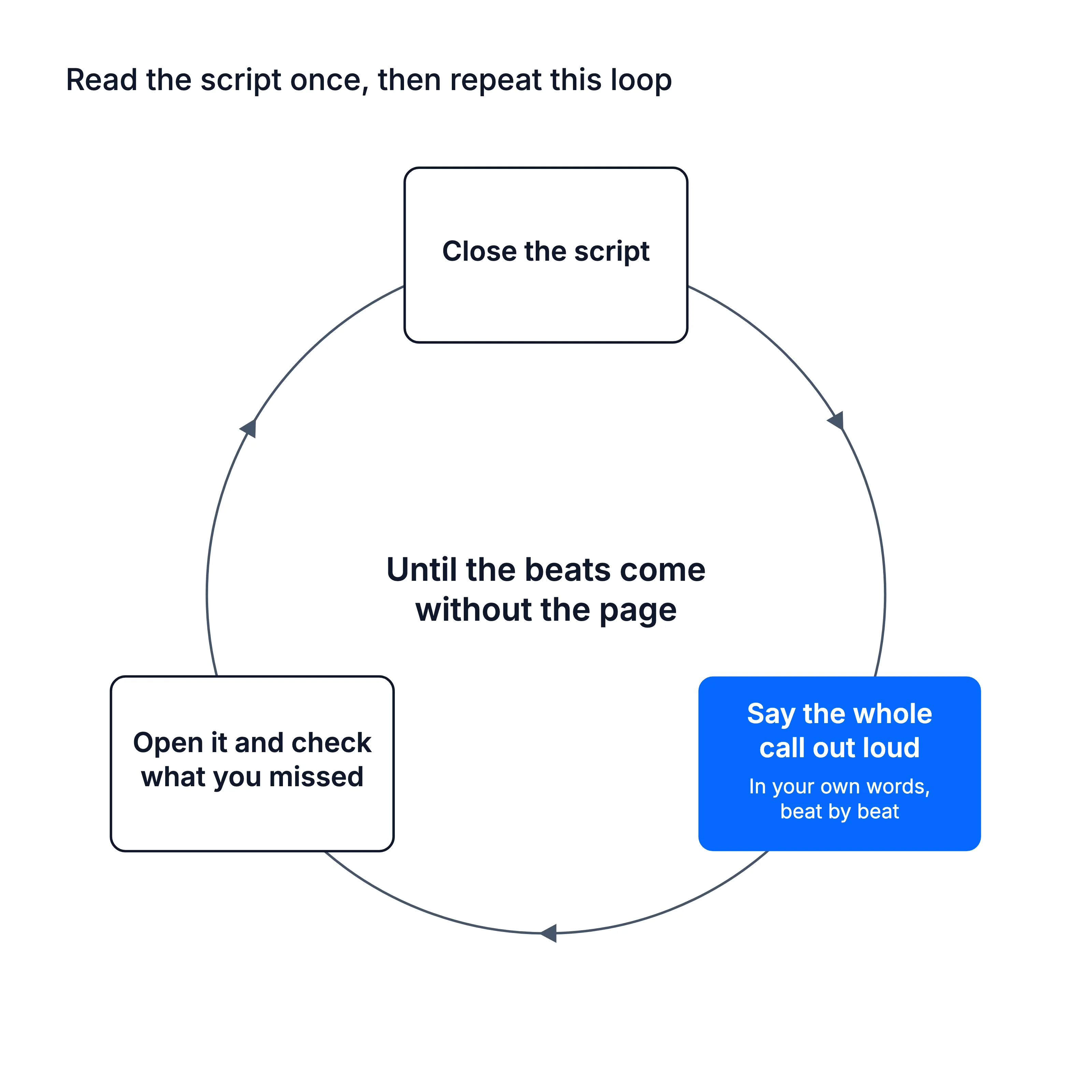
The drill. Read the script once. Close it and say the whole call out loud in your own words, beat by beat. Open it, check what you missed, and repeat until the beats come without the page. Recalling without looking builds memory better than rereading: a meta-analysis of 222 classroom studies with 48,478 students found a moderate overall benefit for practice tests (Yang and colleagues, 2021). Those were students in classrooms, so the finding supports the method and says nothing about close rates.
If you’re a founder selling your own product, you know it better than anyone, so the pull is to demonstrate before you have asked a single question. The beats keep discovery ahead of the demo. The direction cue CallPrompter shows at that moment, a short instruction beside the meeting window, reads “stop explaining features.”
Step 2: Lock only the lines that must be said word for word
Lock a line, meaning you say it word for word on every call, only when changing one word would change a fact, a legal duty or a commitment. The one exception is the first sentence of the call. On CallPrompter’s own sales calls, the opener is locked because “the first sentence is when you’re most likely to ramble, and because that question sets up everything after it.”
Lines marked “ours” are locked on our own sales calls; the rest are written for this guide.
| Part of the call | How you say it | Example line |
|---|---|---|
| First sentence | Word for word | Ours, on a booked call: “Thanks for the time. Before I show you anything, can I ask what made you take this call?” |
| Reason for the call | Your own words | “You’re hiring three SDRs this quarter, and I wanted to ask how they’ll learn the pitch.” |
| Discovery questions | Your own words, purpose fixed | To learn how new reps get ready: “What does a new rep’s first week on the phone look like?” |
| A required disclosure, such as a recording notice | Word for word, as compliance wrote it | An insurance broker’s version: “I’m an independent broker, so I compare policies from several insurers, and the insurer you choose pays my commission.” |
| Prices, numbers, contract terms, product facts | Word for word | Ours: “$99 a month for Starter, $249 per seat for Pro.” |
| The answer to an objection | Your own words, with any number or claim in it word for word | To “It’s too expensive”: “Fair. What are you comparing it with?” Then the price, exactly as locked. |
| The bridge back after a detour | Your own words | “That’s useful. Can I go back to how your new reps get ready?” |
| The ask for the next step | Word for word | Ours: “Let’s put 20 minutes in the diary while we’re both here: Tuesday 10:00 or Thursday 14:00?” |
On a cold call, the locked first sentence says who you are and why you’re calling, in one breath: “It’s [your name] from [company]. I’m calling because you’re hiring SDRs, and I have one question about how they get ready.”
Our price line is said flat, with no cushion and no apology, because “improvising around a price is how discounts happen.” It quotes our prices as listed on September 21, 2026, and changes the day they do. Our ask always names two times.
Before you lock a line, rewrite it for speech: contractions, one idea per sentence, words you would say to a colleague. “I would like to take this opportunity to introduce our platform” becomes “Here’s why I called.”
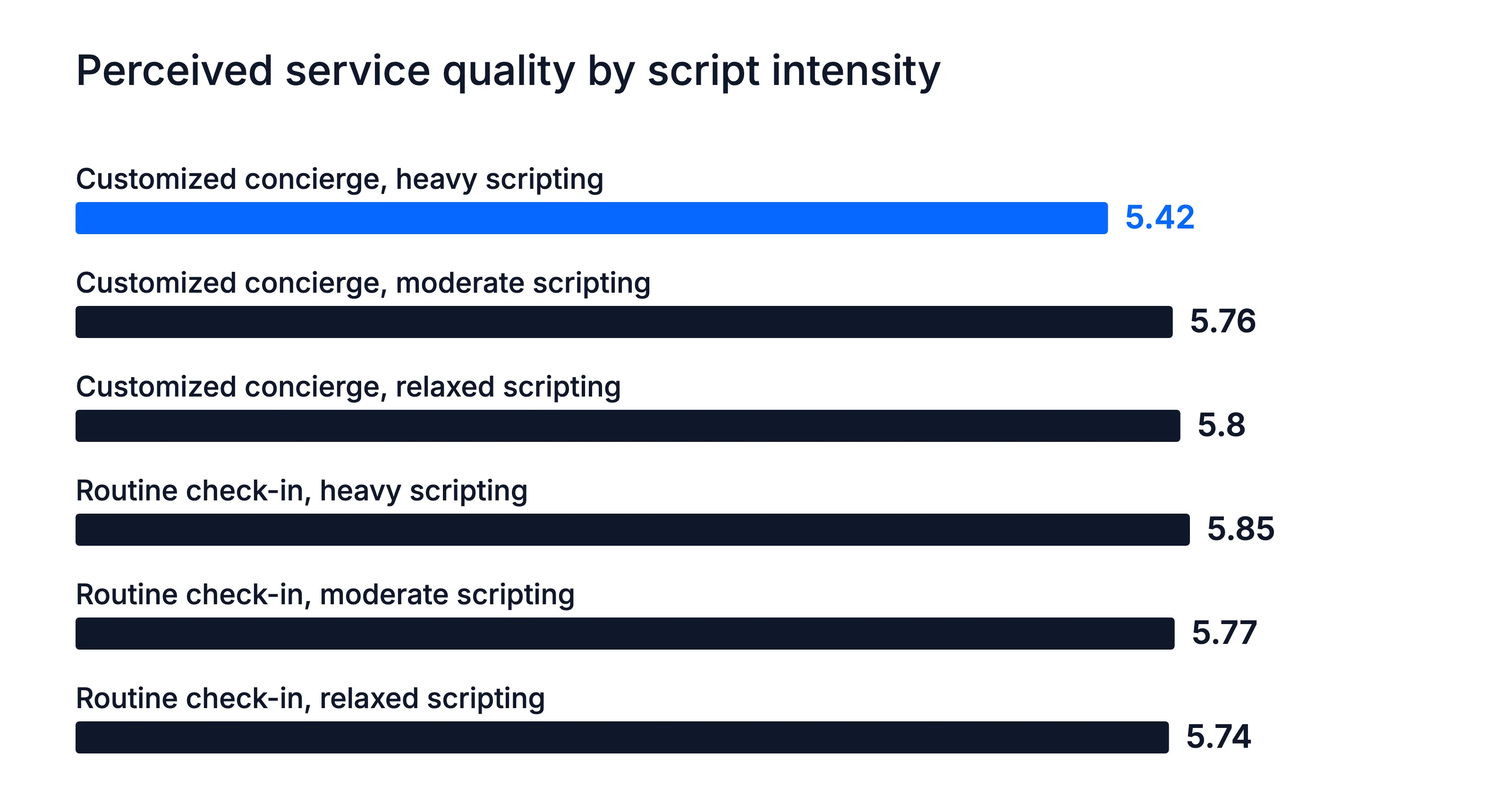
Keep the locked list short. In a video experiment, heavy scripting lowered perceived quality in a customized concierge encounter (5.42 against 5.80 for relaxed scripting, on the study’s quality scale) and made no significant difference at a routine hotel check-in (Victorino, Verma and Wardell, 2013). On a sales call, the customized moments are discovery and the objections.
Regulators mostly prescribe what a disclosure has to contain and when, and leave the wording to the firm. The US Telemarketing Sales Rule makes a covered outbound caller state the seller, the sales purpose and what is being sold, promptly and clearly (16 C.F.R. § 310.4(d)). A typical cold call selling software to a business is exempt from that opening disclosure (16 C.F.R. § 310.6(b)(7)), though since 2024 the rule’s ban on misleading statements applies to it. EU insurance rules list what an intermediary must disclose, including whom it acts for and how it is paid, without supplying a script (Directive (EU) 2016/97). Locking your firm’s approved wording makes sure the required content comes out complete. This is information, not legal advice.
If you hand one script to a team, agree the locked list centrally, leave every other line to each rep, and revise the list after the first real calls, because that is where you find out what reps actually get asked.
Step 3: Turn every other line into a short cue
Everything you did not lock becomes a cue: a few words carrying one idea. Apply the rule we design CallPrompter’s live prompts against to your own notes: if you have to read it, it is too much. Together your cues make up your cue sheet, and the whole sheet fits on one screen or one page. Working from notes is ordinary preparation. A prospect only hears the difference when you read.
These pairs, written for this guide, cover the four kinds of cue our live prompts use:
| Kind of cue | The script sentence | The cue |
|---|---|---|
| The next question | “Could you walk me through how a new rep on your team gets ready for their first live calls?” | New rep, first week? |
| The core of an objection answer | “I completely understand that the timing might not feel right, but it’s worth thinking about what waiting another quarter would cost.” | Timing: cost of one more quarter |
| A direction | “This would be a good moment to ask what budget they have set aside.” | Ask about budget |
| A fact | “The standard agreement runs for twelve months, and you can cancel at any renewal with 30 days’ notice.” | 12 months, 30 days’ notice |
A fact cue keeps the number exact. Only the sentence around it goes.
Where the sheet sits. On a video call, keep it beside the meeting window and as close to the camera as you can, so a glance does not turn your head away from the prospect. In a simulated online job interview, 38 evaluators rated the same prepared answer lower when the speaker looked down and away from the camera (Shinya and colleagues, 2024). That was an interview rather than a sales call, but it tested a downward look away from the camera, which is what a sheet on the desk forces. On a phone call, paper or a second screen works, and the sheet still has to be short.

Why a full sentence costs you. Reading, listening and forming a reply all draw on the same verbal processing, so multiple-resource theory predicts they interfere with each other (Wickens, 2002). In a lab study, when 197 adults talked while tracking a moving target, their speech got slower, shorter and less complex as the task got harder (Kemper and colleagues, 2010). Neither was tested on sales calls, so treat them as the reason short cues make sense. No study sets a word limit for a cue, either. If you can take one in without losing the prospect’s sentence, it is short enough.
The sheet shrinks as you ramp. Our rule of thumb, which we have not measured: “Under about three months on the product, recall is not automatic yet and the card beats memory. After that it mostly gets in the way, except on a new product or a new objection.” A new rep starts with the full sheet and cuts it down as the beats become automatic.
Step 4: Let the prospect’s answer pick your next line
A script sounds recited the moment your next line ignores what the prospect just said. Four habits keep the answer in charge:
- Hear the answer to the end. The most common gap between a question and its answer is a fifth of a second or less, in all ten languages one study compared (Stivers and colleagues, 2009). You only answer on time if you were listening instead of reading your next line.
- Pause only when you are thinking. A short pause before a real answer sounds natural. A long, deliberate delay can backfire: in a series of experiments, delayed answers were judged less sincere (Ziano and Wang, 2021).
- Reuse one of their words. If the prospect says “our reps wing it,” say “wing it” back. Mirroring a counterpart’s words early improved outcomes in online negotiations (Swaab, Maddux and Sinaceur, 2011), while strong, obvious mimicry lowered liking and trust (Wessler and colleagues, 2023).
- Ask one follow-up before the next beat. People who asked more follow-up questions were liked more in controlled conversations (Huang and colleagues, 2017), though a reanalysis of their speed-dating data was less clear-cut (Kluger and Malloy, 2019). One follow-up that reacts to the answer does the job, and a string of them turns into an interrogation.
Following the answer inside a plan is what a branching script is for. A meta-analysis of 155 samples and more than 31,000 salespeople linked adaptive selling, meaning adjusting to the situation in front of you, to better performance (Franke and Park, 2006). CallPrompter follows a call by meaning rather than waiting for an exact phrase, and one script branches for each buyer persona you sell to.
How to get back on script after the prospect changes the subject
Take the detour, then return to the next beat with a bridge line, one sentence that ties what the prospect just said to the question you need next. Three, written for this guide:
- “That’s helpful. Can I go back to something you said earlier about onboarding?”
- “Let’s come back to that before we finish. First, I’m curious how your new reps get ready today.”
- “Good to know, and it ties into what I wanted to ask next: who decides how the team ramps?”
To find your own, open the transcript of your last call or practice run, find the point where the prospect changed the subject and read what you said next. That sentence is your bridge line, or the gap where one should have been.
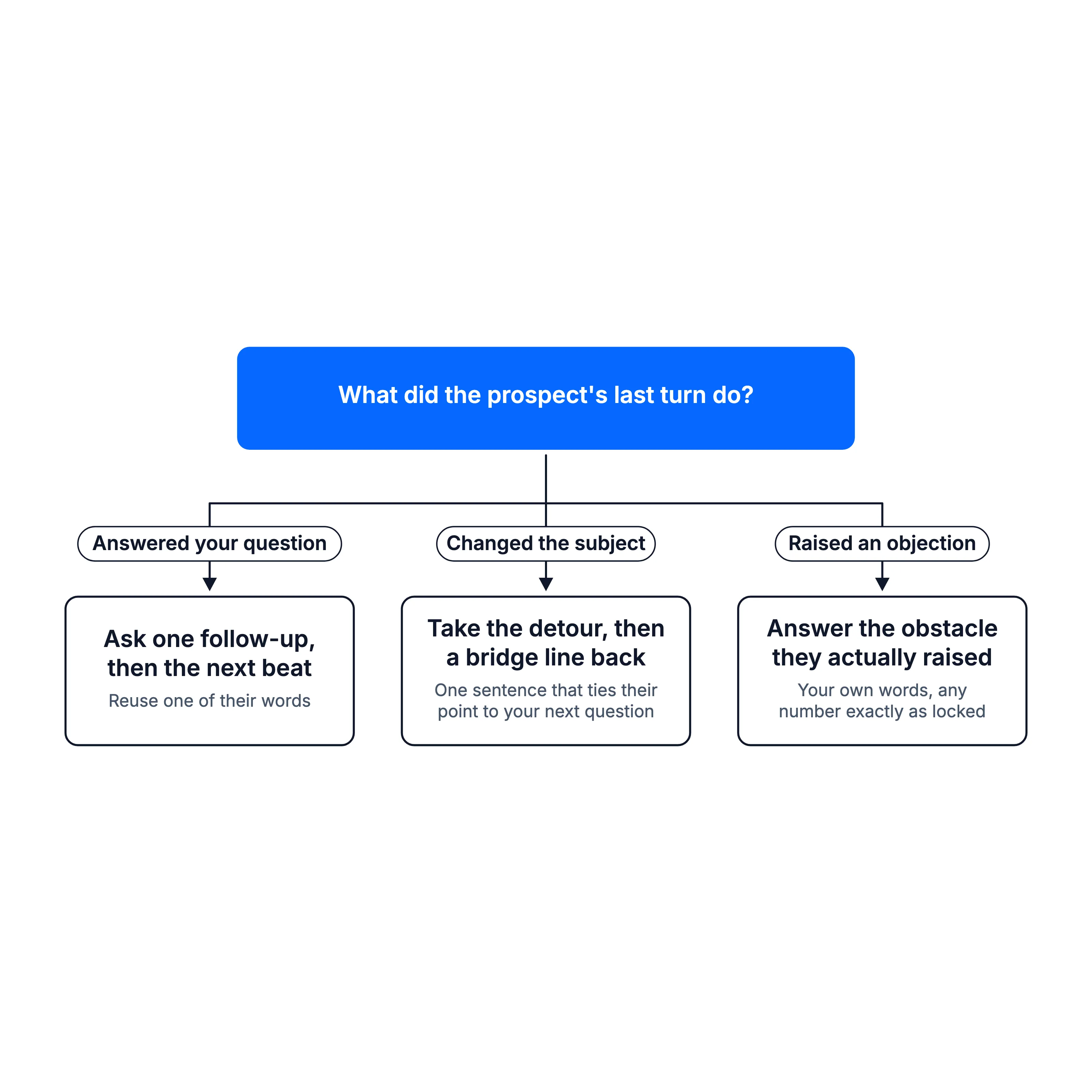
An objection that pulls the call off course gets the Step 2 treatment: your own words, with any number or claim exactly as locked. Answer the obstacle the prospect actually raised. A study of 159 real cold calls separated resistance that blocks a call from resistance that only stalls it, and found sellers responding to the specific obstacle in the prospect’s last turn (Huma and Stokoe, 2023). A cue such as “Not the decision-maker: ask who owns it” answers that obstacle, where a generic rebuttal talks past it. For the objection most likely to end the call, what to say when the prospect already has a provider works the same way, one beat at a time.
Step 5: Practice out loud, then read your transcript
Practice the call the way it will happen: out loud, from your cues, against someone who does not cooperate. Four moves, in order:
- Say the call once from memory, in your own words.
- Run it from your cue sheet against a buyer who interrupts and goes off-script. A colleague can play the buyer if you record the run. In CallPrompter’s practice mode, a simulated buyer does both out loud, and the prompt overlay runs exactly as it does on a live call.
- Replay the run and mark three things in the transcript: stretches where you recited the script word for word outside your locked lines, long stretches of your own talking, and questions you asked without reacting to the previous answer.
- Fix what you marked and run it again. Each marked line becomes a cue, or a locked line if the Step 2 test says so.
In practice mode, the full transcript and a replay sit in History afterward. The run is not scored, so the three marks are your review. Review a real call only where recording it is lawful and everyone on it has agreed: California requires every party’s consent to record a confidential communication (Penal Code § 632), and in Switzerland recording a nonpublic conversation generally needs every participant’s consent (FDPIC). This is information, not legal advice.
The interruptions are the point. As we put it when we set out how we would judge a roleplay tool: “The objection you can handle is the one you saw coming. A simulated buyer who waits politely for you to finish teaches you to deliver a monologue.” If the buyer only ever asks what you prepared for, you are “rehearsing recall rather than composure,” and recall is all a memorized script ever trained. Training also carries over best to tasks that resemble it (Sala and colleagues, 2019), and a practice call with interruptions resembles a real call far more than silent script study does.
When practice pays off. Our rule of thumb: “it is worth it when the conversation repeats. If you will have roughly the same call fifty more times, with the same product, the same buyer type and the same handful of objections, rehearsal compounds.” Recruiting and staffing is the clearest case: consultants run the same candidate and client pitch dozens of times a day, and new consultants are on the phone in week one, so that week should start with a few practice runs before the first live call.
How can you stay on script during a sales call without sounding robotic?
Stay on the structure and the few lines you say word for word, and say everything else in your own words from short cues. A call sounds robotic for four reasons, and each has its fix in the steps above:
| What causes it | What the prospect hears | The fix |
|---|---|---|
| Sentences written for reading | Long, formal sentences nobody says out loud | Rewrite for speech (Step 2), cue the rest (Step 3) |
| Attention on your next line | Replies that ignore what was just said | Let the answer pick the next line (Step 4) |
| The sound of read speech | Phrasing and emphasis that follow the page | Practice from cues, check the transcript (Step 5) |
| Talking in long blocks | A monologue with no room to answer | Mark long stretches of your own talking in the transcript (Step 5) |
Listeners can tell when a caller is reading. In a video experiment with 456 respondents, viewers could tell heavier from lighter script use (Victorino and colleagues, 2012). In another experiment, 26 listeners reliably told read from spontaneous speech in a Swiss German dialect, even when the usual giveaways were missing or ambiguous, and no single acoustic measure fully explained their choices (Dellwo, Leemann and Kolly, 2015). Earlier Dutch work on matched read and spontaneous sentences found listeners using the way stressed syllables were accented to tell the two apart (Blaauw, 1992).
Slowing down does not fix it on its own. In a 2025 Czech study, read news came out faster and with fewer pauses than semi-spontaneous speech (Veroňková, 2025), so read speech is not reliably slower. What gives it away is phrasing and emphasis that follow a written sentence, and the fix is to stop speaking from written sentences.
What this looks like as a live prompt during the call
On a live call, CallPrompter does the cue sheet’s job as the conversation moves. When the call reaches a beat, the matching cue appears beside the meeting window: the next question, the answer written into your script for the objection you just heard, a direction such as “slow down” or “ask about budget,” or a product fact. It follows the conversation by meaning, so it does not wait for an exact phrase or scroll your script line by line the way a teleprompter does. The same script runs in practice mode, so you rehearse against the cues you will see on the real call.
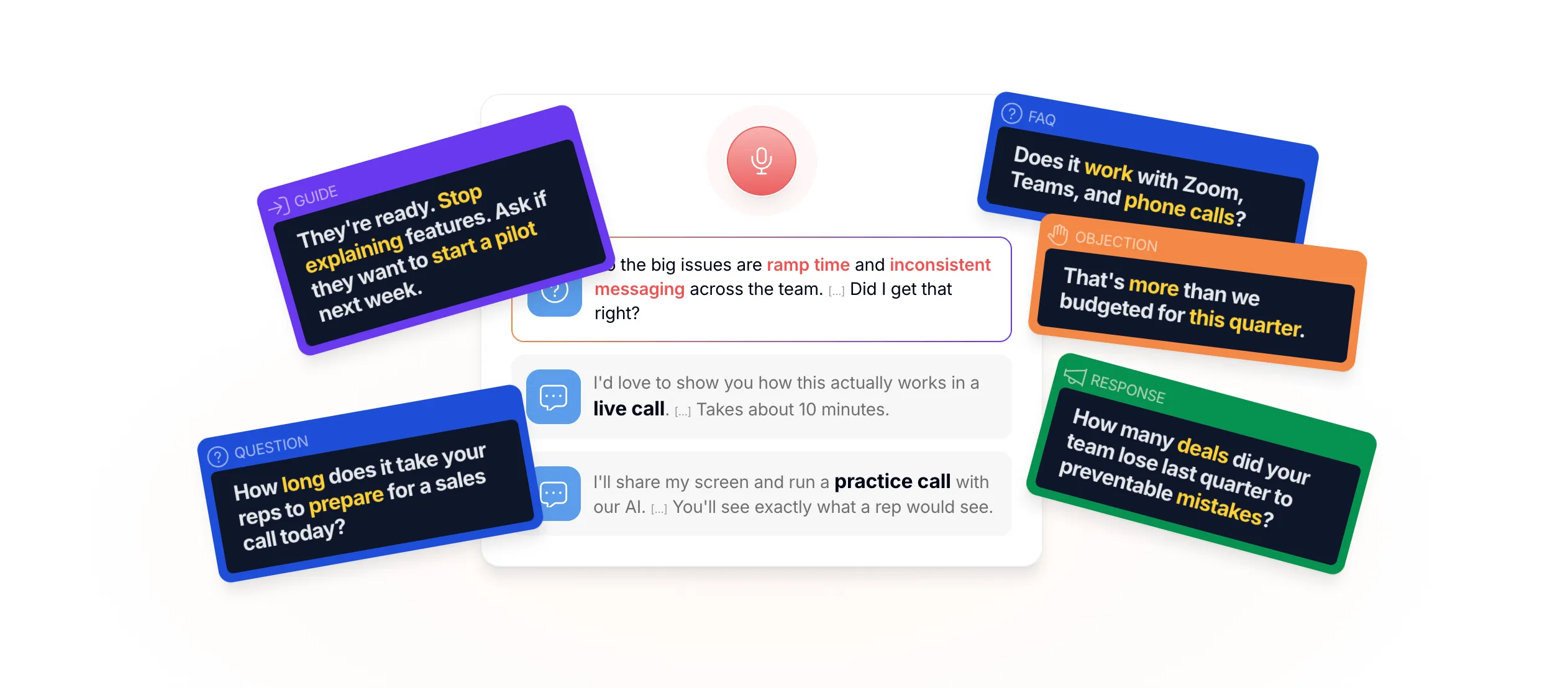
Out of the box, CallPrompter transcribes and follows the call, and what it shows is what you wrote into the script. Steps 1 to 3 are the work either way.
Frequently asked questions
Should you memorize a cold-call opener word for word?
Memorize the first sentence word for word and say the rest of your first minute in your own words. The fixed sentence gets you through the moment of most pressure. No independent study has shown that a memorized opener keeps prospects on the line, so judge it by how steady you sound.
What should you do when you lose your place in the script?
Go back to the prospect’s last answer and ask one follow-up about it, then glance at the next beat while they reply. When you know the beats, losing a sentence costs you nothing.
Run your script in practice mode before your next call
Split your own script into locked lines and cues today, then run the call once in CallPrompter’s practice mode before your next call block. As listed on September 21, 2026, the free trial runs seven days, needs no credit card and includes 30 minutes of AI practice. Live call coaching is a paid plan and is not part of the trial.
Questions about building your first script? Send a message through the contact page and the founder will get back to you.
Related posts
Conversation Intelligence or Live Coaching: Which One Solves My Problem?
Adding In-Call Help to Your Meeting Notetaker in 2026