Help that arrives after the call tells you what happened. Help that arrives during the call changes what happens. That is the whole decision. Everything else about these two categories follows from it.
Conversation intelligence records your calls and analyzes them afterward, so someone can see the pattern across fifty conversations. Live coaching runs while the call is happening and shows the seller what to say next. The first is usually a manager’s problem. The second is the rep’s. A team can have one, the other, or both, and this page covers all three answers instead of sending you somewhere else for two of them.
We build the second kind. CallPrompter is a desktop app that puts the answer to an objection on the seller’s screen while the prospect is still on the line. In our own measurement, the response is ready 485 milliseconds after the model has heard enough of the sentence to classify the objection, and detection runs while the prospect is still talking. That number is why we care so much about the timing distinction. It is also why we are the wrong answer for someone whose real question is what happened across last quarter’s pipeline.
Key takeaways
- Conversation intelligence answers what happened on your calls. Live coaching answers what to say next. What separates them is when the output arrives.
- Let the problem decide. A question about the pattern across fifty calls is a conversation-intelligence question. A question about the sentence a rep needs in the next nine seconds is a live-coaching question.
- Live coaching pays off under three conditions we use as a rule of thumb: a rep inside their first three months on the product, a fixed objection set where roughly 80% of calls hit the same eight or ten objections, and at least ten calls a week.
- The strongest evidence for in-call assistance comes from customer support rather than sales. In a study of 5,172 agents published in the Quarterly Journal of Economics, a real-time assistant raised issues resolved per hour by 15% on average, and by roughly 30% for the least experienced agents.
- The same study found the most skilled agents got slightly faster and slightly worse. For senior reps, that is an argument for leaving prompting switched off.
- More coaching is not better coaching. In a randomized field experiment published in the Journal of Marketing, restricting how much feedback an AI coach delivered produced a significant improvement in agent performance.
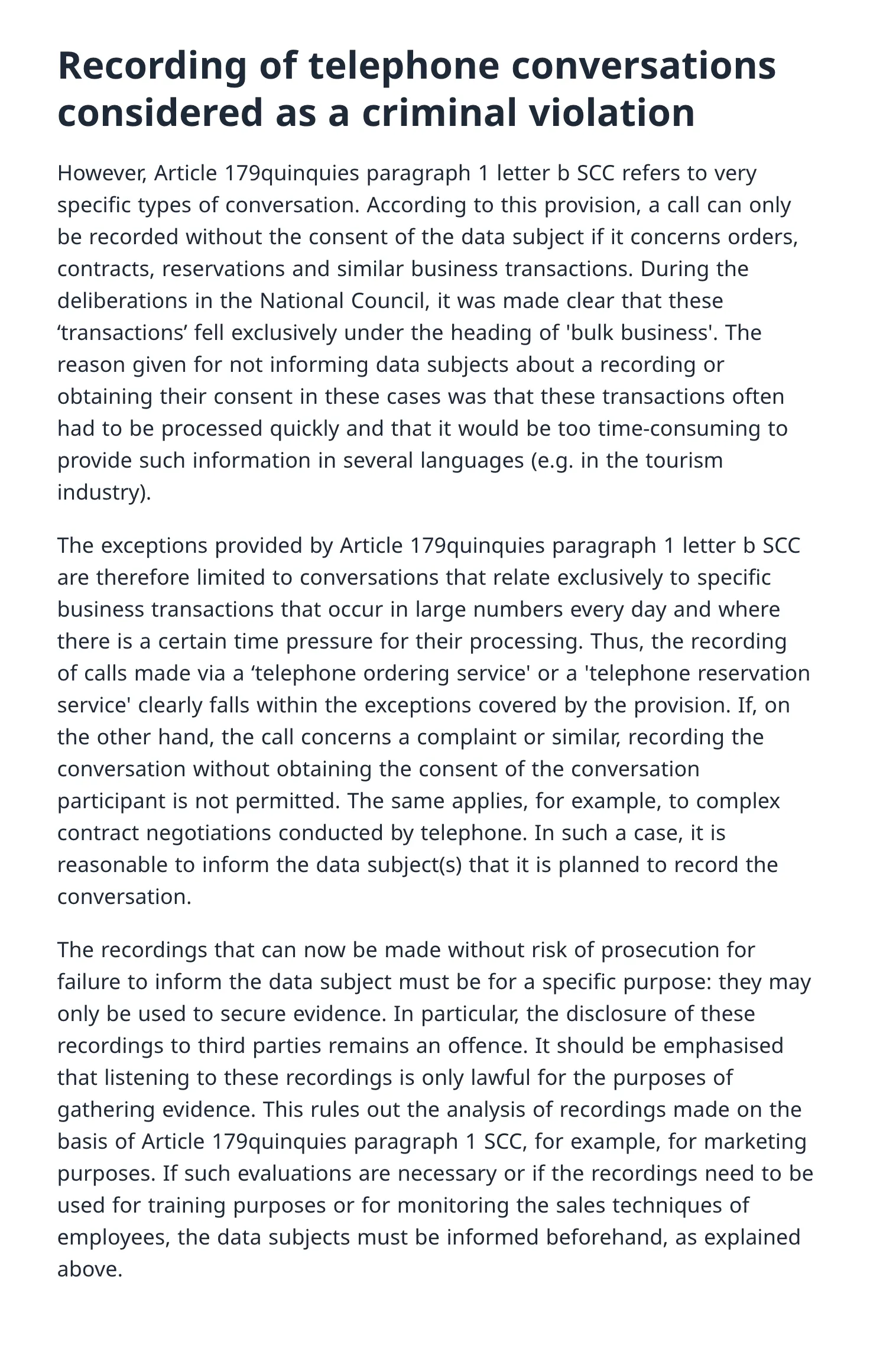
- Conversation intelligence requires recording, and recording carries consent obligations that differ by country and by US state. The Swiss federal regulator states that using recordings to monitor employees’ sales techniques requires informing the people on the call beforehand.
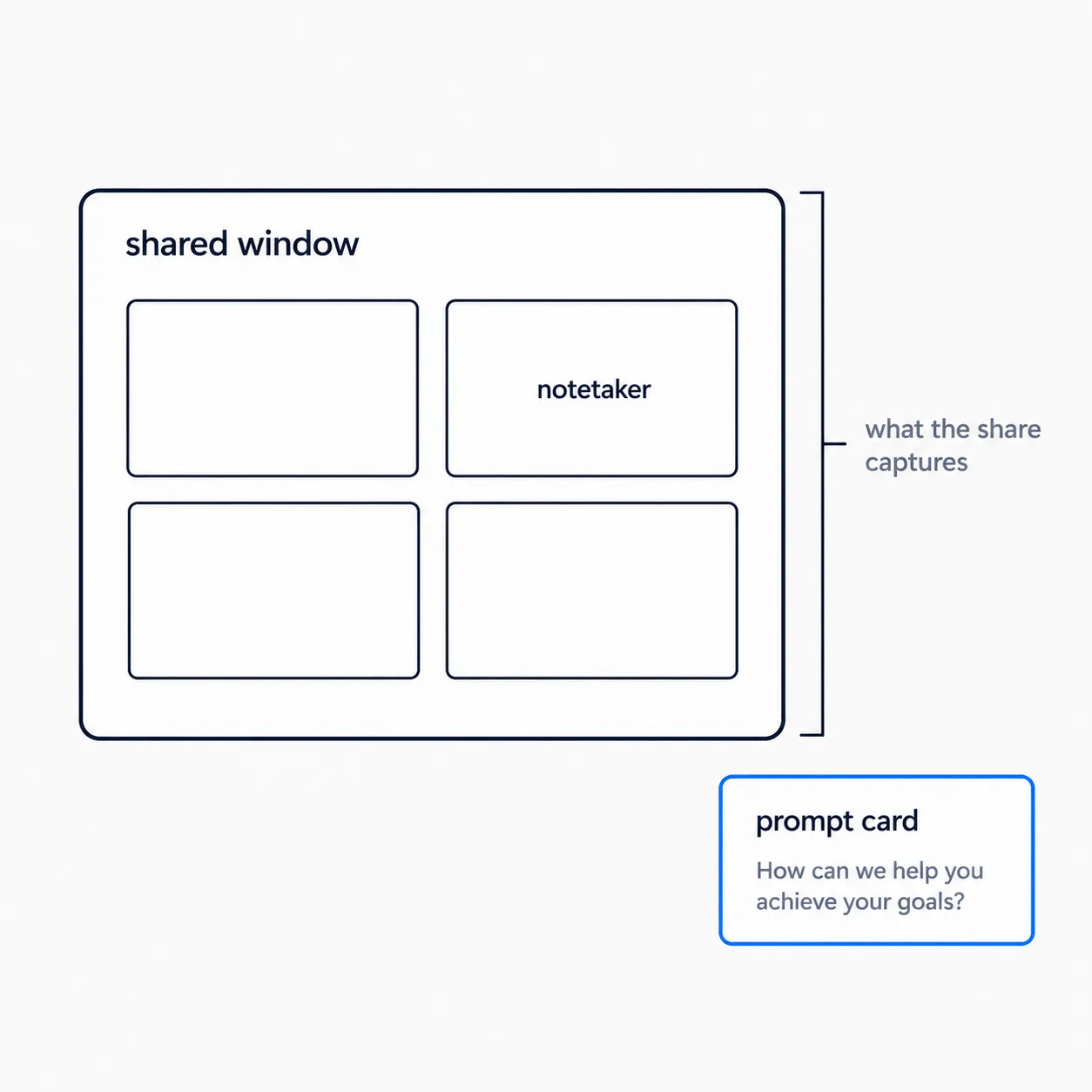
- Teams that run both usually keep them at different layers: a notetaker inside the meeting for the record, and a local overlay outside it for the seller.
What is conversation intelligence?
Conversation intelligence is software that records sales calls, transcribes them, and analyzes the transcripts afterward to produce insight about what was said. The output is a report: talk-time ratios, topics covered, objections that came up, deals flagged as at risk, and a searchable library of recordings a manager can review.
Two things are worth knowing before you shop for it.
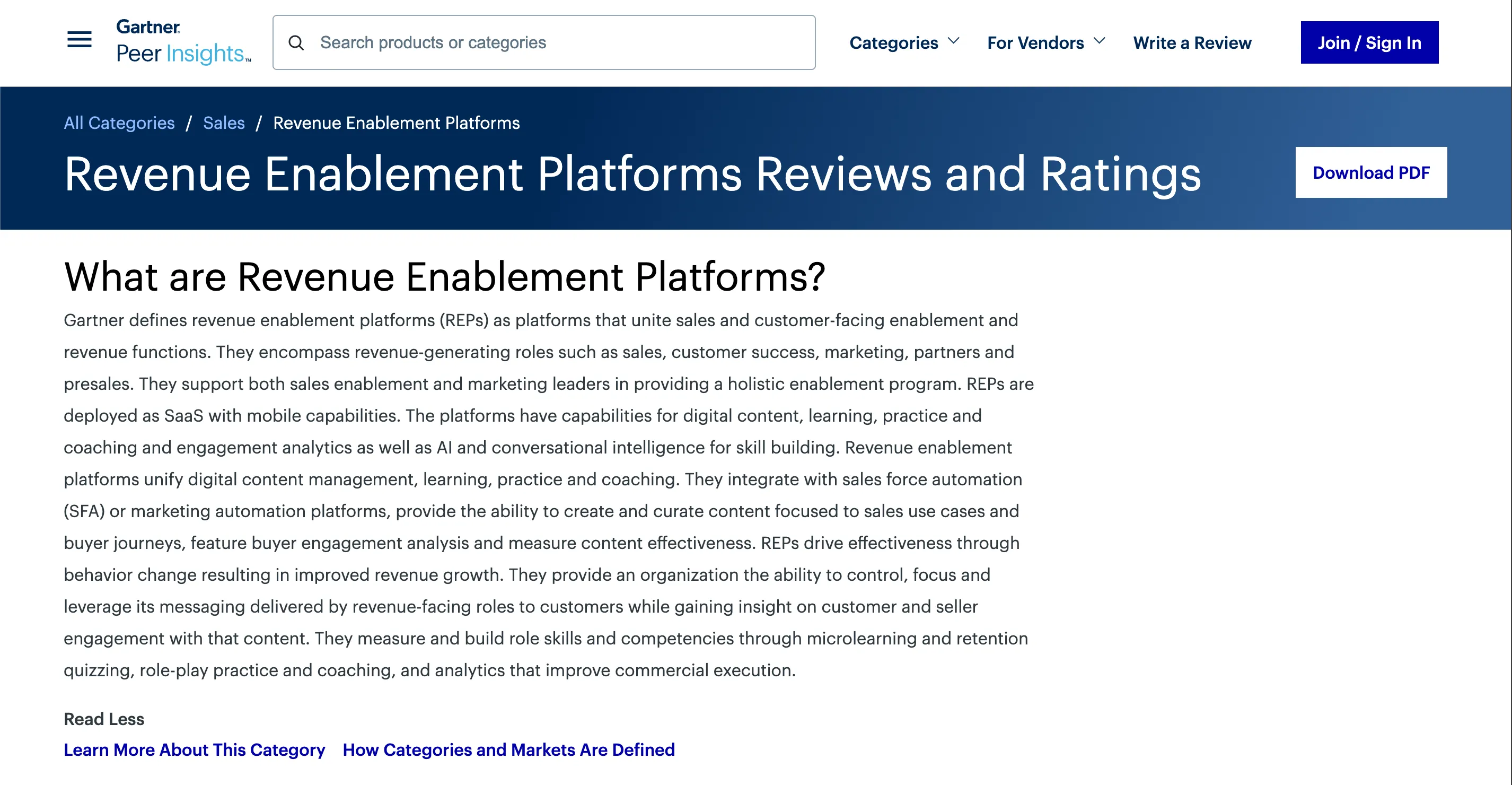
Gartner does not treat conversation intelligence as a standalone market. It files it as a capability inside revenue enablement platforms, alongside digital content, learning, practice and engagement analytics. That is a fair description of what it is: an analytics layer for the people who manage sellers.
Forrester describes it primarily as the mechanism for capturing interaction data to power AI-generated insight, and notes that the market has consolidated to the point where undifferentiated products are common. If every demo you sit through looks the same, that is not your imagination.
What is live coaching during a call?
Live coaching is software that follows the conversation as it happens and shows the seller something useful before the moment passes: the response to the objection that was just spoken, the discovery question to ask next, or a signal to stop explaining and ask about budget. Only the seller sees it. There is no scorecard.
Almost every glossary entry for either term was written by a company selling one of them, so the cleanest neutral description of this category comes from somewhere else. The economists who ran the largest field study of it call it a system that monitors conversations and provides real-time suggestions for how to respond.
The misconception we hear most often in first conversations is that live coaching means recording the call and scoring it afterward for a manager to read, which would make it a compliance and reporting tool. It works the other way around. It runs during the call, for the person on it, and nobody else sees the moment.
Three different things get called AI sales coaching
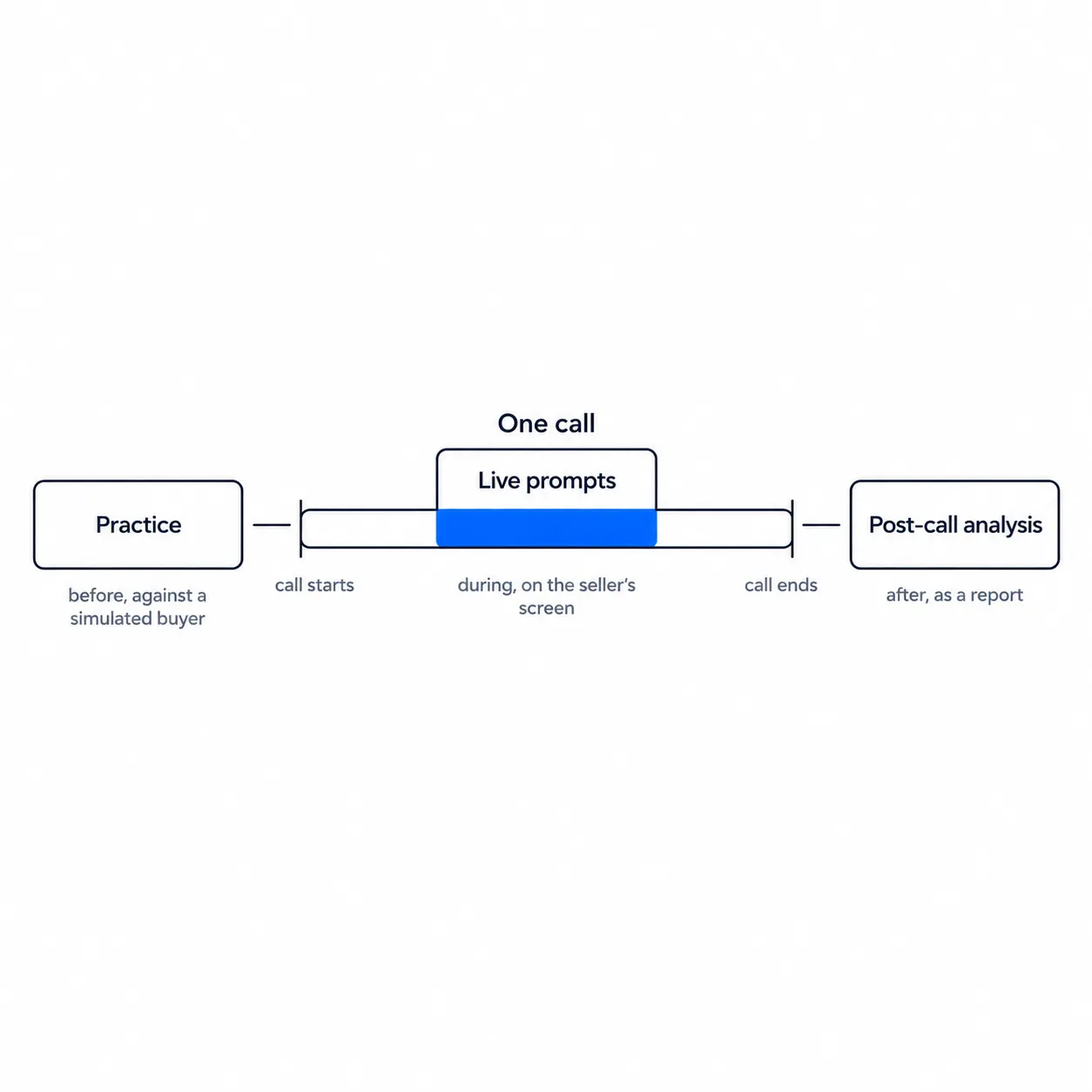
The category is careless about its own vocabulary, and untangling it is what makes the rest of this comparison hold together. Three separate products share the label:
- Post-call analysis. The call is recorded, transcribed and scored after the fact. This is conversation intelligence.
- Practice. The rep rehearses out loud against a simulated buyer, before any real prospect is involved. This is roleplay, and it is a training tool.
- In-call prompts. Help appears while the conversation is running. This is what this article means by live coaching, and it is the only one of the three it means.
CallPrompter includes practice as well as live prompts, running on the same scripts, so we are not neutral about the second bullet. The two solve different problems, and buying one when you needed the other is the most common mistake we see. Practice fixes a rep who has never said the words out loud. Live prompts fix a rep who knows the words and cannot retrieve them in three seconds while someone is talking at them.
Conversation intelligence vs live coaching, side by side
| Where they differ | Conversation intelligence | Live coaching |
|---|---|---|
| When the output arrives | After the call, usually within minutes to a day | During the call, while the sentence can still change |
| The question it answers | What happened on our calls? | What do I say right now? |
| Who reads the output | Managers, enablement, revenue leadership | The seller on the call, and nobody else |
| What it needs from you | Recordings and consent to make them | A script, an objection library, and the content behind them |
| Where you would meet it | Platforms that record, transcribe and score calls, sold by seat or by team | Desktop tools that draw prompts beside the meeting window. CallPrompter is ours |
| Where it stops working | It cannot change the call it is describing | It cannot tell you what went wrong across fifty calls last quarter |
| What it costs you beyond money | Recording obligations, and a library nobody has time to watch | Attention during the call, which is the scarcest thing the seller has |
Which problem calls for which tool?
The table below is the fastest way to place yourself. Find the row that describes your week.
| The situation | What it calls for | Why |
|---|---|---|
| A rep blanks on an objection while the call is running | Live coaching | The answer has to arrive before the silence does |
| Deals are lost and nobody can say where they turned | Conversation intelligence | You need the pattern, and the pattern lives in the transcripts |
| Someone is on the phone this month who has never cold-called | Live coaching, with practice first | Practice builds the words, prompts hold them under pressure |
| A manager cannot listen to every call and needs the pattern across fifty | Conversation intelligence | This is exactly what the analytics layer was built for |
| The answer to a recurring question sits in a document nobody opens mid-call | Live coaching | A document you have to open is a document you skip |
| A compliance sentence has to come out right every time and be provable afterward | Both | Prompts get the wording right, recordings prove it happened |
| The same weakness shows up in call reviews month after month | Both | Review finds it, in-call prompts are what actually change it |
| Someone sells in a language that is not their first | Live coaching | The words are known, and getting to them fast is the hard part |
Eight questions that tell you which one you need
Answer these yes or no. Count where the yeses land.
| # | Question | A yes points to |
|---|---|---|
| 1 | Would you struggle to name, from memory, the objection that lost your last deal? | Conversation intelligence |
| 2 | Do your reps hear the same eight to ten objections on most calls? | Live coaching |
| 3 | Is anyone selling your product inside their first three months on it? | Live coaching |
| 4 | Is what you need to know about the pattern across fifty calls rather than one? | Conversation intelligence |
| 5 | Does anyone on the team make fewer than ten calls a week? | Conversation intelligence, for that person |
| 6 | Does a compliance sentence have to come out the same way every time, and be provable afterward? | Both |
| 7 | Do call reviews keep surfacing the same fault month after month? | Both |
| 8 | Is anyone selling in a language that is not their first? | Live coaching |
The reading rule. Questions about what happened point to conversation intelligence. Questions about what to say next point to live coaching. If your yeses are split roughly evenly, you have both problems, and the section below on running both is the one to read.
Three of those questions come from the rule of thumb we use when someone asks us whether they are the right buyer.
Tenure is the first. Under about three months on the product, recall is not automatic yet and the card beats memory. After that it mostly gets in the way, except on a new product or a new objection.
A fixed objection set is the second. Prompts pay off when roughly 80% of calls hit the same eight or ten objections, and they stop paying off when every call is bespoke.
Volume is the third. Below about ten calls a week there are not enough repetitions of the same conversation for live help to compound, so post-call review is the better spend.
If conversation intelligence alone is the answer
Buy it when your open question is about the aggregate. You want to know which objection precedes the most stalled deals, whether the new positioning is actually being said out loud, or where in the call the good reps do something the others do not. None of that is visible from inside a single conversation, and no amount of in-call help produces it.
One honest warning about the evidence here. We could not find a single independent, non-vendor study measuring whether buying a call-recording platform changes what reps say. Not on manager time spent reviewing calls, not on coaching cadence before and after adoption, not on what fraction of a recorded library is ever watched. Every figure in circulation on those questions was published by someone selling the category or consulting into it. That does not mean the tools do not work. It means the case for them is a logical one rather than a measured one, and you should buy on your own reasoning rather than on a statistic somebody quoted at you.
If live coaching alone is the answer
Buy it when the gap is retrieval under time pressure. The rep knows the product. The answer exists in a document. It just does not arrive in the two seconds available before the pause gets awkward.
The best evidence for this is real, and it comes from customer support. Brynjolfsson, Li and Raymond studied a staggered rollout of a generative AI conversational assistant across 5,172 customer support agents at a Fortune 500 software firm. The assistant monitored chats and suggested responses in real time. Issues resolved per hour rose 15% on average. Less experienced and less skilled agents improved across every productivity measure, with roughly a 30% increase in issues resolved per hour. The finding we think matters most for a sales team is the ramp result: treated agents with two months of tenure performed about as well as untreated agents with more than six months. The paper is published in the Quarterly Journal of Economics.
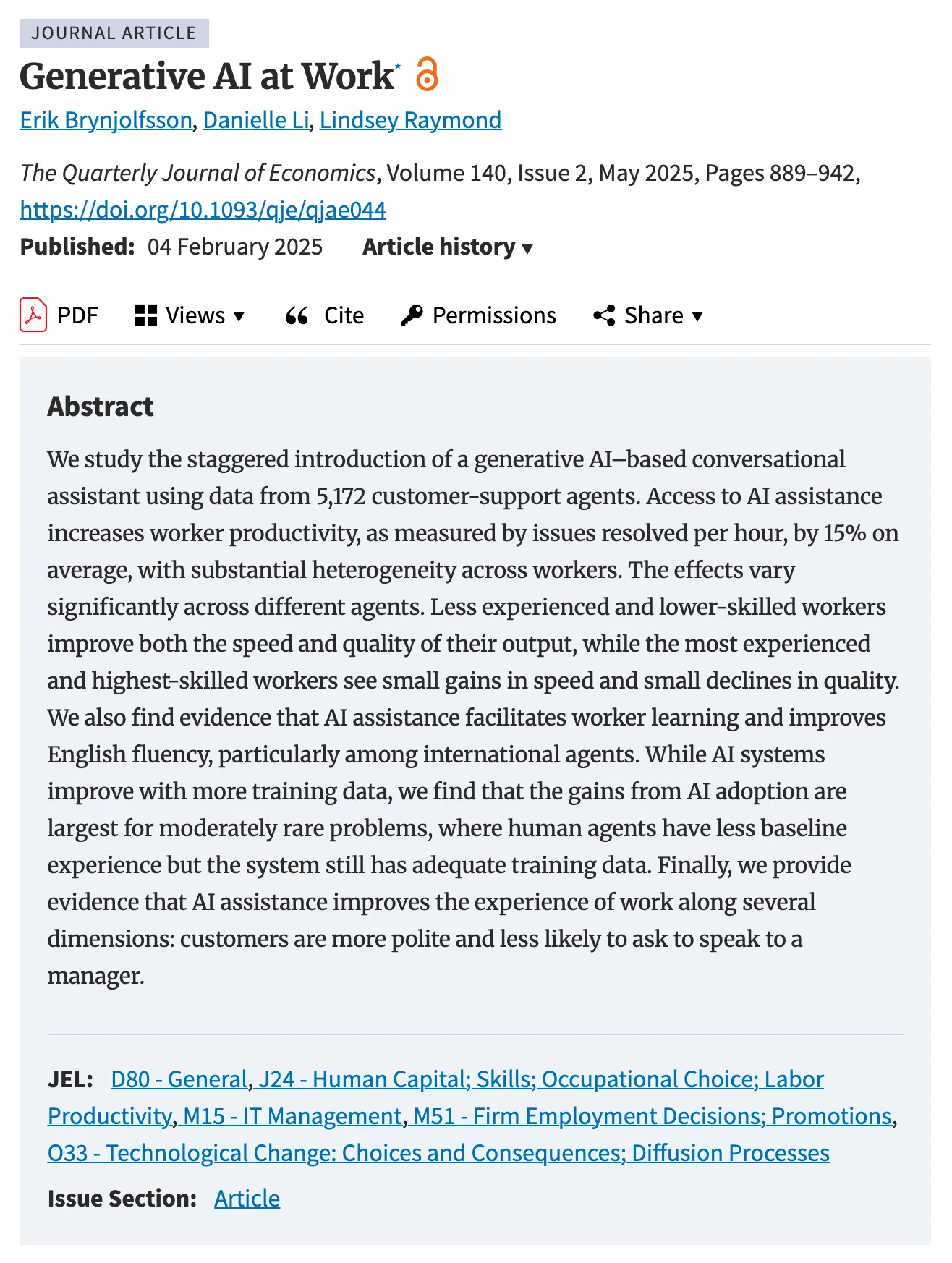
Now the limits, because they are large. This is customer support chat, not B2B sales voice calls. The outcome measure is throughput on bounded problems that have correct answers, and a discovery call has no equivalent metric and a far longer feedback loop. We know of no field experiment testing in-call prompting in B2B sales conversations. The mechanism transfers plausibly. The effect size does not, and anyone quoting 15% at you about your sales team is quoting a study about a different job.
The same paper contains the reason not to give everyone a prompt. The most experienced and highest-skilled agents saw small speed gains and small quality declines. If you are rolling live coaching out across a team, the senior reps are the ones to leave out, or to leave it switched off for until they ask.
If this is where you land, the practical question is what standing it up involves, and most of that work is content rather than software. Our getting-started guide walks through it.
If you need both, which comes first?
This is the outcome nobody writes a page about, because the two categories are usually sold as a choice. It is also the one this page owes the most detail to.
Running both is the arrangement we see most often, and the two sit at different layers. The notetaker joins the meeting as a participant and records for later. CallPrompter runs on the seller’s own machine and draws its prompts in a separate desktop app, outside the surface the meeting window shares, so the notetaker does not see it and it does not see the notetaker. No operating system offers a public API that reliably hides a window from capture, so this is a question of what gets captured rather than a guarantee. We wrote about that arrangement in more detail in our post on in-call help sitting beside a meeting notetaker.
That layering matters most to teams whose calls are demos, which is why we set it out separately for software teams weighing the two for a SaaS sales floor.
Which to put in place first. Start with whichever one answers the question you can already name. If you can name the problem (“our new reps freeze on pricing”), you have a live-coaching problem and recording will not solve it any faster. If you cannot name it (“we lose deals in the middle and I don’t know why”), start with recording, because you are still diagnosing.
Where they compete. What goes wrong when you run both is attention. A post-call platform produces a long report and a live tool produces a short card, and if you treat them as the same kind of coaching you end up delivering the report’s volume through the card’s channel. There is experimental evidence for that failure. In a series of randomized field experiments with two fintech companies, Luo, Qin, Fang and Qu found the benefit of an AI coach followed an inverted U: middle-ranked agents improved most, and bottom-ranked agents suffered the most severe information overload. In their second experiment, restricting the level of feedback the AI coach delivered significantly improved performance. Their third experiment found the AI and human coach combination outperformed either alone, which is the strongest published support for running both.
Read that study carefully before you use it, though. The AI coach in it delivered training feedback on conversations rather than prompts during a live call, so it sits closer to conversation intelligence than to what we build. The finding it supports is about feedback volume, not about in-call prompting specifically.
How to judge a live coaching tool
The rule we design CallPrompter against, stated so you can apply it to any tool in this category including ours: if the seller has to read it, it is too much. A live card has to be absorbed in a glance while someone else is talking.
That sounds like a design opinion. It has a mechanism behind it. Wickens’s multiple resource theory predicts that two tasks interfere more when they share processing codes, and reading text and producing speech both run on the verbal code. Putting the prompt on a screen and the speech in a mouth looks like separation and is not. A seven-word objection cue and a three-line paragraph are not the same intervention, because reading the paragraph competes directly with the sentence the rep is currently saying. To be straight about the evidence: this is a predictive model of dual-task interference, and we have not found a published measurement of prompt reading during sales calls.
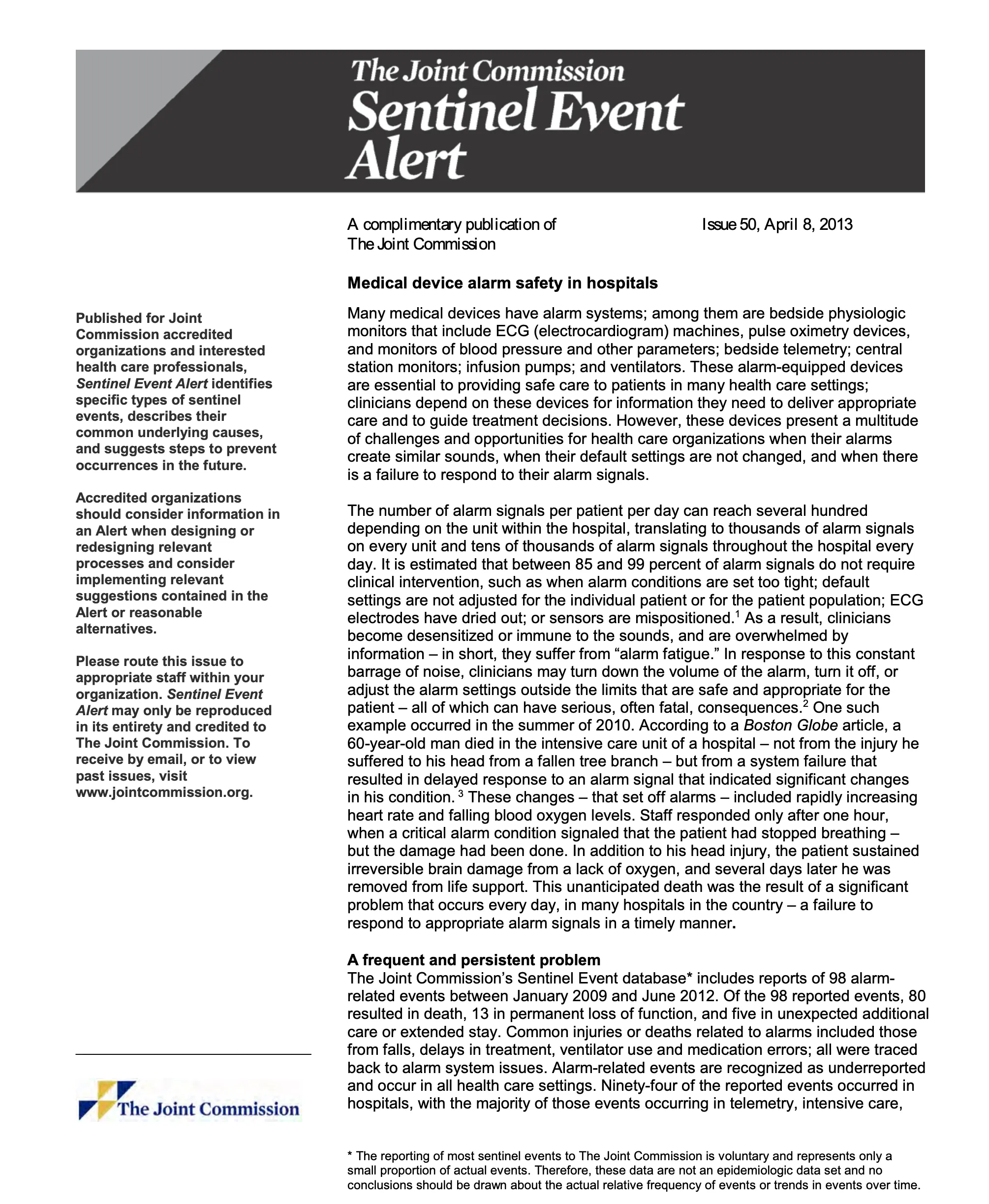
The second thing to test is how often it fires. Systems that alert too frequently get ignored at the moments they are right, and the best-documented case is clinical. The Joint Commission estimates that between 85% and 99% of clinical alarm signals do not require intervention, and clinicians become desensitized to them. A systematic review of drug-safety alerting in the Journal of the American Medical Informatics Association looked at seventeen studies and found override rates running from 49% to 96%. Habituation is not domain-specific. A live coach that fires on every call is a live coach nobody reads by week three.
So in a demo, ask three questions. How many prompts appear in a ten-minute call. How long the average prompt is. What the tool does when it is not confident, which should be nothing.
One more thing decides more than the software does. Live prompts are only as good as the script behind them, because the tool follows the conversation but says what you supplied. A tool that transcribes well and has nothing useful written into it will surface nothing useful. That content layer, the scripts, the objection library, the persona branches, is where the actual work sits, and it is worth understanding how a first script gets built before you evaluate anything.
What the evidence does and does not support
The honest summary: help arriving during the conversation does something a post-call report cannot, and the question of who benefits most is genuinely unsettled.
The counterweight worth knowing is a preregistered systematic review and meta-analysis of 106 experimental studies reporting 370 effect sizes, which found that on average human and AI combinations performed significantly worse than the best of humans alone or AI alone. The pattern was directional: losses in decision-making tasks, gains in content-creation tasks. A sales call sits closer to content creation than to decision-making, since the rep is composing a response rather than picking between options with a verifiable right answer, and content creation is the regime where the combination did well. That is a defensible reading and it is still a reading.
| Study | What it tested | What it found | Why it does not transfer directly |
|---|---|---|---|
| Brynjolfsson, Li and Raymond, Quarterly Journal of Economics | A real-time assistant rolled out across 5,172 customer support agents | Issues resolved per hour rose 15% on average and by roughly 30% for the least experienced agents; the most skilled got slightly faster and slightly worse | Customer support chat, not B2B sales voice calls, and the outcome measure is throughput on bounded problems that have correct answers |
| Preregistered meta-analysis, Nature Human Behaviour | 106 experimental studies reporting 370 effect sizes on human and AI combinations | Combinations performed worse on average than the best of humans alone or AI alone, with losses in decision-making tasks and gains in content creation | An average across task types rather than a test of in-call prompting; placing a sales call on the content-creation side is a reading, not a result |
| Luo, Qin, Fang and Qu, Journal of Marketing | Randomized field experiments with an AI coach at two fintech companies | Middle-ranked agents improved most and bottom-ranked agents suffered the most severe information overload; restricting the level of feedback significantly improved performance | The coach delivered feedback on conversations rather than prompts during a live call, so it sits closer to conversation intelligence than to live coaching |
| Telemarketing field experiment, Academy of Management Journal | An AI chatbot handling the initial lead-generation step, with the persuasion conversation left to human agents | Creativity rose and sales followed, but the effect was much more pronounced for higher-skilled employees | The AI did a different job rather than assisting during the persuasion conversation, so it is not a clean test of live prompting |
The evidence base for this article, with the gap between each study and a B2B sales call stated in its own row.
In sales specifically, the evidence tilts the other way from the customer-support result. A telemarketing field experiment published in the Academy of Management Journal handed the initial lead-generation step to an AI chatbot and left the persuasion conversation to the human agents. Creativity rose, and so did the sales that followed from it, but the effect was much more pronounced for higher-skilled employees, while lower-skilled agents made only limited improvements to their scripts. A 2025 review of the AI-and-jobs literature reads the same experiment as leaving the low-skilled agents slower, because the AI had screened out the uninterested customers and left them a harder residual caseload. The AI there did a different job rather than assisting during the persuasion conversation, so it is not a clean test of live prompting, and that difference matters when you weigh it.
Our reading of all of it: the effect of live help depends less on the seller’s skill level than on how much the help shows. That is why the design rule above is the load-bearing part of this page and not a footnote.
Does recording carry obligations that live prompting does not?
This is the axis most comparisons skip, and it is a real difference between the categories, because one of them requires a recording to exist and the other does not.
In Switzerland, recording a conversation engages both data protection law and the Criminal Code at the same time. The Federal Data Protection and Information Commissioner states that a participant who records a private conversation without the consent of everyone involved commits an offense under Art. 179bis and 179ter of the Swiss Criminal Code, and that consent must be obtained before recording begins. There is a narrow telephone exception for orders, contracts and reservations, which the regulator records as having been understood during parliamentary deliberation to cover high-volume routine transactions only. Complaints and complex contract negotiations by telephone fall outside it. The decisive part for a sales team: recordings made under that exception may only be used to secure evidence, and the regulator states explicitly that if recordings are needed for training purposes or for monitoring the sales techniques of employees, the people on the call must be informed beforehand. That is a plain description of what conversation intelligence is bought to do.
In the United States, federal law sets one-party consent as the baseline under 18 U.S.C. § 2511(2)(d), and roughly a dozen states are stricter. We are not going to publish a count, because compilers disagree on it: several statutes are split between criminal and civil provisions and get classified differently. California requires all-party consent for confidential communications under Penal Code § 632, and in Kearney v. Salomon Smith Barney (2006) the California Supreme Court applied that rule to calls placed into California from a one-party state. The working default for a distributed team: if anyone on the call is in an all-party state, treat the call as requiring all-party consent.
In the EU, a recorded disclaimer is not a lawful basis on its own. In April 2019 the Danish data protection authority banned Denmark’s largest telecom from recording customer calls for internal training until it had a way of obtaining consent, rejecting the argument that improving customer service was a legitimate interest. It reached the same conclusion again in 2021, holding that consent was the only legal basis for recordings used for internal training. Both decisions are published in Danish only.
| Where | What has to happen before a call is recorded | The source named in this article |
|---|---|---|
| Switzerland | Consent from everyone on the call, obtained before recording begins. Recordings made under the narrow business exception may only be used to secure evidence, and using them for training or to monitor employees’ sales techniques requires informing the people on the call beforehand | Federal Data Protection and Information Commissioner; Art. 179bis and 179ter of the Swiss Criminal Code |
| United States, federal baseline | One-party consent: it is enough that one party to the call has consented | 18 U.S.C. § 2511(2)(d) |
| United States, the stricter states | Roughly a dozen states are stricter. California requires all-party consent for confidential communications, and that rule has been applied to calls placed into California from a one-party state | California Penal Code § 632; Kearney v. Salomon Smith Barney (2006) |
| European Union | A recorded disclaimer is not a lawful basis on its own; a regulator has twice held consent to be the only basis for recordings used for internal training | Danish data protection authority, decisions of 2019 and 2021 |
A summary of what this article’s sources say, not legal advice. The safe working default is to treat any call with a participant in an all-party jurisdiction as requiring all-party consent.
The open question, stated as open. Whether live prompting that stores nothing triggers the same obligations has not been settled by any regulator or court we could find. The Swiss criminal provision is written around recording on a recording device, and a system that transcribes transiently arguably does not record for that purpose. It unambiguously processes personal data, which engages data protection law regardless. The answer plausibly differs between the criminal layer and the data protection layer. Take it to counsel rather than to a vendor, and whichever category you buy, ask what the tool retains and for how long, in writing.
Frequently asked questions
Is conversation intelligence the same as call recording?
No. Recording is the input. Conversation intelligence is the analysis layer that transcribes the recording and turns it into topics, scores and searchable transcripts. You can record without analyzing, but you cannot analyze without recording, which is why the consent obligations above attach to the whole category.
Does live coaching replace a meeting notetaker?
No, and CallPrompter is not built to. The two run at different layers: the notetaker joins the meeting as a participant and produces the record, while a live overlay runs on the seller’s own machine and produces nothing afterward. Most teams that use both keep both.
Can a new rep use live coaching from day one?
They can, and our own rule of thumb points at new reps as the group it helps most, but the sequence matters. Practice against a simulated buyer first, so the words have been said out loud once, then take the same script into a real call with prompts. Live coaching holds words the rep already has. It does not install them.
Should experienced reps have prompts switched on?
Usually not by default. The customer-support study above found the most skilled agents got slightly faster and slightly worse with real-time assistance, and our own rule of thumb is that after roughly three months on the product, prompts mostly get in the way except on a new product or a new objection. Switch it on for the new thing, not for the person.
Do you need consent to record a sales call?
It depends on where everyone on the call is sitting, and the safe default is to assume yes. Switzerland requires consent from everyone before recording begins, US federal law allows one-party consent while roughly a dozen states require all-party consent, and EU regulators have held that a recorded notice without a way to opt out is not consent. If any participant is in an all-party jurisdiction, treat the call as requiring all-party consent.
Where to start
If the diagnostic pointed you at conversation intelligence, buy that first and come back to this page when the reports have told you what to fix. That is the honest answer and it costs us nothing to give.
If it pointed at live coaching or at both, we would rather talk it through than sell you a seat you do not need. Book a call with us and we will set up a script and a first objection set together. One thing to know before you start a trial instead: the free trial covers the script editor, the objection library and 30 minutes of AI practice. Live call coaching is a paid feature and is not part of it.
Related posts
How to Follow a Sales Script Without Sounding Scripted, Robotic, or Like You're Reading It
Adding In-Call Help to Your Meeting Notetaker in 2026