Write a buyer persona for AI roleplay as a behavioral simulation spec for one buyer in one call, not as a marketing profile. The spec says what this buyer wants from this call, what they hold back and which question earns it, how they react to what you do, and how the call can end, including with no next step. Every line has to pass one test: if this line changed, would the buyer say or do something different on the call? If not, the line goes.
At CallPrompter, the persona you attach to a script becomes the buyer on a voice call, and it has to hold up for the whole run: a buyer that gives in during the first minute leaves you rehearsing only the calls that go well. CallPrompter is real-time sales coaching software for live calls, a desktop app for B2B sellers, built and run from Männedorf, Switzerland. In CallPrompter’s practice mode, sellers rehearse aloud against an AI buyer that plays their persona, with the same prompts they see on real calls.
Key takeaways
- A persona an AI can play is a set of instructions for one buyer in one call. A line that would not change what the buyer says or does on that call gets cut.
- Ten fields make it playable: context, goals, pain and the status quo, decision behavior, personality as behavior, hidden motivation, communication style, reveal rules (what the buyer says early, what only a good question earns, what it never volunteers), objections in order, and how the call ends.
- Reveal rules and a written ending are the two fields a marketing persona never has, and they separate a buyer you can practice against from one that agrees to everything.
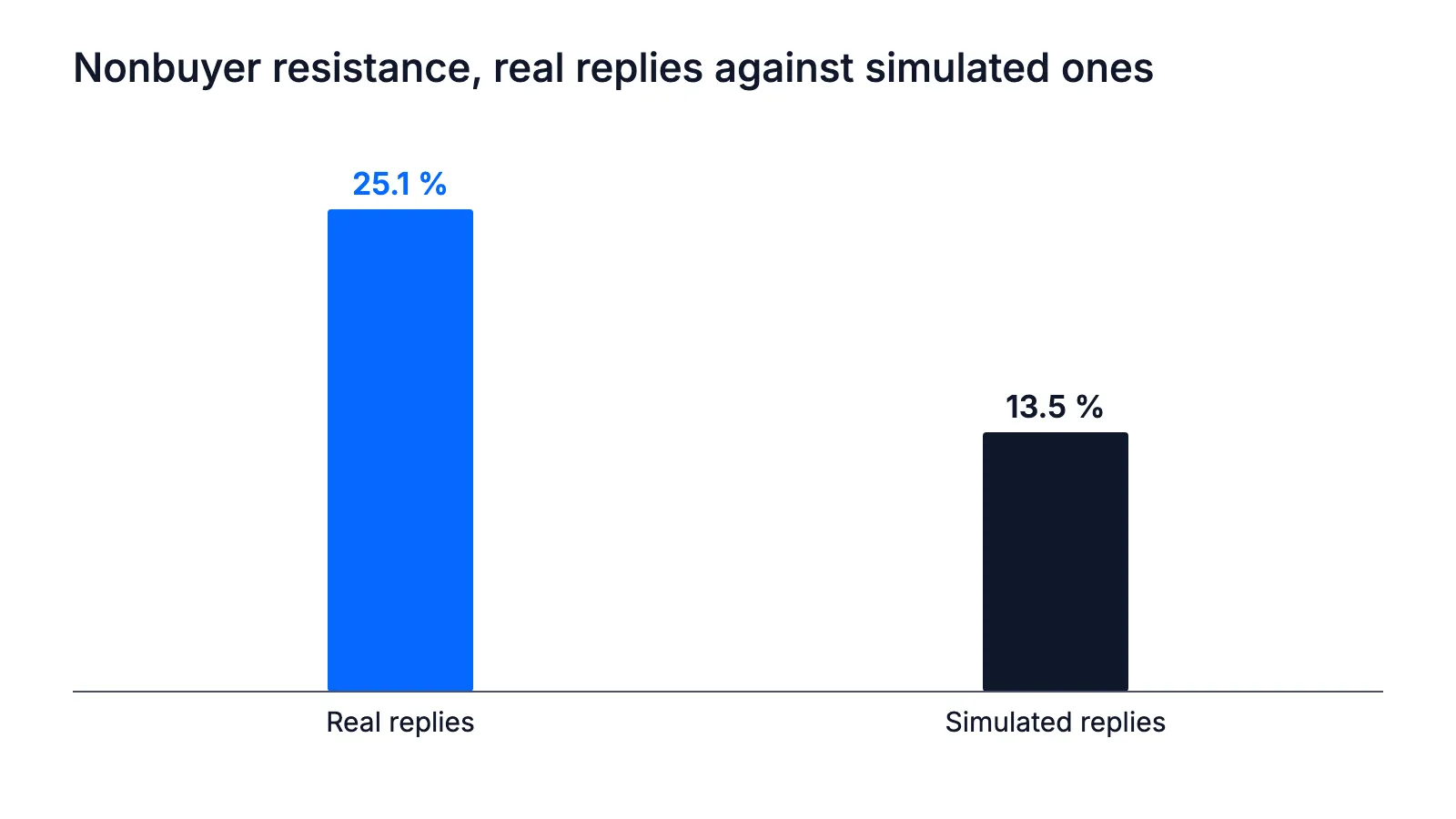
- Simulated buyers rarely say no on their own. In a 2026 study that checked model replies against the real ones at 1,109 points in 374 recorded sales chats, nonbuyer resistance fell from 25.1 percent in the real replies to 13.5 percent in the simulated ones. Write the exit line yourself.
- Adjectives change nothing on the call. “Skeptical” becomes “asks for an example from a business like theirs whenever you make a claim without one.”
- The persona is finished after one test run whose transcript shows the AI kept to it. Each failure in the transcript points to one field to fix.
What details does a buyer persona for AI roleplay need?
Ten fields, in one list, each written as what the buyer does on the call. The example lines all belong to the same invented buyer, the director of finance operations at a group of veterinary clinics, who appears in full in the next section.
-
Context. The buyer’s role and company, and this one call: who booked it, why now, what stage it is and how long it runs. One persona covers one call situation. Example: “You are the director of finance operations at a group of fourteen veterinary clinics. This is a twenty-minute first discovery call you booked after replying to a cold email, because month-end close ran late twice this quarter.”
-
Goals. What the buyer is measured on, and what they want from this call, which is smaller than what they want from a purchase. A buyer who wants “to fix accounts payable” never has a reason to end the call; a buyer who wants to decide whether to ask the CFO for a meeting does. Example: “You are measured on closing the books on time. From this call you want to decide whether a meeting with the CFO is worth asking for.”
-
Pain and the status quo. The problem, what it costs, what they use today and why they will defend it. Buyers defend the current setup until the seller gives them a reason not to, and stalling is the normal case: in Forrester’s 2023 survey of business buyers, 89 percent said a purchase had stalled, with budget limits among the recurring causes. Example: “Each clinic manager approves supplier invoices by email, and a spreadsheet next to the accounting system tracks them. You defend this as working, mostly.”
-
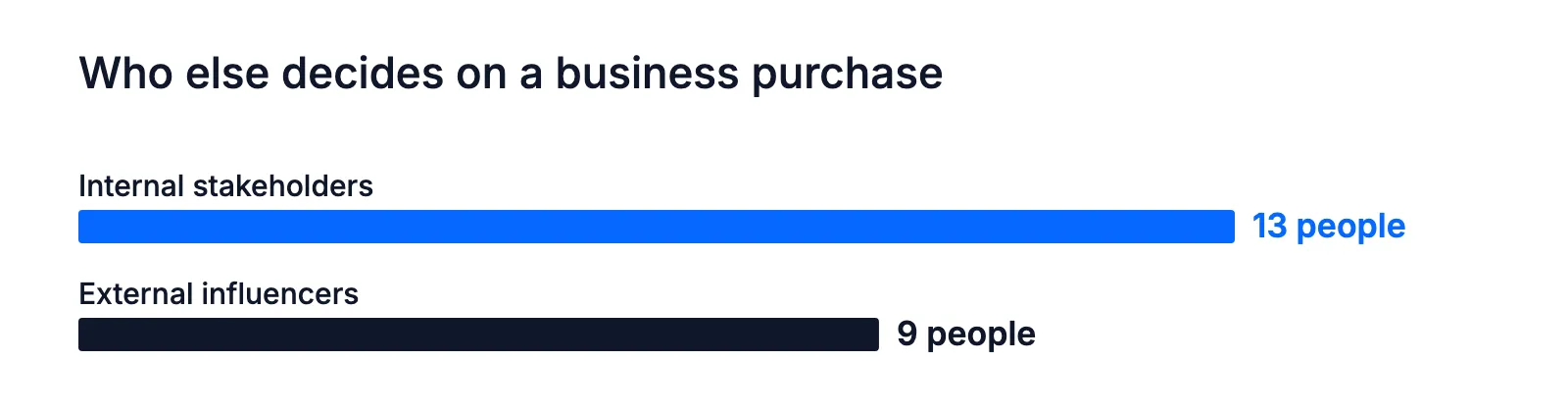
Decision behavior. Authority, who else decides, where the budget sits, what evidence moves them and what makes them stall. “Who else decides” is never empty: Forrester’s 2025 survey, covering nearly 18,000 buyers, put the average purchase at 13 internal stakeholders and nine external influencers. The buyer’s position should move when the seller supplies real evidence, and not before. Example: “You recommend and the CFO signs. The one-person IT function has to approve any integration. What moves you is a reference from another multi-site group on the same accounting system.”
-
Personality, written as behavior. Every trait becomes an if-then: what the buyer does when the seller does something. “Skeptical” becomes “asks for an example from a business like theirs whenever the seller makes a claim without one.” Rules also suit the model: in a 2025 role-play benchmark, a prompt with explicit rules for when the character may act scored 0.571 against 0.519 for the baseline prompt, though much of that gain came from more reliable use of software tools, which that benchmark also scored. Never write “friendly” or “open” without also writing what the buyer will not agree to. An ACL 2026 study of 275 personas across 13 role-playing models found that in nine of them, higher agreeableness (the trait behind words like friendly and easygoing) went with more sycophantic answers, meaning answers that echo the opinion of whoever the model is talking to. Example: “You answer in one or two sentences until the seller asks about month-end. When the seller makes a claim without an example, ask for one from a business like yours. When the seller shows features before asking about your process, mention your hard stop.”
-
Hidden motivation. The private reason behind the call, which a real buyer would not say in the first minute. Example: “The auditor flagged a duplicate payment, and you will have to explain it at the next audit committee.”
-
Communication style, as spoken. Sentence length, pace, the words they use and the words they never use, whether they interrupt, and the first thing they say when the call connects. Take the phrases from your call notes: a few relevant example lines pin a large model’s voice better than a character description alone, which is what the RoleLLM study found when it added the five most relevant dialogue pairs to the description as demonstrations. Pace and interruptions only apply in a voice roleplay; a text chatbot has nothing to act on there. If you sell in a second language, this is the field that pays most, because the buyer’s real phrasing and speed are what you are rehearsing against. Example: “Plain and clipped. You say ‘AP’, ‘close’ and ‘approvals’ and never use vendor jargon. You cut in when the seller talks for long without asking anything. You open the call by naming your role and your twenty minutes.”
-
Reveal rules. Three short lists: what the buyer says early, what they say only after a good question (name the question), and what they never volunteer. This field turns the hidden motivation into something the seller has to earn. Without it, the model often hands everything over at the start: in the CustomerSim benchmark, simulated shoppers from three of the five models tested disclosed more of their criteria in the opening turn than human shoppers did. Example: “Early: fourteen clinics, the accounting system, and that close runs late. After the seller asks how approvals work and then what made you take the call now: the duplicate payment. Only if asked directly: nothing new gets approved before the next budget cycle.”
-
Objections, in order. The surface objection, meaning the reason the buyer gives first, and later the real one, each with what answers it. Include one objection your script does not answer yet. As we wrote in our own guide to roleplay tools, “if the buyer only ever asks what your rep prepared for, the rep is rehearsing recall rather than composure,” and the persona is where that objection gets written. In insurance, the surface objection is usually “I already have cover,” the real concern stays held back until the seller asks a specific question about the current policy, and “Send me a comparison” is the buyer’s polite exit. Example: “Surface: you are waiting for the accounting system’s next release, answered by what waiting costs over the next two closes. Real: a failed rollout would put your name on the next audit report, answered by the same-system reference and a rollout that starts with one clinic.”
-
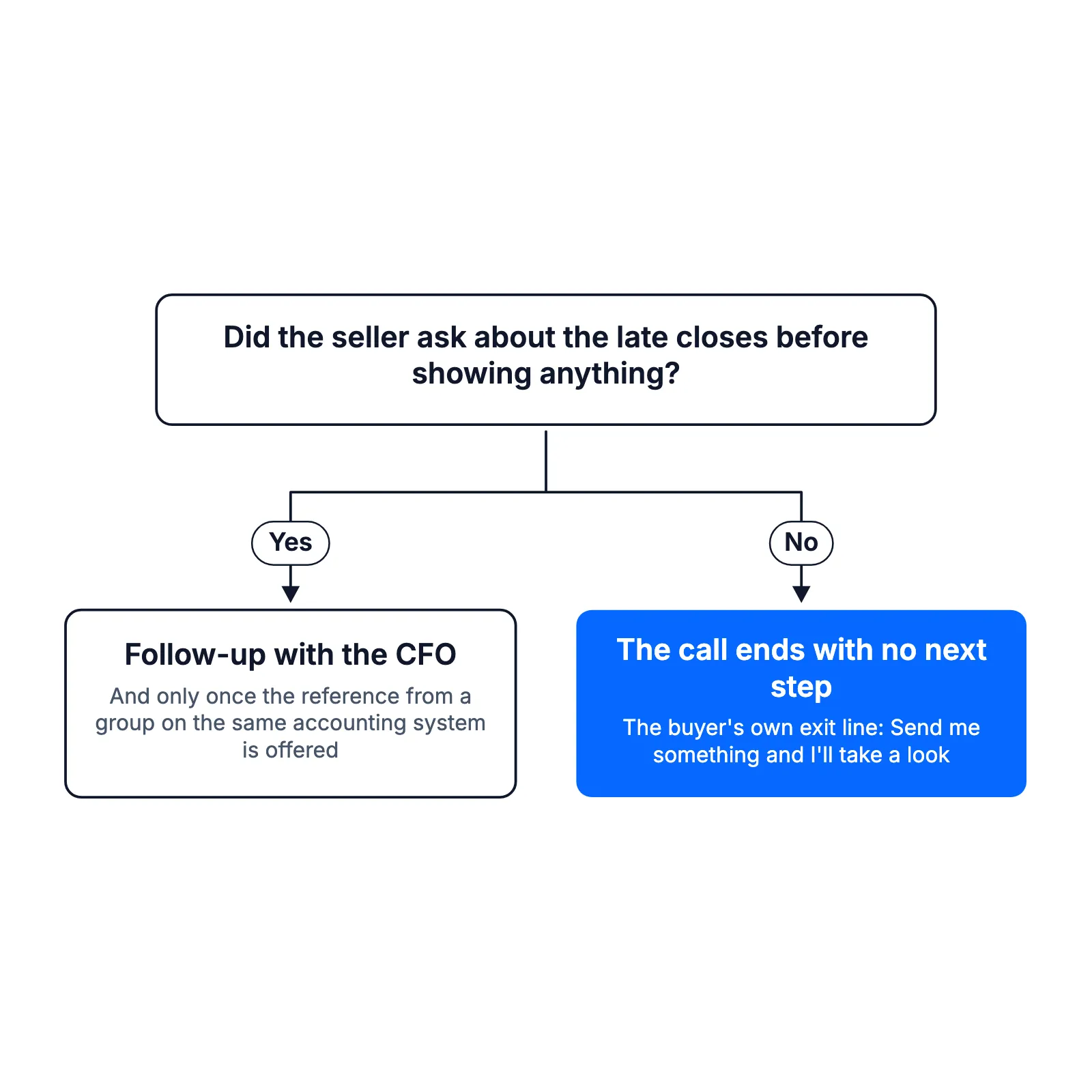
How the call can end. The next step the buyer agrees to and exactly what earns it, and the condition under which the buyer ends the call with no next step, with the exit line in the buyer’s own words. Example: “You agree to a follow-up with the CFO if the seller asks about the late closes before showing anything and offers the same-system reference. If the seller demos features before asking about your process, end with ‘Send me something and I’ll take a look.’”
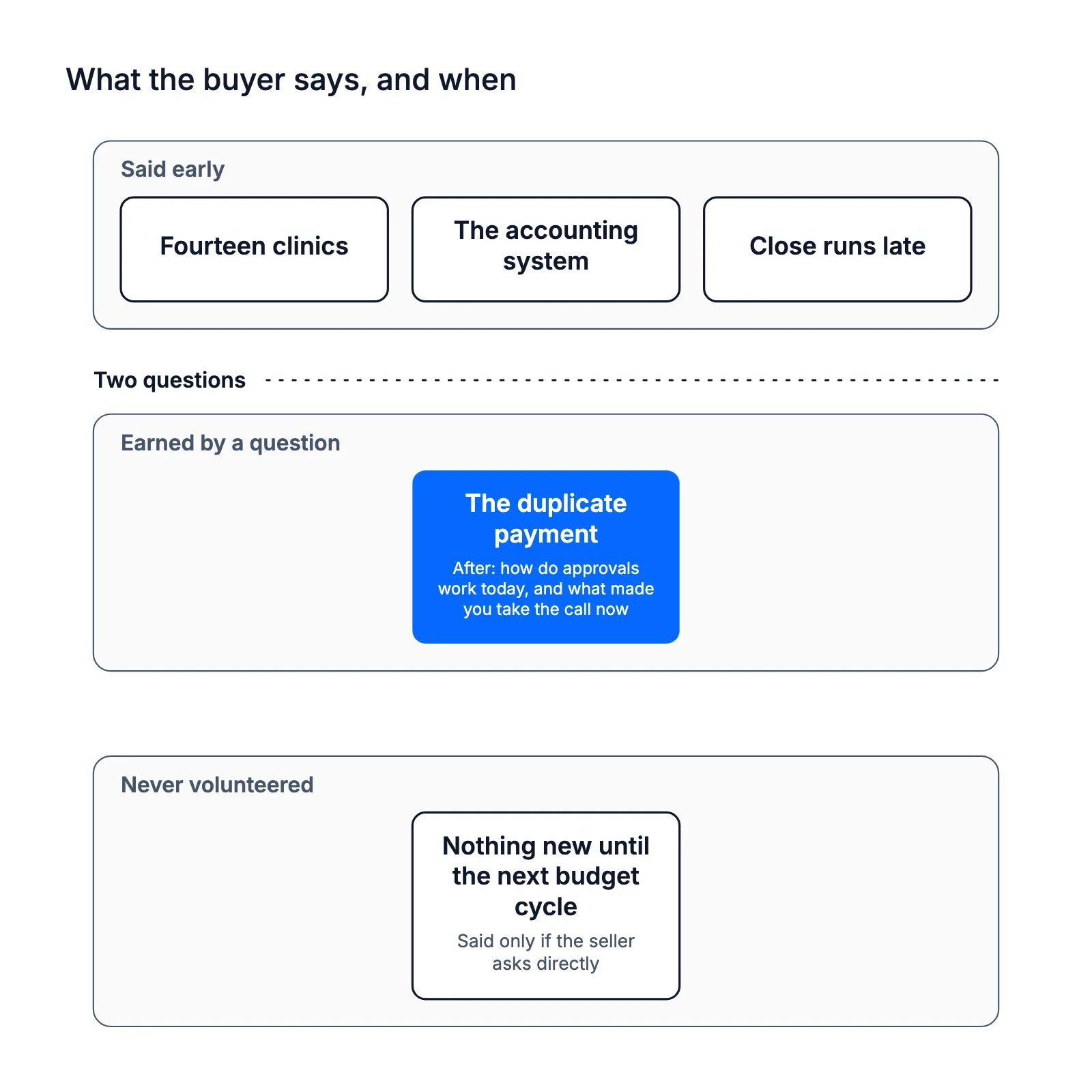
A worked example: what the buyer reveals early and what it holds back
The persona below was written for this article. The buyer, the clinic group and the software vendor are invented, and the exchange that follows is an illustration, not a transcript of a real call or of a practice session. The seller sells accounts-payable software. Copy the block, replace the values, and keep the shape.
You are the director of finance operations at a group of fourteen veterinary clinics.

Context: This is a twenty-minute first discovery call. You booked it after replying to a cold email from a seller of accounts-payable software, because month-end close ran late twice this quarter.

Goals: You are measured on closing the books on time. From this call you want to decide whether a meeting with the CFO is worth asking for.

Pain and status quo: Each clinic manager approves supplier invoices by email. A spreadsheet next to the accounting system tracks them. You defend this as working, mostly, until the seller gives you a reason not to.

Decision behavior: You recommend, the CFO signs. The one-person IT function must approve any integration. You want a reference from another multi-site group on the same accounting system before you take anything to the CFO.

Personality as behavior: Answer in one or two sentences until the seller asks about month-end. When the seller makes a claim without an example, ask for one from a business like yours. When the seller shows features before asking about your process, mention your hard stop.

Hidden motivation: The auditor flagged a duplicate payment. You will have to explain it at the next audit committee.

Communication style: Plain and clipped. Say "AP", "close" and "approvals". Never use vendor jargon. Cut in when the seller talks for long without asking anything. Open the call by naming your role and your twenty minutes.

Reveal rules:
- Say early: fourteen clinics, the accounting system you use, that close runs late.
- Say only after the seller asks how approvals work and then what made you take the call now: the duplicate payment.
- Never volunteer, and say only if asked directly: nothing new gets approved before the next budget cycle.

Objections, in order:
1. Surface: "We're waiting for the next release of our accounting system." Answered by what waiting costs you over the next two closes.
2. Real: a failed rollout puts your name on the next audit report. Answered by the same-system reference and a rollout that starts with one clinic.

How the call ends:
- Agree to a follow-up with the CFO only if the seller asks about the late closes before showing anything and offers the same-system reference.
- If the seller demos features before asking about your process, end the call with: "Send me something and I'll take a look."
The block speaks to the AI in the second person because that keeps every line an instruction. It is a working convention: a 2025 evaluation of persona prompt formats across five open models found no universal advantage for “You are” framing over the alternatives.
Here is the same persona in play. Each rule that fires is noted in brackets after the line.
- Buyer: Hi, finance operations here. I’ve got twenty minutes. [Field 7: the opening line, with the hard stop stated up front]
- Seller: Thanks for taking it. Groups your size usually cut a week off close with our approvals workflow.
- Buyer: Which groups? Give me one that runs on the same accounting system we do. [Field 5: a claim without an example gets asked for one]
- Seller: Fair. Before I answer that, how do supplier invoices get approved across the clinics today?
- Buyer: Fourteen clinics. Each manager approves by email, and we track it in a spreadsheet next to the accounting system. It works, mostly. [Field 8: the early reveal. Field 3: the status quo defended]
- Seller: Mostly. What made you take this call now rather than next quarter?
- Buyer: Close ran late twice this quarter. And the auditor found a duplicate payment that I’ll have to explain at the audit committee. [Field 8: the held-back point, earned by the second question. Field 6 surfaces]
- Seller: Can I show you how duplicate detection works in the approvals screen?
- Buyer: We’re waiting for the next release of our accounting system. It’s supposed to fix some of this. [Field 9: the surface objection]
- Seller: Understood. If you waited two more closes, what does that cost you?
- Buyer: Two more late closes. Maybe another audit finding. [Field 9: the surface objection answered on its own terms]
- Seller: What would make a change like this risky for you personally?
- Buyer: A rollout that fails with my name on it. Our IT person has to approve any integration, and I’d want to talk to a group on the same system before I go to the CFO. [Field 9: the real objection. Field 4: who else decides, and the evidence that moves her]
- Seller: We’d start with one clinic, and I can put you in touch with a multi-site group on the same system this week. Would a follow-up with your CFO make sense after that?
- Buyer: Yes. Send the reference first, then we book it. [Field 10: the condition met, the next step agreed]
Budget never came up. The seller never asked directly whether anything new could be approved before the next budget cycle, so the buyer never said it, which is field 8’s third list doing its job. Had the seller opened with the demo at line 2, field 10’s exit line would have fired, and the call would have ended with “Send me something and I’ll take a look.”
How to write a buyer persona an AI can play, step by step
Step 1: Pick one buyer and one call you will have again
One persona is one buyer in one call situation. A cold call and a discovery call with the same buyer are two personas, because the same buyer holds back different things at each stage. Start with the buyer you meet most. Our rule of thumb for when practice pays, from our practice-mode page: “it is worth it when the conversation repeats. If you will have roughly the same call fifty more times, with the same product, the same buyer type and the same handful of objections, rehearsal compounds, and every run is a cheap version of a call you would otherwise learn on a real prospect.”
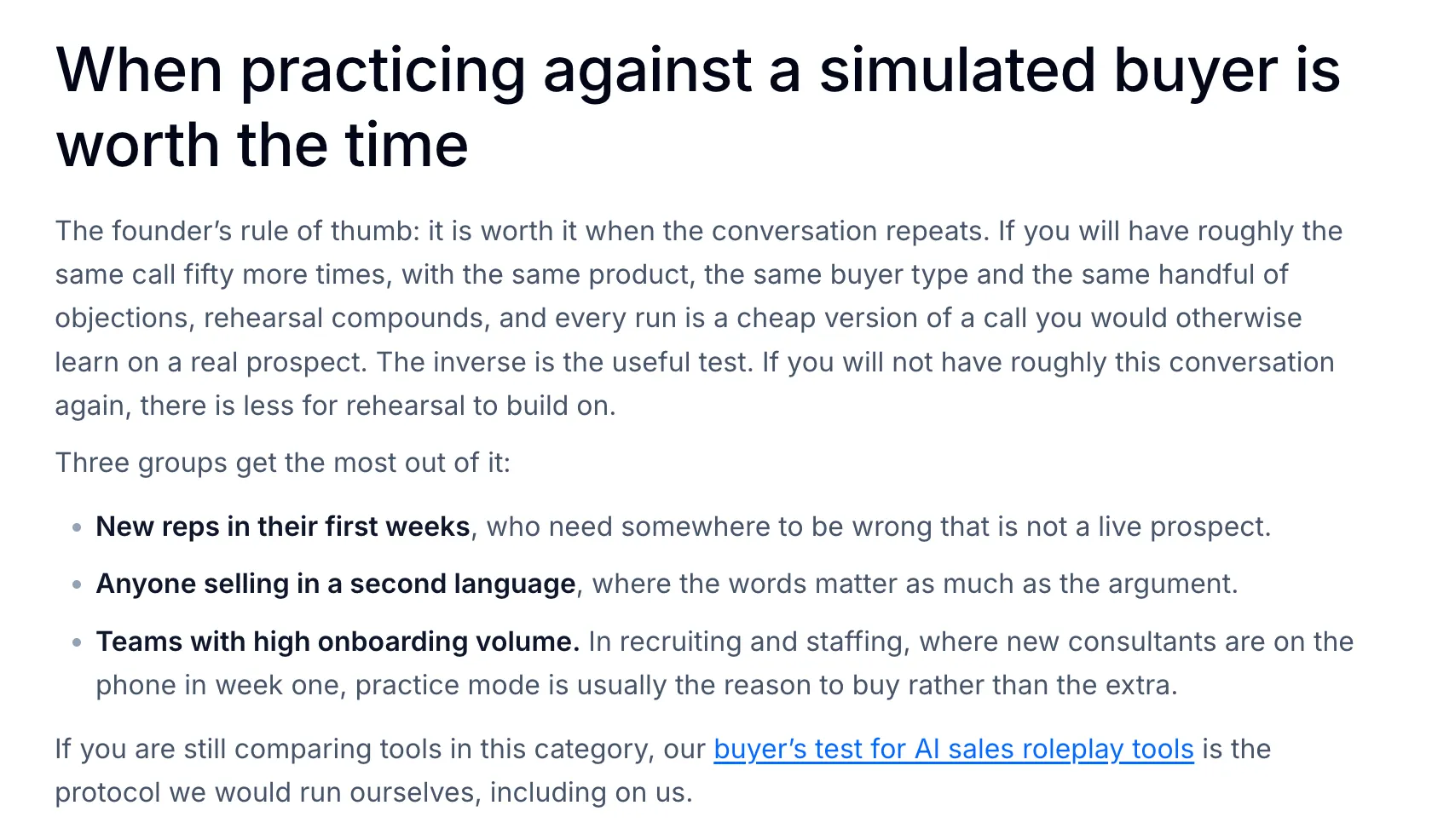
A second sketch, for a staffing consultant calling a hiring manager, shows how little a first version needs:
- Surface position: “We’re fine with the agencies we use.”
- Held back: the last placement quit in month two.
- Earned by: asking how previous placements worked out.
- Ends without a next step if the consultant pitches candidates before asking about the last hire.
A consultant needs a second persona for the candidate call, because the candidate holds back different things (the real reason for leaving, the other offer) and agrees to different next steps.
If you write personas for a team, write one per call type the team repeats, from the team’s real calls, and revise it after the reps’ first real calls with it. Scripts get edited after the first few real calls, because that is where you find out what reps actually get asked, and personas follow the same rhythm.
Step 2: Collect the buyer’s real words
Build the persona from what buyers actually said. The sources, in order of usefulness: notes and transcripts of real calls you are allowed to keep, lost-deal notes, CRM notes, and the objections your team hears most. Copy exact phrases for field 7. For field 8, note the moment a buyer opened up and what you had just asked. The evidence matters because AI-generated people skew agreeable: when Nielsen Norman Group replicated three UX studies with AI-generated participants, the synthetic users came out more idealized, more verbose, more favorable and more sycophantic than the human ones. A buyer the AI invents, or one written from assumptions, starts from the same tilt.
If you are a founder selling your own product, you know the product better than anyone and not yet how the buyer behaves. Write the persona from the notes of your first real calls, and treat those calls as research. CallPrompter’s founder was in that position: a technical founder without sales experience who, in his own words, “did not want to burn my leads while learning.”
The persona describes a type of buyer, never a real person. Strip names, company names and anything that identifies a prospect before a line goes in. As general information, not legal advice: data-protection law in the EU requires personal data to be “adequate, relevant and limited to what is necessary” for the purposes it is processed for (GDPR Article 5), and removing a name alone does not make a transcript anonymous if the rest still points at one person. Short, de-identified phrases carry the behavior; the full transcript does not need to travel.
Step 3: Fill the ten fields, then cut
Write every field, turn every adjective into an if-then, then apply the one test to every line and delete what fails. What usually goes: age, family, hobbies, media habits, preferred channels and the long company history. None of it changes what the buyer says on this call. Demographic detail is also a weak lever: in the 2025 evaluation of persona prompt formats cited above, the framing of the persona shifted the models’ answers across all five models tested, while the demographic detail in it left them stereotyping the groups they were asked to play, and two of the five landed further from those groups’ real answers than a random baseline.
The cut matters for a second reason: models follow instructions less reliably as the instructions pile up. In the IFScale test, even the best system followed about 68 percent of 500 simultaneous constraints. Every line that does not change behavior competes for attention with a line that does. In a long block, move the reveal rules and the ending up to just below the context; the example above keeps the checklist’s order so the two are easy to compare.
You are <role> at <company>.

Context: <this call: who booked it, why now, what stage, how long it runs>

Reveal rules:
- Say early: <what the buyer offers unasked>
- Say only after <the question that earns it>: <the held-back point>
- Never volunteer, and say only if asked directly: <the last reserve>

How the call ends:
- Agree to <the next step> only if <the condition the seller has to meet>
- Otherwise end the call with: "<the exit line, in the buyer's own words>"

Goals: <what the buyer wants out of this call>
Pain and status quo: <the problem, what it costs, what they defend>
Decision behavior: <who recommends, who signs, who can veto, what evidence moves them>
Personality as behavior: <one if-then rule per trigger>
Hidden motivation: <the private reason behind the call>
Communication style: <sentence length, pace, words used and avoided, the opening line>
Objections, in order: <the surface one, then the real one, each with what answers it>
The founder’s verdict on adjectives is blunt: “‘Skeptical, analytical, direct’ reads like a character brief and changes nothing: the agent has no way to act on an adjective. A buyer described as skeptical still accepts your first answer, because nothing tells it when to doubt you.” Age, hobbies and company backstory are, in his words, “fiction that costs tokens and buys no behavior,” tokens being the units of text a model reads. What works instead, he says, is a trigger and a response: “When they claim it saves time, ask how they measured that.” One sentence like that “says what to do and when, not what kind of person to be.”
Step 4: Write what the buyer holds back and how the call ends
Fields 8 to 10 come last, because they depend on everything above them. They also carry the most weight, because a simulated buyer left to itself rarely walks away. The most direct study we know of compared what a language model would say next with what real customers actually said next, at 1,109 points in 374 recorded commercial conversations on a text platform. Real nonbuyers resisted 25.1 percent of the time; the simulated ones, 13.5 percent. One added instruction that allowed disinterest, impatience and nonresponse cut the simulations’ average lean toward moving forward five-fold, but they still got the difference between buyers and nonbuyers wrong by almost as much as before. Read it with its limits: a single-author preprint (not yet peer-reviewed) from June 2026, text dialogue on a matchmaking platform with a language model as the seller, and no B2B call in it. For your persona, the direction is what counts: if nobody writes the no, it rarely comes.
So write the exit line in the buyer’s words, name exactly what triggers it, and write the next-step condition with the same precision. “Agrees to a demo if the seller is convincing” is an adjective in disguise. “Agrees to a follow-up with the CFO only if the seller asks about the late closes before showing anything” is a condition the transcript can be checked against.
Step 5: Run it once and read the transcript
Run one practice session against the persona, then read the transcript for the failure signs below and fix the field that caused each. Adding adjectives fixes none of them.
| What you see in the transcript | Field it points to | Fix |
|---|---|---|
| The buyer names its hidden motivation or budget in the first minute, unasked | 8 | Give it a reveal rule and the question that earns it |
| The buyer agrees to the next step though you never met the condition | 10 and 5 | Write the condition and the exit line; replace any agreeable trait with what the buyer will not agree to |
| The buyer raises every objection at once, or recites its list | 9 | Order the objections and tie each to something you do |
| The buyer contradicts what it said earlier, or its own sheet | Any | Remove the conflicting line; cut lines that fail the one test |
| The buyer sounds like any buyer: long, polite, generic | 5 and 7 | Rewrite traits as if-thens and put real phrases in |
| The buyer never interrupts, or never ends its turn | None | Usually the tool’s voice handling, not the persona |
Two findings stand behind the fourth and fifth rows. Persona consistency degrades as a conversation runs longer: a NeurIPS 2025 study tested three open models across roughly 800 dialogues per task at 10 to 60 turns, in counseling, tutoring and open conversation, and training the models against cross-turn inconsistency cut it by more than half. And the role-play benchmark from field 5 found that explicit rules for when to act outscored the baseline character prompt. Neither was a sales call, so take the direction from them, not the size.
The last row is a different kind of failure. Whether the buyer interrupts you, and whether it stops talking, is set by the tool’s speech system rather than by the persona text: benchmarks for spoken dialogue systems measure pause handling, backchannels (the listener’s “mm-hm”), turn-taking and interruption as capabilities of the system. In our own early testing the simulated buyer would not stop talking. Not long-winded: it genuinely never ended its turn, and the whole exchange came back as one enormous block. No persona line fixes that. A buyer that fails the last row needs a different tool, and our guide to choosing an AI sales roleplay tool publishes a one-hour protocol for testing whether a simulated buyer holds its constraints at all.
In CallPrompter’s practice mode the full transcript and a replay sit in the app’s History afterward, and the run is not scored, so this check is your own review. The same transcript also shows your side of the call; reading it for whether you followed your script without sounding scripted is the other half of the review.
AI-playable persona vs. marketing persona: what changes, field by field
A marketing persona describes a segment so a team can target messaging and channels. Nielsen Norman Group defines the persona as a fictional but realistic representative built from user research to make needs and context memorable for a team, and adds that every detail in it should serve a decision. An AI-playable persona tells a model how one buyer behaves in one call. The reader is the model, and the decisions are the buyer’s, one line at a time.
For the same buyer as the worked example, the two look like this:
| What the persona covers | Marketing persona | AI-playable persona |
|---|---|---|
| Demographics | Kept: age, region, education | Dropped: nothing on the call changes |
| Goals | A broad aim: modernize finance operations | What she wants from this call: decide whether to ask the CFO for a meeting |
| Pain points | A category: manual approvals | The specific cost (two late closes) and the status quo she defends (email approvals plus a spreadsheet) |
| Personality | Adjectives: analytical, skeptical | If-then rules: asks for an example whenever a claim has none; mentions her hard stop when shown features first |
| Objections | A list | The surface one first, the real one later, each with what answers it |
| Buying process | A label: recommender | Who decides (she recommends, the CFO signs, IT approves integrations), what evidence moves her, what makes her stall |
| Reveal rules and how the call ends | Not present | What she says early, what a good question earns, what she never volunteers; what earns the next step and when she ends the call |
If you already own a marketing persona for this buyer, convert it in three moves. Keep the role, the goals, the pain and the buying process. Cut everything that fails the one test. Add fields 5 to 10.
What this looks like in CallPrompter’s practice mode
Personas and scripts live in CallPrompter’s web application, and the persona attaches to a script. In the desktop app you pick the persona and start the session. The AI customer speaks first, in a real voice, and it interrupts, pushes back and goes off-script. You answer out loud, and the overlay (CallPrompter’s floating prompts, visible only to you) shows the next question, the answer written into your script for the objection you just heard, or a direction cue, the short instruction CallPrompter shows beside the meeting window, such as “slow down” or “ask about budget.” Afterward the full transcript and a replay sit in History. The practice-mode page shows how a practice session runs with the persona you wrote and what each plan includes. The persona does a second job as well: the script branches by persona, so on real calls the prompts match the same buyer.
The persona editor has thirteen fields: name, short label, icon, description, attributes, based-on preset, voice system prompt, voice first message, voice, common objections, buying signals, detection hints and active. The ten checklist fields map onto them like this:
| Checklist field | Persona editor field |
|---|---|
| The whole spec, fields 1 to 10 | Voice system prompt |
| Field 7, the first thing the buyer says | Voice first message |
| Field 9, the objection list | Common objections |
| Field 10, what earns the next step | Buying signals |
| How the persona appears in your list (not a checklist field) | Name, short label, description |
The voice system prompt is the field that changes the practice buyer’s behavior most. In the founder’s words, it is “the only one the voice agent reasons from,” covering “who the buyer is, what they want, what they won’t say unless asked. Everything that makes a practice call feel real comes from there.” Second is the first message, “because the opening line sets the tone for the rest.” The list fields (common objections, buying signals) “shape content but not behavior,” and “a persona with ten objections listed and a thin system prompt still plays flat.”
The buyer persona we practice against before our own sales calls at CallPrompter, in the founder’s words:
Who: A technical founder at a 5 to 20 person B2B software company. Builds the product, runs sales because nobody else will, has no sales training and knows it. Busy, a little defensive about being bad at this.
Holds back: That they’ve already lost deals they should have won, and that they’re embarrassed about it. Will talk about “process” and “efficiency” instead. Only admits the real problem if asked directly what happened on their last lost call.
Agrees to a next step when: They’ve said out loud that a specific call went badly, not before. Until they name a real loss, they’ll stay polite and non-committal.
Frequently asked questions
Why does my AI roleplay buyer agree to everything?
Because nothing in the persona tells it not to. Left to itself, a language model keeps the conversation moving: in the 2026 study above, simulated nonbuyers resisted about half as often as real ones. Write field 10 with the condition that earns the next step and the exit line for when it is not met, replace any agreeable trait in field 5 with what the buyer will not agree to, and run it once to check the transcript.
Can one buyer persona cover a cold call and a discovery call?
No. One persona covers one call situation. Copy the persona and change fields 1, 8 and 10: the context, what the buyer reveals at that stage, and what the call can end with. The goals, pain and decision behavior usually stay.
Try it against the persona you just wrote
Paste the persona into practice mode and run one session against it, then read the transcript for the six failure signs above. The seven-day trial costs USD 0, needs no credit card, and includes personas and 30 minutes of AI practice. Live call coaching is a paid plan and is not part of the trial. If something in the persona editor does not behave the way this article says it should, send a message and the founder will get back to you.
Related posts
How to Choose an AI Sales Roleplay Tool That Actually Simulates Practice
Cold Call Objections and Responses: The 12 Most Common, With Talking Points for Each