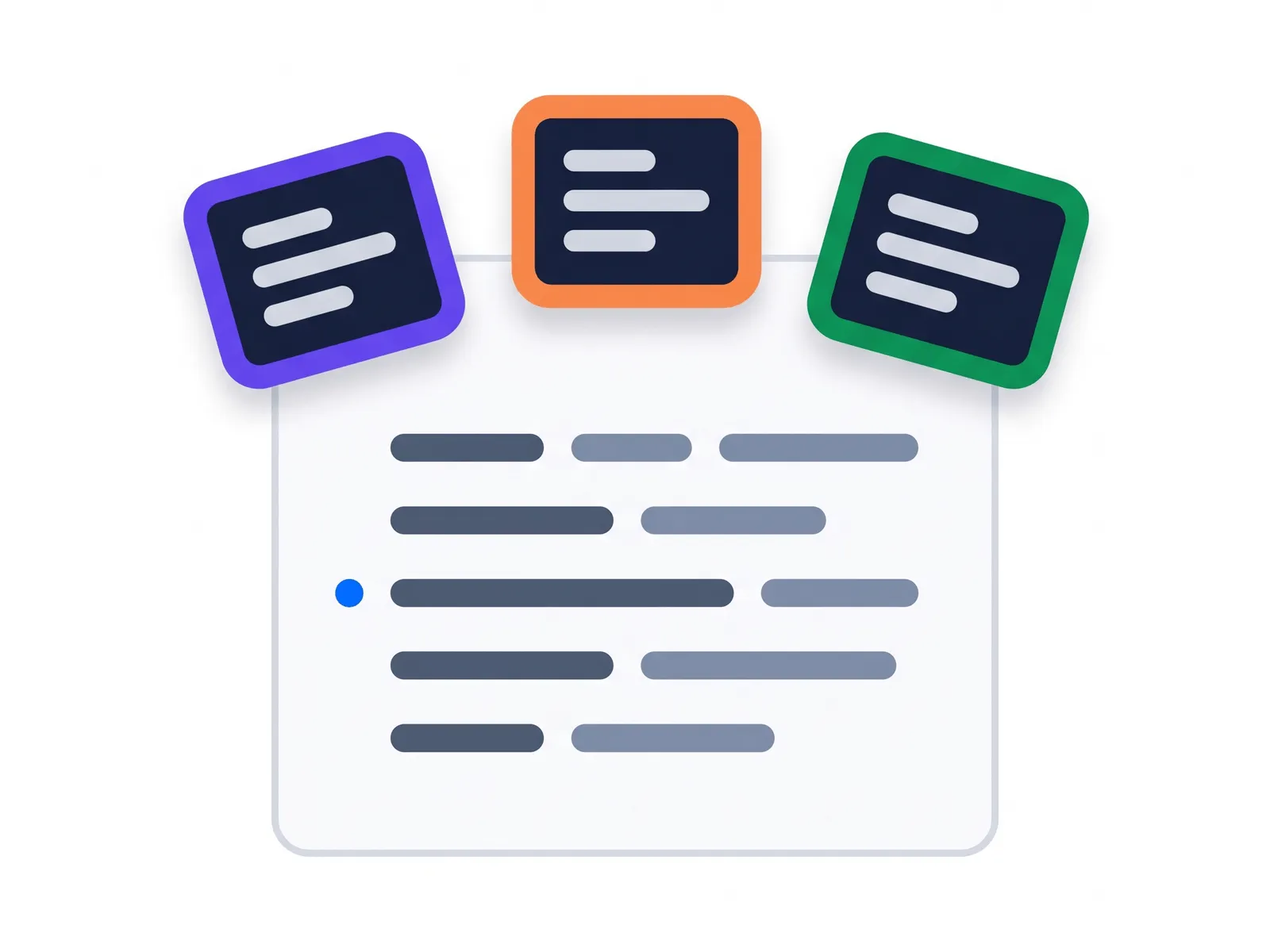
“That makes sense, and I’m not asking you to replace anyone on this call. What does the current setup handle well, and where, if anywhere, does it still leave work on your side?” Then stop talking. Those two sentences are the whole response to “we already have someone for that,” and at no point do they ask who that someone is. At CallPrompter this is the response we recommend for the incumbent objection, and the rest of this page is the four steps behind it: acknowledge, ask the gap question, branch on the answer, close.
Key takeaways
- Accept the incumbent as a fact before you say anything else: “That makes sense, and I’m not asking you to replace anyone on this call.”
- Ask one question about the arrangement, never about the vendor. The name tells you nothing about whether there is a gap. The gap question does.
- Branch on the answer. “It’s fine” gets one scope question and a dated check-in. “It’s fine, but” gets a follow-up on whatever came after the but.
- Close on one small next step tied to the gap the prospect named, or on the date they would have to decide by. Never on a switch.
- Never name, guess at or criticize the other provider. It moves the call from the prospect’s situation onto a decision they already made, and an improvised claim about a named rival can carry legal exposure in the US, Switzerland, the EU and the UK.
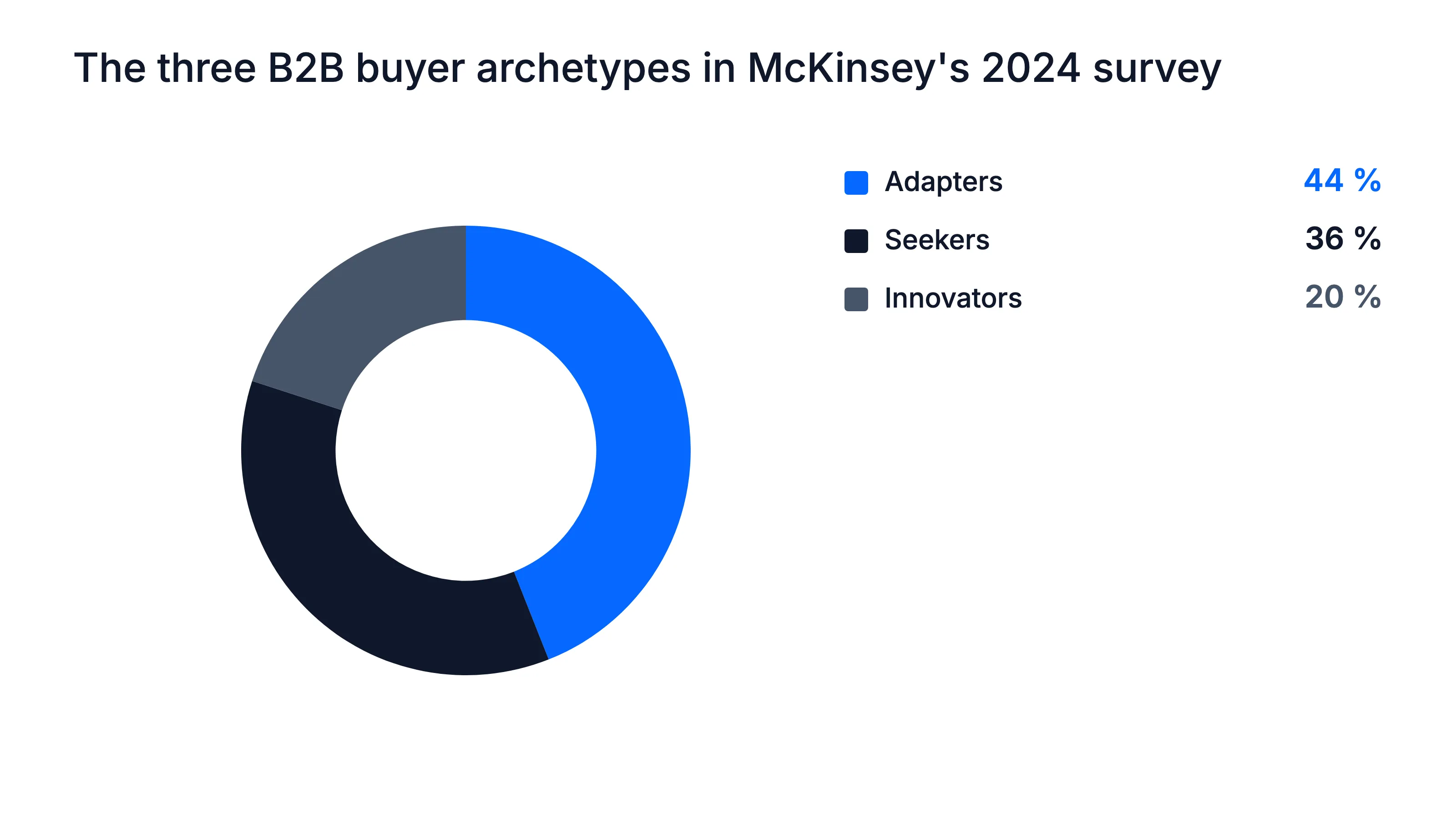
- Having a provider does not mean the buyer is satisfied. In McKinsey’s 2024 survey of nearly 4,000 B2B decision-makers, 44% were relationship-oriented buyers who were slow to try a new supplier even when the status quo was less than satisfactory.
The two branches, on one screen
Everything after the opening script depends on what the prospect says next. There are two answers, and each has its own words. Steps 3 and 4 expand both.
| What you hear | Say this | Where it goes |
|---|---|---|
| Branch A: “It’s fine, we’re happy.” | “Good, then I won’t manufacture a problem. When do you next look at that setup, and by what date would a change have to be decided?” | A dated check-in, then a clean exit |
| Branch B: “It’s fine, but…” or a workaround (“we export it and then…”) | “Say more about the part after the but. When that happens, what does it delay, cost or put at risk?” | Straight to the gap, then one small next step on that gap alone |
One answer moves a prospect from Branch A to Branch B without a single complaint: the arrangement renews within the next year. A happy prospect with a decision date is a check-in, not a goodbye.
Step 1: Acknowledge the incumbent as a fact
Say: “That makes sense, and I’m not asking you to replace anyone on this call.”
You are conceding one fact, that they have a provider, so the conversation can move to a fact you do not have yet. No “but.” No “a lot of our customers said the same thing.” The sentence takes replacement off the table for the next minute, and that is the only way the next question gets an honest answer.
McKinsey’s 2024 B2B survey of nearly 4,000 decision-makers across 13 countries sorted buyers into three archetypes. The largest group, 44%, were “adapters”: relationship-oriented buyers who were slow to try a new supplier even when their current position was not fully satisfactory. Seekers were 36% and innovators 20%. “We already have someone” is very often a statement about loyalty and inertia. It says nothing yet about the quality of the arrangement.
Forrester’s 2024 research adds the other half. Across more than 16,000 business buyers, 81% reported dissatisfaction with the provider they had selected. Having a provider does not establish satisfaction with it, and the acknowledgment leaves room for that to surface on its own.
One limit, stated plainly: neither survey measured what happens on a cold call when a seller acknowledges the incumbent. They describe the buyer you are talking to, not the effect of the sentence.
Step 2: Ask the gap question, never the vendor question
Say: “What does the current setup handle well, and where, if anywhere, does it still leave work on your side?”
Then be quiet. The question is about the arrangement: what it covers, how it is used, what still lands on the prospect’s desk. It is never about the vendor, because the vendor’s name does not answer the only question you have on this call, which is whether there is a gap worth twenty minutes.
The two questions do different jobs. “Who do you use?” supplies seller intelligence and puts the prospect in the position of explaining a decision they already made. “Where does it still leave work on your side?” supplies buyer-relevant information and lets the prospect define any problem in their own words. Research on live conversations found that people who asked more questions, and especially follow-up questions, were better liked because they came across as responsive: understanding, validating and attentive. The gap question is a follow-up to what the prospect just told you. The vendor question is an interrogation.

Where the evidence stops: no study has put “who do you use?” up against a gap question on a live B2B call and measured the difference. Treat this as well-grounded script design, not as proven cause and effect.
How to avoid asking who the incumbent is
The vendor question is a habit, and a habit needs a replacement. These three phrasings each get the prospect describing what the setup does and does not do, and none of them produces a name. Pick one per call, not all three.
- “What does the current setup handle well, and where does it still leave work on your side?” The default. Use it on the first call, right after the acknowledgment, when you know nothing yet.
- “Walk me through how that gets done today, from the moment it comes up to the moment it’s finished.” Use it when the first answer was one word. A process description surfaces the workaround, the spreadsheet and the person who does it by hand, none of which a vendor name would have told you.
- “If you could change one thing about how that works today, without losing what already works, what would it be?” Use it when the prospect sounds content but is still talking. It invites a wish without asking for a complaint, and it is the phrasing that fits regulated industries, where the question has to be about the buyer’s needs rather than the current provider’s shortcomings.
What if the prospect volunteers the vendor’s name?
Acknowledge it in one word and return to the arrangement: “Understood. What matters most in that setup, and what, if anything, would you change?” You do not have to repeat the name, characterize the company or guess at its weaknesses. Hearing a competitor’s name is not a problem under any of the rules discussed below. What you assert about it afterwards is where the exposure starts.
Do I ever need to know who the incumbent is?
Not to handle the objection. Later, possibly. A formal evaluation, a migration plan or a regulated insurance replacement can require the current provider, contract, renewal date or policy details, and in some of those cases you are obliged to collect them. The rule on this page covers the first response to the objection, not the whole sales process.
Step 3: Branch on the answer
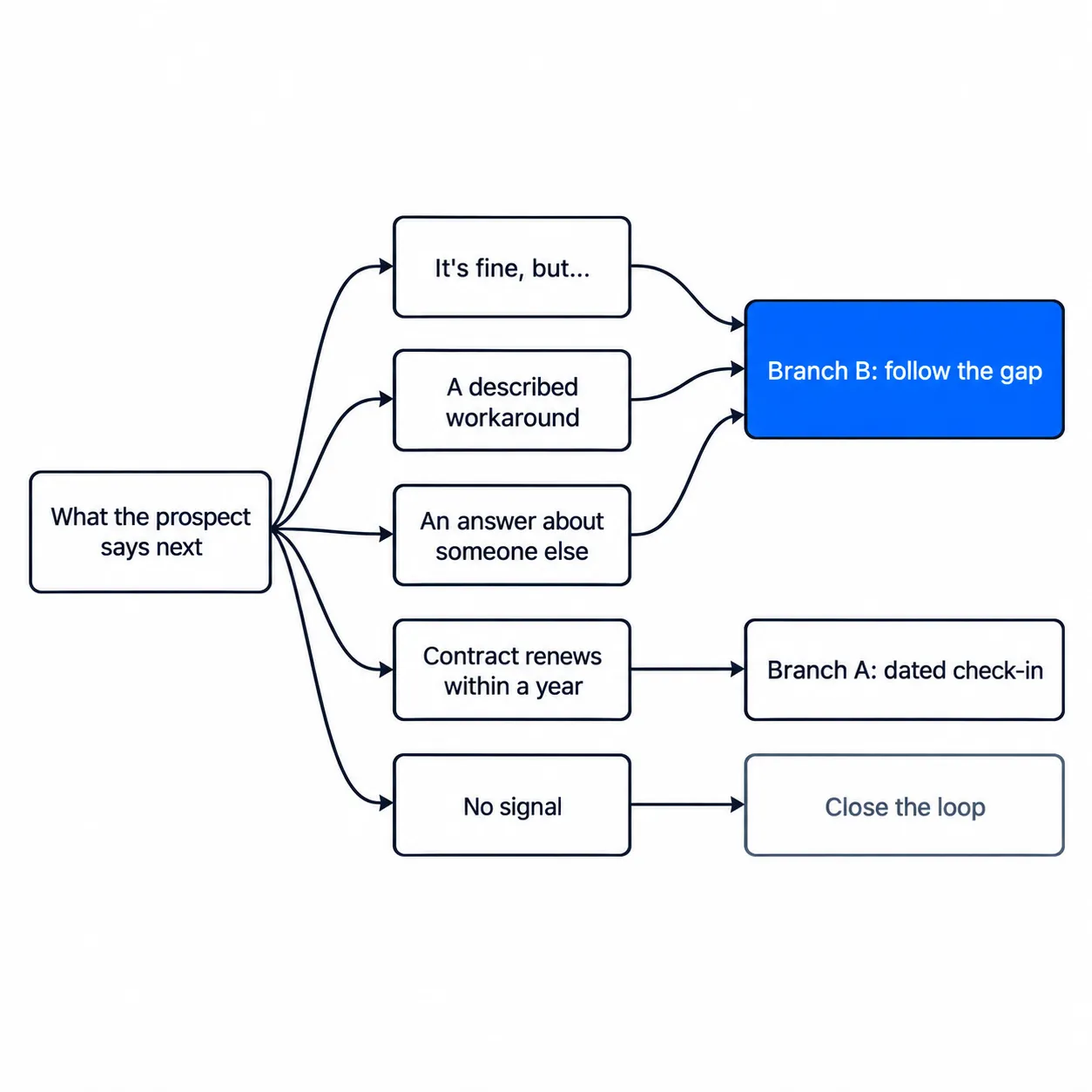
Listen for four signals. This is the rule of thumb we use at CallPrompter to tell a prospect who is worth another five minutes from a call that is already done:
- “It’s fine, but…” Anything after the but is the opening.
- A described workaround. “We export it and then…” is a gap the prospect has stopped noticing.
- An answer about someone else. “My team finds it clunky” is a complaint with a sponsor attached.
- The contract renews within a year. That puts a real decision on a real calendar.
The first three send the call down Branch B. The fourth turns a Branch A answer into a dated check-in instead of a goodbye. None of the four, and there is probably nothing here.
Branch A: the prospect is happy with the current setup
Say: “Good, then I won’t manufacture a problem. When do you next look at that setup, and by what date would a change have to be decided?”
Take the answer at face value. Probing on after a real no-gap answer is exactly the pressure step 1 was built to avoid, and it costs you the check-in. Switching is also a bigger ask than it looks from the seller’s side. In McKinsey’s research on technology and telecom buyers, only about 20% of the switching that buyers had said they intended a year earlier had actually happened twelve months on. A happy prospect is not going to switch on this call, and pretending otherwise burns the one thing you can still get: permission to call back on a date that matters.
In insurance and financial advisory, Branch A arrives in its own dialect: “I already have coverage,” “my broker handles that,” “my advisor handles all of it.” Ask about scope, not quality: “Good, that tells me the core is covered. Does that arrangement handle this specific area too, or is it managed separately?” If the scope question comes back clean, take the date and leave. There is a compliance reason to hold this line, and it is covered below.
Branch B: the prospect names a gap
Say: “Say more about the part after the but. When that happens, what does it delay, cost or put at risk? That’s the one area I’d compare, not the whole relationship.”
Repeat their words for the gap. If they said “we export it into a spreadsheet every Friday,” the thing you are comparing is the Friday export, and the meeting you are about to ask for is about the Friday export. You are comparing your capability with a gap the prospect named thirty seconds ago, which is a fact you both agree on. A comparison of your company with theirs is a claim you cannot verify on a call and they can reject in a word.
A carve-out beats a replacement here. The prospect has already told you the arrangement mostly works. Proposing to solve one piece alongside it asks for far less than proposing to replace it, and it is the ask a Branch B prospect can say yes to today.
Step 4: Close on a small next step or a dated check-in
Say, on Branch B: “Worth twenty minutes on that one piece? I’ll show you how we’d handle the Friday export, and nothing else has to change.” Swap the Friday export for whatever gap they named, in their words.
Say, on Branch A: “When would you have to make a decision to avoid rolling over into another term? I’ll call you two weeks before that, and not before.”
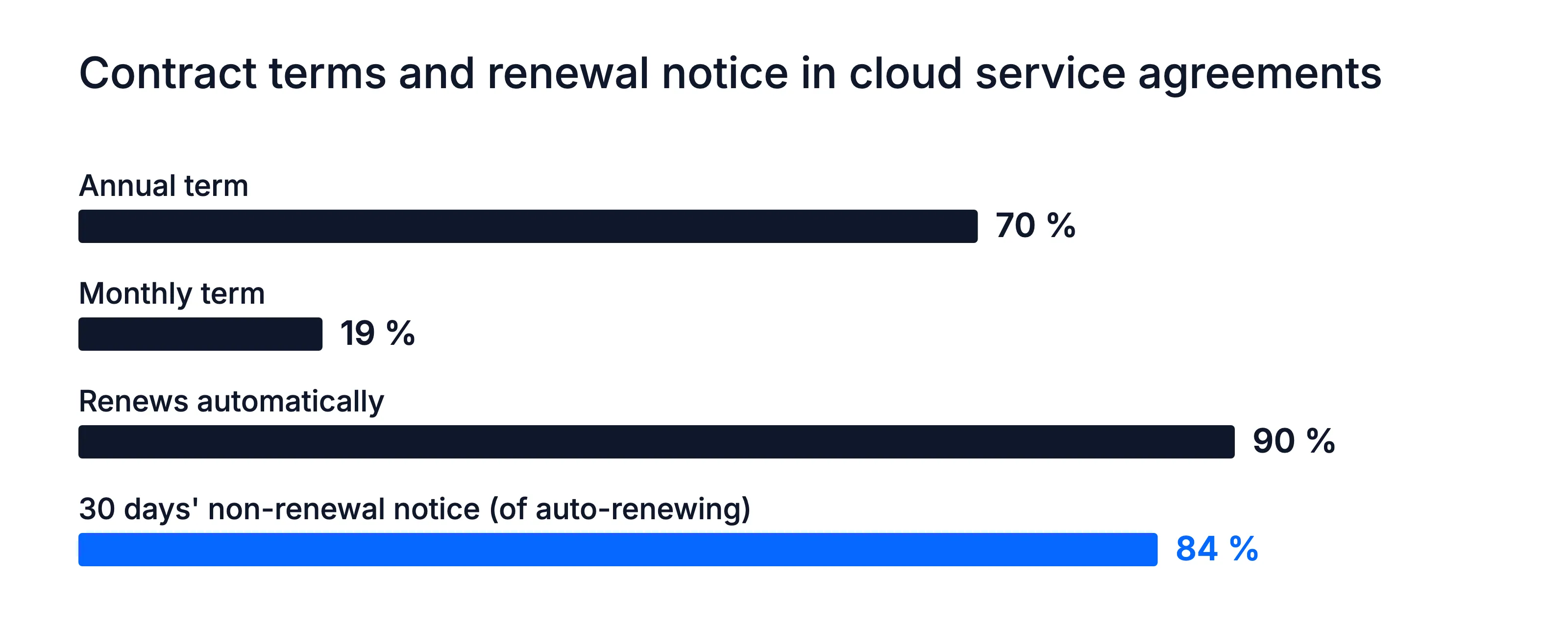
The second question is more useful than “when does it renew?” because the renewal date is rarely the decision date. In Common Paper’s 2024 benchmark of cloud service agreements from more than 1,000 companies, 70% had annual terms, 90% renewed automatically, and 84% of those auto-renewing agreements required 30 days’ notice of non-renewal. The decision to change has to be made before the notice window closes, and that can sit months in front of the date on the contract. The dataset is one platform’s sample rather than a census of every contract, so use it as a reason to ask for the prospect’s dates, not as a rule about theirs.
If there is no gap, no signal and no decision date, close the loop: “Then it sounds like you’re covered. If that changes, I’ll be here.” A disqualified prospect you left on good terms is worth more than a meeting you forced.
Wrong responses to “we already have someone for that”
Each of these fails for the same reason: it moves the call from the prospect’s situation onto the vendor, which is the one subject you cannot win from outside.
| What not to say | Why it fails |
|---|---|
| “Who are you using at the moment?” | Turns the call into a comparison you cannot make from outside, and asks the prospect to justify a decision before they have told you anything about the arrangement. |
| “A lot of people are leaving them for us.” | An unverifiable claim about a vendor you have not even named yet. It also puts the prospect on the side of a provider they were not defending a second ago. |
| “We’re better.” | Better at what? Without a gap to compare against, it is a boast, and the prospect has no reason to believe it. |
| “What are you paying them?” | Asks for the incumbent’s commercial terms before you have earned any interest, and signals that your only argument is price. |
| “What would it take to get you to switch?” | Asks for a replacement inside the first two minutes of a call where the prospect just told you the arrangement works. The honest answer is “nothing,” and you have handed it to them. |
Why you never name the other provider
Our rule for live calls at CallPrompter is simple: name the gap, never the provider. Three reasons, in descending order of how often they apply.
Tactically, naming the provider turns the prospect from someone describing a situation into someone defending a decision they already made, and inertia is already doing enough work for the other side.
Practically, you cannot verify a claim about someone else’s product in the four seconds you have to say it. Improvised competitive claims are where sellers say things they cannot support, and “they’re expensive” and “everyone is switching from them” are the two most common.
Legally, the rule is narrower than “you can’t name competitors,” and it is worth getting right. This is editorial information, not legal advice, and the exact rule depends on the country and sometimes the state.
- United States, federal. The Lanham Act’s false-advertising provision, 15 U.S.C. § 1125(a)(1)(B), reaches false or misleading representations in “commercial advertising or promotion.” In Fashion Boutique of Short Hills v. Fendi USA, the Second Circuit held that a total of 27 oral statements about a competitor’s products, in a marketplace of thousands of customers, were not disseminated widely enough to count. A routine one-to-one call will often fall outside the federal rule. A standardized talk track is different: in Seven-Up v. Coca-Cola, a sales presentation to 11 of 74 targeted bottlers was enough.
- United States, state law. Even where a single call is not federal advertising, a false factual attack on a competitor can still create exposure under state trade-libel or business-disparagement rules, whose elements vary by state. In the Fendi case, the state-law claims went to a jury after the federal claim failed.
- Switzerland. The Federal Act against Unfair Competition treats as unfair the disparagement of a competitor’s goods, services or prices through inaccurate, misleading or unnecessarily injurious statements (Art. 3 para. 1 lit. a), and separately covers inaccurate, misleading or unnecessarily disparaging comparisons (lit. e). The statute speaks of “statements,” not written advertising, so it is broad enough to reach what a rep says on a call. No reported decision squarely tests an ordinary one-to-one cold call, so read this as the scope of the statute rather than settled call-specific precedent.
- European Union. Directive 2006/114/EC permits comparative advertising only when every condition in Article 4 is met: not misleading, like-for-like products, an objective comparison of material, relevant, verifiable and representative features, and no discrediting or denigration of the competitor. The Court of Justice has described the directive’s concept of advertising as particularly broad, and national implementations differ.
- United Kingdom. The Business Protection from Misleading Marketing Regulations 2008 mirror the EU conditions and define advertising as “any form of representation” made in connection with a trade or business. The CAP Code’s denigration rule, which you will see cited for this point, expressly excludes live telephone calls from its scope, so the 2008 Regulations are the relevant reference for call speech.
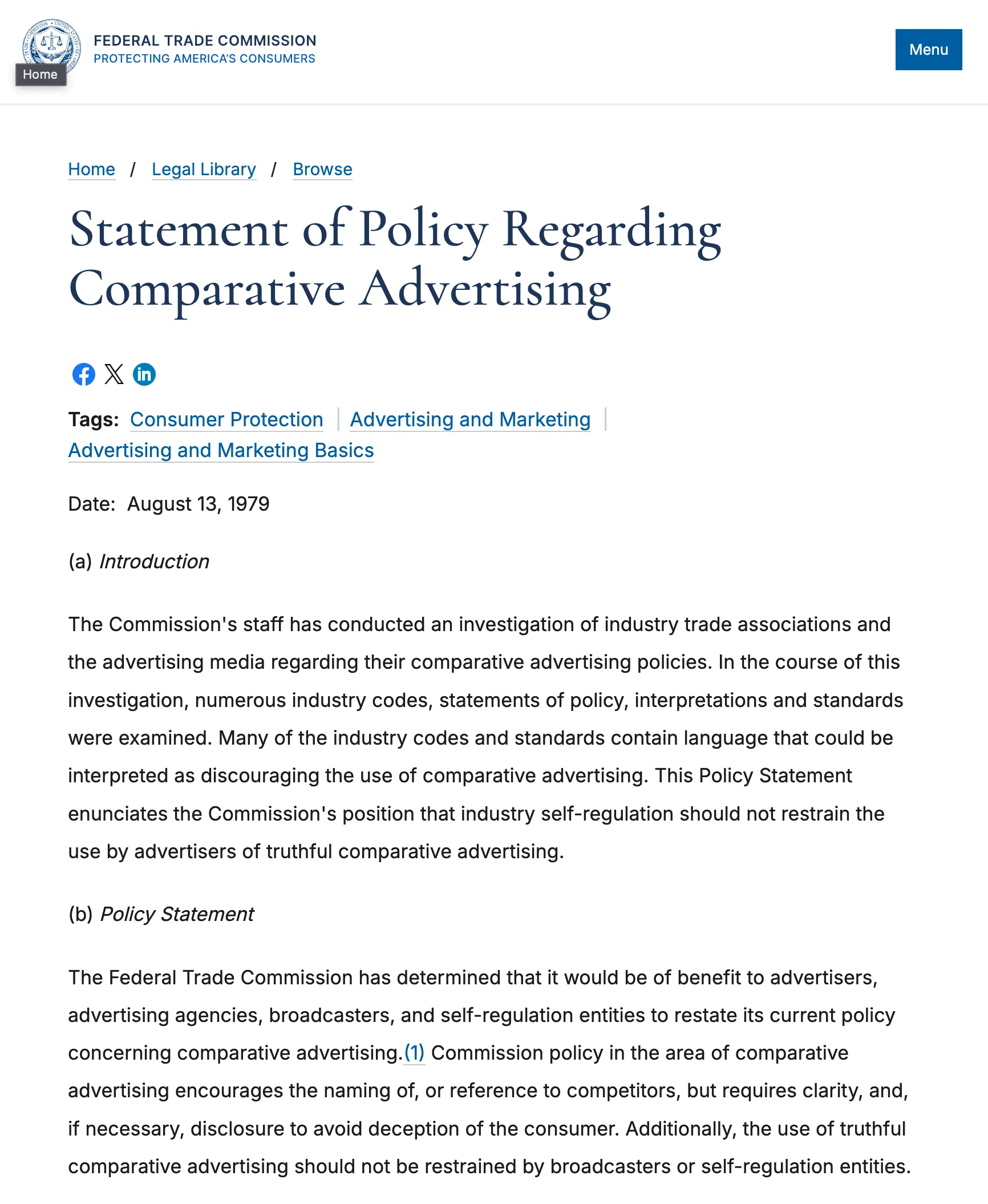
Put together, naming a competitor is not automatically unlawful anywhere on that list. The US Federal Trade Commission actively encourages truthful, non-deceptive comparative advertising, competitors named and all. The exposure concentrates in false, misleading, unverifiable and unnecessarily denigrating claims, and a live call is precisely where those get made. A no-name rule for the first response is a risk-control standard a sales manager can enforce in one sentence, which is why we use one.
If the prospect asks you for a direct comparison later, answer it. Compare documented, like-for-like attributes you can support, or say you will confirm and send it in writing. Never improvise a comparison, and never compare reputations, motives or rumored failures. None of the rules above requires you to refuse a comparison, and a refusal can read as evasion.
The insurance and financial advisory version of the rule
In insurance, the no-naming rule is a compliance point as well as a tactical one. The NAIC’s Unfair Trade Practices Act model, which US states adopt in their own versions, treats as unfair any statement, sales presentation or comparison that misrepresents in order to induce a policyholder to lapse, forfeit, exchange, convert or surrender a policy (§ 4.A(6)). That is the practice commonly called twisting, and improvising about what the prospect’s current policy does or does not do is how a rep walks into it. In the UK, the FCA’s ICOBS 5.2 requires a distributor to identify the customer’s demands and needs from information obtained from the customer before any contract is concluded, and the EU’s Insurance Distribution Directive requires the same. Swiss intermediaries owe clear, comprehensible pre-contract information and conflict management under the revised Insurance Supervision Act, and false or unnecessarily disparaging statements about another insurer fall under the unfair-competition rules above.
The exception runs the other way. Once a conversation becomes a regulated replacement, the process may require the incumbent’s identity: the NAIC’s life insurance and annuities replacement model regulation requires the replacement notice to identify the policy being replaced, including the insurer’s name. You do not need the name to answer the objection. You collect it later, when a legitimate suitability, documentation or compliance step requires it, and not before.
We write by the same rule at CallPrompter. We sell into this market too, and you will not find another product named in our content, including in the comparisons where naming one would make our case faster. In our own category the incumbent is usually a post-call conversation intelligence tool rather than a person, and the honest version of that comparison is about when help arrives, not about whose product is worse.
Drill both branches before a live prospect hears them
The words on this page are easy. The timing is not. Acknowledging takes discipline when your instinct is to argue, the gap question only works if you stop talking after it, and the Branch A exit has to sound like you mean it. Rehearse the opening script and both branches out loud against a simulated buyer before you use them on a call you cannot afford to lose. If you are choosing something to drill against, this is how we would judge an AI roleplay tool.
What this script looks like as a live prompt
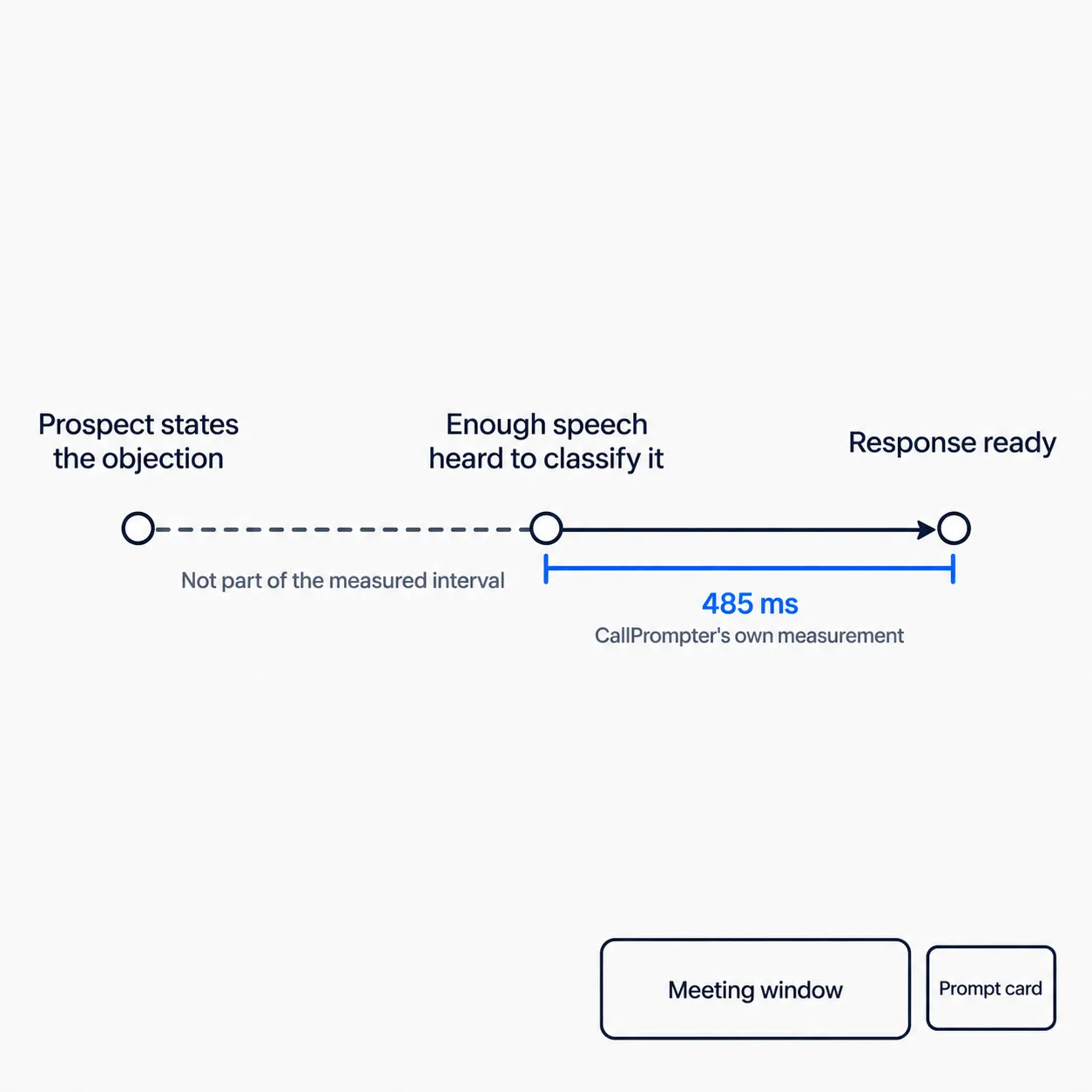
On a live call, all of this has to fit on one card. The desktop app listens to the conversation and matches what the prospect just said against the objection library semantically rather than by keyword, so “we’re already covered,” “we have a tool for that” and “my broker handles it” all resolve to the same entry. When the objection is detected, the response written into the script for it surfaces beside the meeting window. In CallPrompter’s own measurement, 485 milliseconds pass between the model having heard enough of the prospect’s speech to classify the objection and the response being ready.
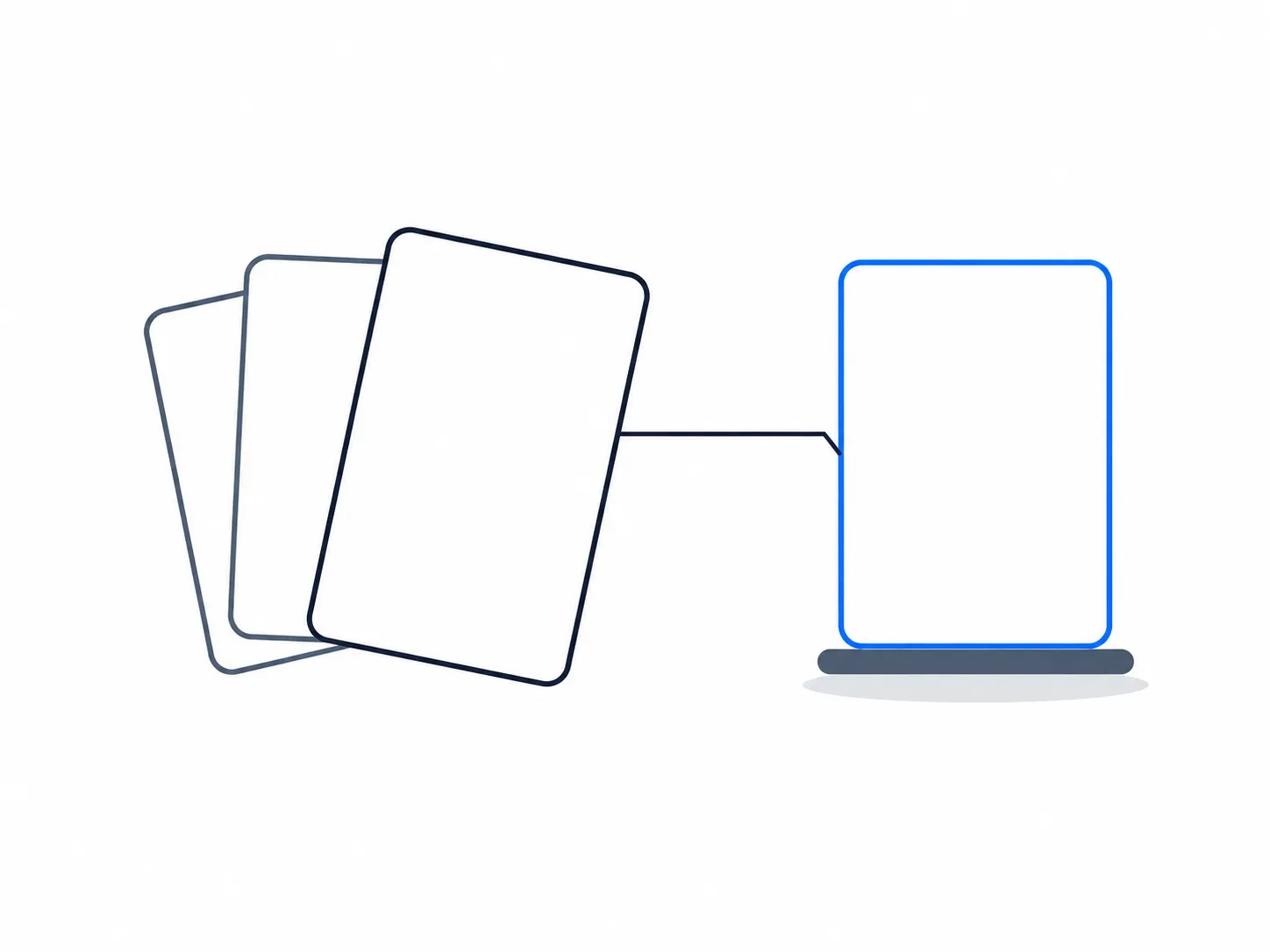
What appears is a short card with the reply and the next question, not the reasoning behind it, because reasoning competes with the words you are speaking. The constraint we design against is how little a seller can absorb mid-call.
Where the product stops: out of the box it transcribes the call and follows where you are in the script. What it says is what you put in it. The four steps on this page only become a prompt once you write them into an objection entry, add the two branches and attach the personas you sell to. The overlay is only ever as good as the script behind it.
Take the script, then practice it
Copy the opening script and both branches into your own objection library today. They are free to use, and there is no signup wall in front of them.
Objection: we already have someone for that

Also sounds like (the library matches by meaning, so these are examples, not a keyword list)
- we're already covered
- we have a tool for that
- my broker handles it
- I already have coverage
- my advisor handles all of it

Step 1. Acknowledge
That makes sense, and I'm not asking you to replace anyone on this call.

Step 2. Ask the gap question, then stop talking
What does the current setup handle well, and where, if anywhere, does it still leave work on your side?

Step 2, alternates. One per call, never all three
- Walk me through how that gets done today, from the moment it comes up to the moment it's finished.
- If you could change one thing about how that works today, without losing what already works, what would it be?

If the prospect volunteers the vendor's name
Understood. What matters most in that setup, and what, if anything, would you change?

Step 3. Listen for four signals
- "It's fine, but..."                  -> Branch B
- a described workaround               -> Branch B
- an answer about someone else         -> Branch B
- the contract renews within a year    -> Branch A becomes a dated check-in
- no signal at all                     -> close the loop

Branch A. The prospect is happy with the current setup
Good, then I won't manufacture a problem. When do you next look at that setup, and by what date would a change have to be decided?

Branch A, insurance and financial advisory
Good, that tells me the core is covered. Does that arrangement handle this specific area too, or is it managed separately?

Branch B. The prospect names a gap
Say more about the part after the but. When that happens, what does it delay, cost or put at risk? That's the one area I'd compare, not the whole relationship.

Step 4. Close on Branch B
Worth twenty minutes on that one piece? I'll show you how we'd handle [the gap, in the prospect's own words], and nothing else has to change.

Step 4. Close on Branch A
When would you have to make a decision to avoid rolling over into another term? I'll call you two weeks before that, and not before.

No gap, no signal, no decision date
Then it sounds like you're covered. If that changes, I'll be here.

If they later ask for a direct comparison
Compare documented, like-for-like attributes you can support, or say you will confirm and send it in writing. Never improvise.

Rule for this entry: name the gap, never the provider.
If you want to drill them before your next dial, practice mode runs the same script the live overlay runs, against a simulated buyer that interrupts and pushes back out loud. CallPrompter’s free trial is seven days with no credit card and includes 30 minutes of practice. Live call coaching sits on the paid plans rather than in the trial, which we would rather say here than have you find out after signing up. Thirty minutes is enough to find out which of the four steps you skip under pressure.
Related posts
How to Choose an AI Sales Roleplay Tool That Actually Simulates Practice

Conversation Intelligence or Live Coaching: Which One Solves My Problem?