
Recruiters practice candidate and client calls with AI roleplay by rehearsing out loud against an AI persona (the candidate or hiring manager the AI plays) that has a goal and keeps something back. Pick one candidate call and one client call you will have again this week, run each one by voice, read the transcript, rewrite the line that failed and run it again against a harder version of the persona. A good first pair is a screening call with a passive candidate and a hiring manager who says “Your fee is too high”.
Which tool to run it in depends on what you need after the rehearsal. If you want the line you drilled on screen when the real candidate or hiring manager pushes back, and you want to start alone this week, we built CallPrompter for that case: its practice mode (AI roleplay by voice) runs on the same scripts and the same on-screen prompts as a live call. If your agency needs scored certification across a cohort of new consultants, a dedicated roleplay platform fits better. For a free first try tonight, a general AI assistant in voice mode will do, as long as the persona brief holds something back. At CallPrompter, we often see practice mode as the reason recruiting and staffing teams buy in the first place.
CallPrompter is real-time sales coaching software for live calls, built in Switzerland by Carigiet Labs GmbH. CallPrompter lets recruiters and staffing agencies rehearse candidate and client calls against an AI persona, then use the same script live. It is not a teleprompter: it follows the conversation by meaning and shows the line that fits what was just said. This guide covers recruiters rehearsing their own calls. AI that interviews, screens or scores candidates is a different category and is not covered here.
Key takeaways
- Rehearse the calls you repeat every week. On the candidate side: the screening call, the salary conversation and the counteroffer. On the client side: the job brief, the fee objection and the business development call.
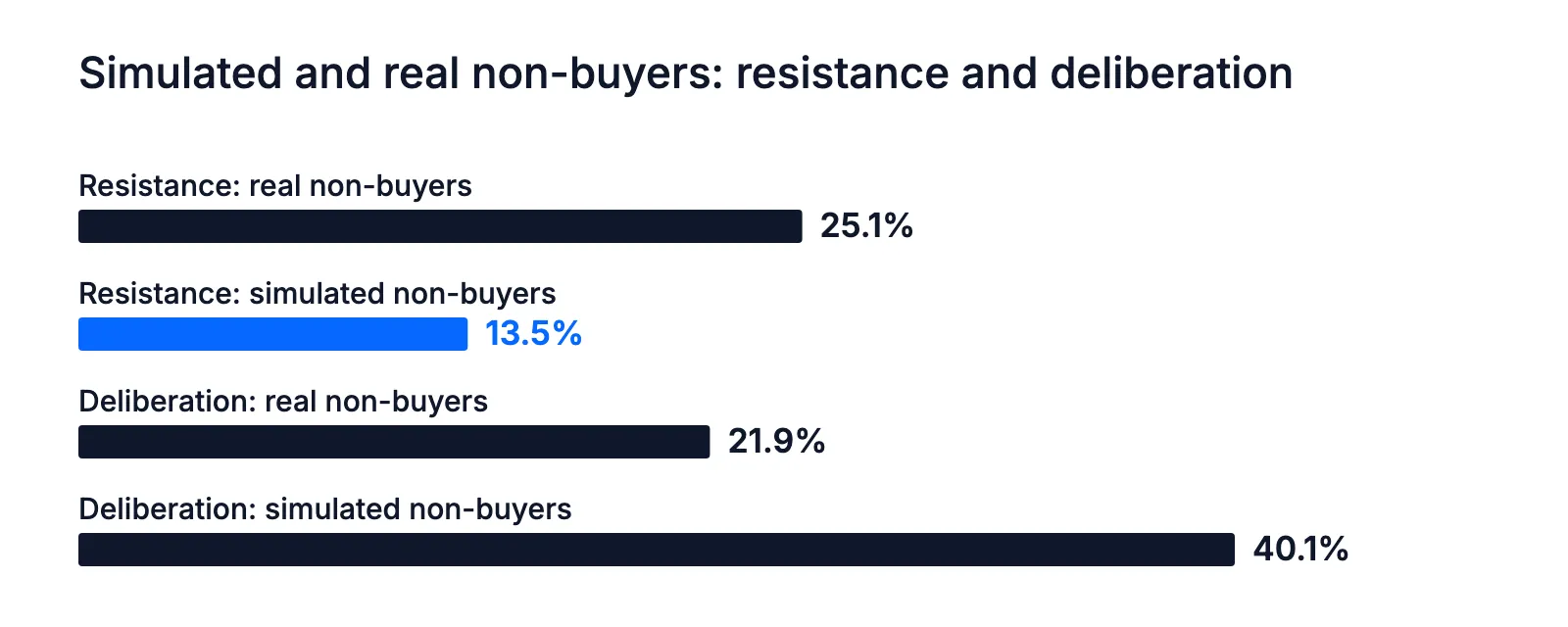
- Write the persona as a goal plus the facts it holds back. Default AI personas are too agreeable: in a June 2026 study against 2,790 real sales conversations, simulated non-buyers expressed resistance about half as often as real ones (13.5% against 25.1%).
- Practice out loud, by voice. Recruiter call time hit a record 286 minutes per week in the first quarter of 2026, and a typed rehearsal skips the interruptions those calls are full of.
- Practice with fictional or anonymized candidates and clients. Real candidate details in an AI tool are personal data under Swiss, EU or UK data protection law, depending on where you and the candidate are.
- CallPrompter has published no figure on how practice changes recruiter call outcomes. Judge any tool on one session against the candidate or hiring manager you speak to most.
AI roleplay tools for recruiters, ranked by tool type
We ranked six types of AI tool on their fit for candidate calls and client calls, for a recruiter who has the same calls every week and wants the rehearsal to show up on the real call. CallPrompter is the one named row. The other rows describe a type of tool as a whole, and products within a type differ.
| Rank and tool type | Candidate-call fit | Client-call fit | Out loud by voice | Your own scripts and personas | Help on the real call | What you get after a run | Who can start |
|---|---|---|---|---|---|---|---|
| 1. Voice roleplay on your own scripts that carries into the live call (CallPrompter) | Strong: your own candidate personas, a voice that interrupts and pushes back | Strong: the same for hiring managers and business development calls, once you write the persona | Yes | Yes, built in chapters (opening, discovery, objections, close); the AI can write a first version | Yes: the same script and prompts on screen during live calls (Starter and Pro) | Full transcript and a replay of the session | One recruiter alone, on a 7-day trial without a credit card |
| 2. Recruiting-specific roleplay and training platforms | Strong: ready-made staffing scenarios such as screening and offer calls | Partial: business development and fee calls depend on the library | Usually | Partial: library scenarios first, custom ones vary | Usually none | Often a score or rubric feedback | Varies: some self-serve, many through a demo |
| 3. Dedicated AI sales roleplay platforms (persona libraries, scored runs, manager reports) | Partial: built around buyers, so candidate personas take custom work | Strong: a business development call is a sales call | Yes | Yes, usually set up by an admin | Usually none in the roleplay product | Scores, rubrics and manager reports | A team rollout, usually after a demo |
| 4. Roleplay modules inside learning or enablement suites (the training software a company already runs) | Partial: generic scenarios unless your learning team builds recruiting ones | Partial: same limit | Varies: text or voice | Through the suite’s authoring tools | None | Completion and scores in the learning record | A company-wide rollout |
| 5. A general AI assistant in voice mode with a roleplay prompt (ChatGPT, Claude, Gemini, Microsoft Copilot) | Partial: drifts toward a cooperative candidate unless the prompt holds facts back | Partial: the same drift on fee pushback | Yes, in voice mode | You paste them into each session | None | Whatever you ask for, plus the chat history | Anyone alone, often on a plan they already have |
| 6. Communication and speaking coaches (pace, clarity, filler words) | Weak: nobody plays the candidate | Weak: nobody plays the client | Yes | No | Rarely, and only on delivery | Pace, clarity and filler-word measures | One person alone |
| Not ranked: roleplay with a senior consultant, no AI | Strong: knows the market and the candidate type | Strong: has heard the fee objection many times | Yes | Yes | No | Their judgment, if they have time to give it | Whoever can free a senior consultant |
Voice ranks above typed practice because a recruiter’s calls are spoken, fast and full of interruptions. We found no peer-reviewed study that compares spoken and typed rehearsal on measured skills; in a small 2025 preprint, 24 psychology students rated a voice avatar higher than a text chatbot on usefulness and perceived skill improvement. Voice AI also now comes close to human actors: in a randomized study of 134 medical residents published in March 2026, a real-time voice AI patient came close to actor-played patients on communication performance and matched them on linguistic realism, while the actors stayed ahead on emotional and contextual realism. Role-play itself has strong support. A 2025 meta-analysis of 12 studies with 907 students found a large overall effect over control-group teaching (effect size 0.818), strongest on skills. None of these studies covers recruiters or measured real calls afterwards, so treat the transfer to your desk as likely, not proven.
The senior consultant stays the reference point. They know the market, and in medical training a trained, realistic counterpart builds more self-confidence than practice with fellow students. The limit is time: few desks can free a senior consultant for every new hire’s fee objection, every week.
Our recommendation by situation
- You want the rehearsed line on screen during the real candidate or client call, and you start alone: CallPrompter. Practice and the live call run on one script.
- Your agency needs scored certification across a cohort of new consultants: a dedicated roleplay platform or a recruiting-specific training platform, rolled out with a demo.
- You want a free first try tonight: a general assistant in voice mode, with the persona brief from the step-by-step section below pasted in.
- You only want to sound calmer and slower: a speaking coach, alongside one of the above.
Who CallPrompter is built for on a recruiting desk, and what it fixes
CallPrompter is built for recruiters who make the same candidate and client pitch dozens of times a day, and for new consultants who are on the phone in week one and need somewhere to be wrong that is not a live candidate or client. It fixes two things. The first is blanking on the moments that repeat: “Your fee is too high”, the counteroffer, “We already work with three agencies”. The second is the gap between the line you rehearsed and the line you remember when the real hiring manager pushes back, because the rehearsed answer is on your screen during the live call.
How it works for a recruiter
- Build the script in chapters (opening, discovery, objections, close) in the web application. Or let the AI script generator write a first version from a description of the role or service you are pitching and the goal of the call, then edit every line.
- Attach a persona for the candidate or the hiring manager: who they are, what they want and what they will not say unless asked.
- Rehearse by voice. The AI persona speaks first, interrupts and pushes back, and the prompts from your script show on screen while you answer out loud.
- Review the run. You get the full transcript and a replay of the session in the app’s History.
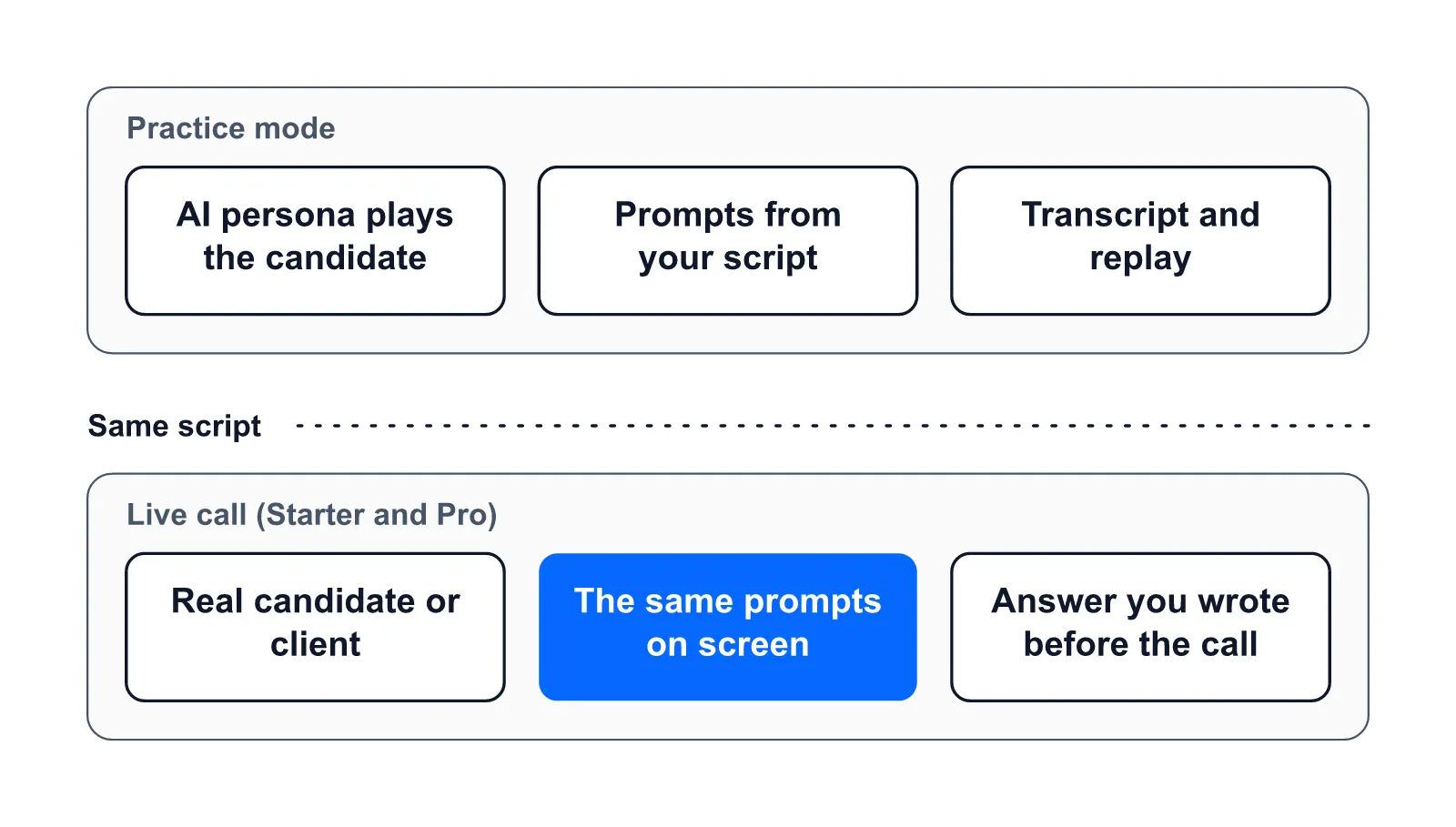
- Take the same script into the live call on Starter or Pro, the plans with live call coaching (your script’s prompts on screen during the real call). The answer on screen is the one you wrote and approved before the call. The AI does not improvise it.
Our founder’s rule of thumb decides which calls to build first: “If you will have roughly the same call fifty more times, rehearsal compounds.” On a recruiting desk that is the screening call, the salary conversation and the fee objection, long before the rare retained search.
For team leads, Pro adds team script sharing, a shared objection library and a manager dashboard. When one consultant finds a better answer to a fee objection, the rewritten answer becomes the answer on every consultant’s screen.
For recruiters who call in a second language, CallPrompter can follow live calls in 90 languages. The app itself is available in English, German and French.
What it costs
As of November 6, 2026, CallPrompter’s prices on callprompter.app, excluding VAT and billed monthly:
| Plan | Price | What practice and coaching it includes |
|---|---|---|
| Free trial | $0 for 7 days, no credit card | Script tools and 30 minutes of AI practice; no live call coaching |
| Starter | $99 / month, one seller | 24 hours of live call coaching or AI practice per month, shared across both, with any number of calls |
| Pro | $249 / seat / month | Unlimited live call coaching and unlimited AI practice, plus team script sharing, the shared objection library and the manager dashboard |
| Enterprise | Custom, from 50 seats | Adds SSO (single sign-on), dedicated onboarding and an uptime SLA (a contractual uptime commitment) |
What we have not measured
CallPrompter has published no figure on how practice changes recruiter call outcomes: no ramp time, no placement rate and no count of practice sessions by recruiting teams. We would rather say that than borrow a number from another industry. Judge it on one practice session against the candidate or hiring manager you speak to most.
Where it falls short
- The persona and the script are yours to write. Installing CallPrompter takes a minute, but expect the better part of an hour on your first script and persona before the first practice call, or let the AI write a first version and edit it.
- Live call coaching is not in the trial. The trial covers script tools and 30 minutes of practice; live coaching starts on Starter.
- It is a desktop app for macOS 14 or later and Windows 10 or later. It does not run in a browser tab.
- Call audio leaves Switzerland during a session. Real-time transcription runs through a provider in the United States, even though stored data sits on servers in Switzerland.
How to run a recruiter practice session, step by step
- Pick one call you will have again this week. A screening call for the senior engineer role you are working, or the business development call to a logistics firm you plan to ring on Thursday.
- Write the persona as goals and held-back facts, not adjectives. Our founder puts it this way: “‘Skeptical, analytical, direct’ reads like a character brief and changes nothing: the agent has no way to act on an adjective.” Write what the candidate wants, what they will not say unless asked and how the call ends.
- Write the lines you want to say, including your answer to the objection you keep losing.
- Run the call out loud. No typing. Let the persona interrupt you.
- Read the transcript. Find the moment the call turned, usually the first objection or the first question about money.
- Rewrite the line that failed. One line, not the whole script.
- Run a harder version. A rushed hiring manager with four minutes, or a candidate who already holds a second offer.
- Take the script into the live call, with the rewritten line in it.
A persona brief you can copy
This is an illustration for a permanent tech recruiting desk. Paste it into your roleplay tool as the persona’s instructions.
Who you are: Daniel, a senior software engineer at a mid-sized fintech. You are not looking for a new job. You took this call because the recruiter's message mentioned remote work.

What you want: a lead role with less on-call duty. Say this only if the recruiter asks what would make a move worth it.

What you keep back: you have a second offer from another company, and you have to decide within 10 days. Mention it only when the recruiter asks about your timing or other processes. If the recruiter asks about salary before anything else, give a wide range and ask why they need it now.

How you behave: answer in short sentences. Say "I'm happy where I am" in your first answer. Interrupt once if the recruiter pitches the role for more than 30 seconds.

How the call ends: agree to a second call only if the recruiter has asked about your timing and proposed a concrete next step. Otherwise say "Just email me the details" and end the call.
The held-back facts matter more than any other line in the brief. A June 2026 study that compared AI-simulated customers with 2,790 real sales conversations found the simulated non-buyers expressed resistance about half as often as real ones (13.5% against 25.1%) and deliberated almost twice as often (40.1% against 21.9%). In the author’s words: “Real non-buyers say ‘not now’ and stop; simulated non-buyers ask about price.” On a recruiting desk, “I’m happy where I am” and “Just send me some CVs” are exactly those brush-offs, and a persona that never uses them trains you for a softer call than the one you will get. The study is a preprint (not yet peer-reviewed) from one sales platform, but it matches what anyone who has tried a default persona notices in the first minute.
A weekly routine for team leads
- One candidate scenario and one client scenario per consultant each week, chosen from the calls that consultant lost recently.
- New consultants rehearse a business development call against a persona before their first live one.
- When a consultant rewrites a line that works, it goes into the shared script so the next new hire starts with it.
Writing for Staffing Industry Analysts in June 2026, Dexian CEO Maruf Ahmed warned that, if leaders are not careful, AI will remove “some of the early repetitions that once built strong recruiting judgment”. A practice routine puts those repetitions back on purpose, without a live candidate or client paying for the mistakes.
Candidate calls to practice with an AI persona
Recruiters spend more of their week on these calls than ever. Data from the American Staffing Association shows recruiter call time reached 286 minutes per week in the first quarter of 2026, the highest on record and double the level of the first quarter of 2024, with interactions with candidates and clients up 60% year on year. The figures come from users of the Prodoscore platform, not from a random sample of staffing firms.
Every scenario below is an illustration, spread across permanent tech recruiting, temp staffing and healthcare staffing desks.
| Candidate call | What the AI persona plays | What it keeps back | What the recruiter has to get |
|---|---|---|---|
| Candidate screening call for a senior software engineer (perm tech recruiting) | A candidate who answers politely and briefly | Why they would move at all | The real reason to move, in the candidate’s words |
| Approaching a passive candidate, a senior engineer on LinkedIn (perm tech recruiting) | Someone “happy where I am” who took the call out of curiosity | The one thing their current job lacks | Permission for a second, longer call |
| Salary expectations and salary negotiation for a contract forklift operator (temp staffing) | A worker who asks for a rate above the client’s budget | That a nearer site pays less but saves an hour of commuting | A rate and a start date both sides can sign |
| The counteroffer conversation with a senior engineer after resignation (perm tech recruiting) | A candidate who says “I’ll wait to see what my employer offers” | The counteroffer amount, until asked directly | Whether the original reasons to move still stand |
| The offer call to a registered nurse for a 13-week contract (healthcare staffing) | A candidate pleased with the rate who hesitates on the shift pattern | A second agency’s offer for the same hospital | A yes, a no, or a dated decision, never “let me think” |
| The rejection or feedback call to a shortlisted engineer the client turned down (perm tech recruiting) | A disappointed candidate who asks why | Whether they will still take your calls | Honest feedback and a reason to stay in touch |
The counteroffer call is worth extra runs because it decides whether a placement holds. The most defensible figure comes from CEB (now part of Gartner), reported by Harvard Business Review in 2016: 50% of employees who accept a counteroffer leave within 12 months. The sample and method sit in a CEB white paper, not in the article. The “80% leave within six months” line repeated on many agency blogs has no primary source we could find, so leave it out of your script.
The rejection call needs the most careful persona. Wharton researchers found that AI plays some roleplay scenarios well, such as pitching or negotiating, and struggles with difficult conversations and conflict. Write the candidate’s disappointment into the brief as a goal (“you want to know what you did wrong”) rather than hoping the persona finds it.
Client calls to practice with an AI persona
| Client call | What the AI persona plays | What it keeps back | What the recruiter has to get |
|---|---|---|---|
| Business development call to a warehouse operations manager who already works with three agencies (temp staffing) | A busy manager who says “Just send me some CVs” | That none of the three filled last month’s night shift | A real vacancy and a time to discuss it |
| Job brief or vacancy intake for a “full-stack engineer who also does DevOps” (perm tech recruiting) | A hiring manager with a long wish list | The two skills that actually decide the hire | A brief with must-haves, budget and interview steps |
| The fee objection from a hiring manager at a software company (perm tech recruiting) | A client who says “Your fee is too high” | What a bad hire or an empty seat cost them last time | Agreement on value before any talk of discount |
| Exclusivity or retained terms for a hard-to-fill engineering lead (perm tech recruiting) | A client who wants to keep four agencies on the role | That the role has been open for five months | A trial period of exclusivity with a review date |
| The shortlist call where the client questions a candidate (perm tech recruiting) | A hiring manager who doubts a candidate’s job changes | What exactly worries them | The concern in writing and a way to test it in interview |
| The unrealistic timeline: eight agency nurses for a ward from next Monday (healthcare staffing) | A ward manager under pressure | That four shifts could move by a week | A split plan with dates the agency can keep |
| The account review with an unhappy client after two early leavers (temp staffing) | A client who opens with “We’re thinking of moving the account” | Which part of the service actually failed | One fixable cause and a dated follow-up |
“Just send me some CVs” deserves a scripted answer of its own, because it ends a business development call politely before anyone has talked about a vacancy. In the practice run, aim for one question that keeps the hiring manager talking about the role they need to fill. The fee objection works the same way: rehearse until the first thing you say to “Your fee is too high” is a question about the cost of the empty seat, and only then talk terms.
What to check before you pick an AI roleplay tool
- Practice by voice, not chat. Your calls are spoken, and a typed rehearsal skips interruptions and silences.
- A persona that holds its goal when you go off-script, and that can say “not now” and mean it.
- Interrupting and being interrupted. A real hiring manager talks over you; the persona should too.
- Your own scripts and scenarios for your desk, not only a generic library.
- Feedback that changes the next run: a transcript you can read, a replay, or a score, as long as it shows you which line to rewrite.
- The languages your desk calls in, for the calls and for the app itself.
- Who can start: one recruiter alone tonight, or a team rollout after a demo.
- What the trial covers, and whether it includes live calls or only practice.
- What happens to candidate and client data, below.
What happens to candidate and client data in practice
Practice with fictional or anonymized candidates and clients. A real candidate’s CV, salary or counteroffer details typed into an AI tool are personal data, and the rules depend on whose data it is and where you work:
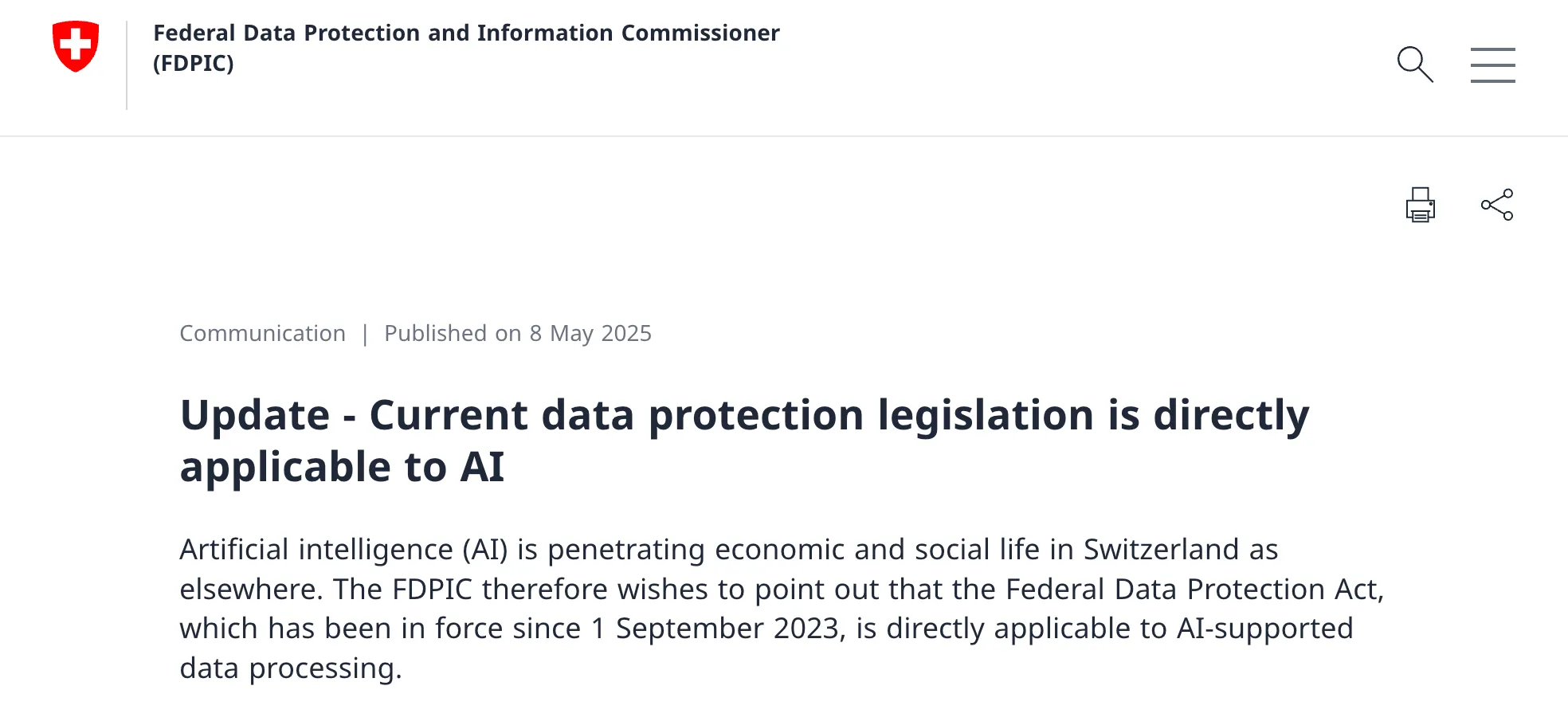
- Switzerland: the Federal Data Protection and Information Commissioner states that the Federal Act on Data Protection (FADP) applies directly to AI-supported processing, in force since September 1, 2023.
- United Kingdom: for organizations processing UK residents’ data, the Information Commissioner’s Office says there is no “AI exemption” to data protection law. Removing the name is not enough when salary, employer and role still point to one person.
- European Union: where the GDPR applies, its rules on lawful basis, purpose limitation and data minimization cover candidate and client data you enter into any AI tool.
CallPrompter’s own setup is one worked example of what to ask a vendor. CallPrompter asks for consent before it captures any audio and shows an indicator while transcription runs. No audio files are kept. Names, company names and other identifiers are removed before transcript text reaches an AI provider, and stored data sits on servers in Switzerland. Real-time transcription runs through a provider in the United States, so audio leaves Switzerland during a session. Ask every vendor on your shortlist the same questions.
For agencies in the EU, two AI Act rules are worth knowing. The EU AI Act treats as high-risk (subject to its strictest obligations) any AI “intended to be used for the recruitment or selection of natural persons”, for example to filter applications or evaluate candidates (Annex III, point 4(a)); those obligations apply from December 2, 2027. A tool where a recruiter rehearses against a fictional persona does not recruit, filter or evaluate anyone, so on our reading it falls outside that wording. The European Commission’s published examples do not address recruiter-training tools either way. Team leads should note that point 4(b) covers AI used to “monitor and evaluate the performance and behaviour” of workers, so practice scores used to rate consultants deserve a second look. Separately, since February 2, 2025 the AI Act has prohibited AI that infers a person’s emotions in the workplace (Article 5(1)(f)). A practice tool that rates your “confidence” from your voice sits near that line; one that shows you what was said does not.
From practice to the live call: do you have to tell the candidate?
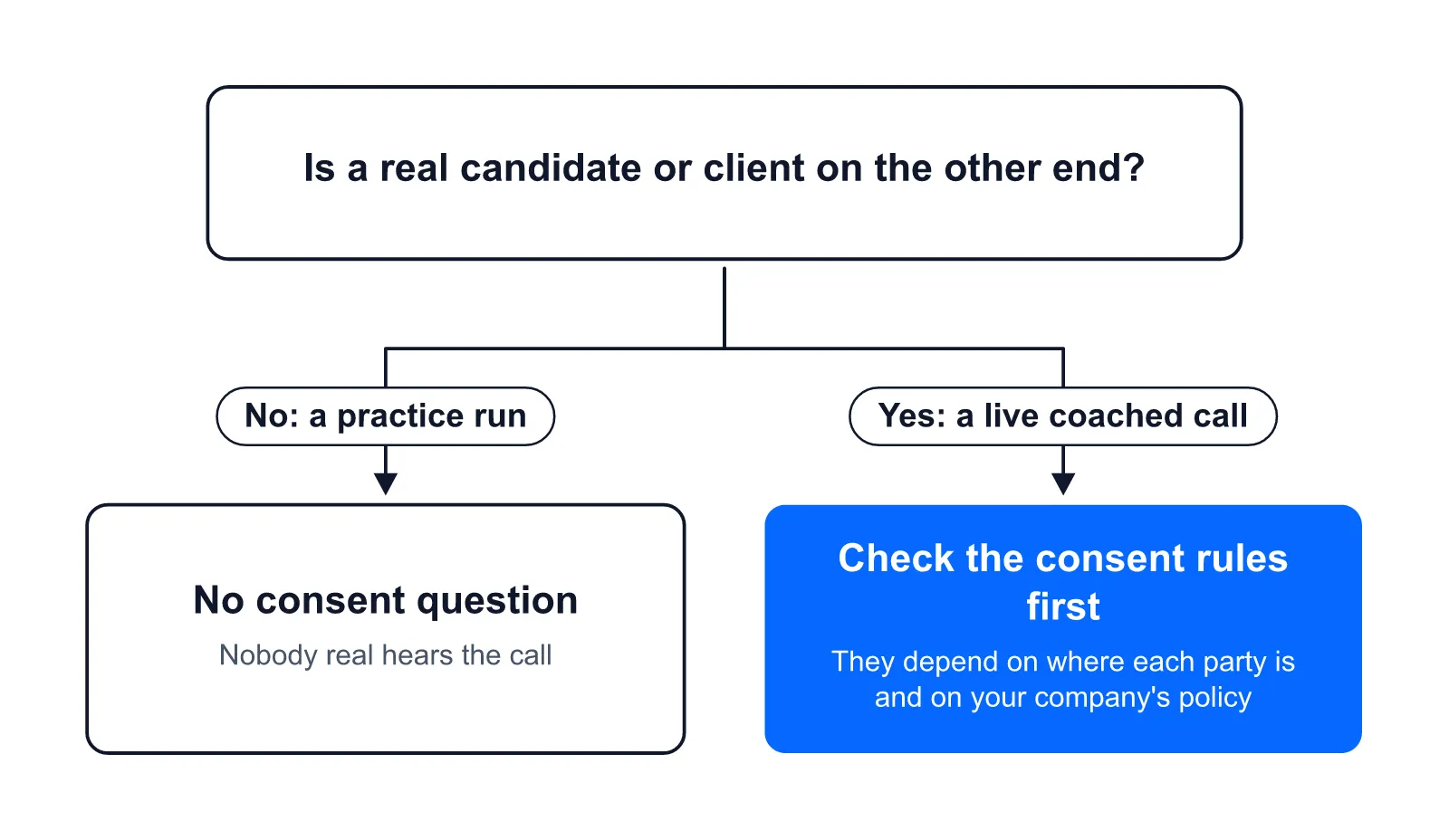
Practice on a script raises no consent question, because nobody real is on the other end. The live call is different. When the rehearsed script goes onto a real candidate or client call with coaching running, whether you have to tell the other side that their voice is transcribed depends on where each party is and on your company’s policy:
- Switzerland: recording a non-public conversation generally needs every participant’s consent. Recording it as a participant without the others’ permission is a criminal offense under the Swiss Criminal Code (Article 179ter).
- United States: federal law allows one-party consent (only one person on the call has to agree), while several states, California among them, require the consent of all parties.
Nothing in a CallPrompter call tells the candidate or client that coaching is running. Check with your own counsel before your first coached live call, especially when you call candidates in another country or state.
Frequently asked questions
Can an AI persona play a candidate who is weighing a counteroffer?
Yes, if you write the counteroffer into the persona as a held-back fact. Tell the persona to mention the counteroffer only when asked about timing, and to say “I’ll wait to see what my employer offers” when pushed for a decision.
Is it safe to use real candidate data in an AI roleplay tool?
Use fictional or anonymized candidates instead. Real CVs, salaries and offer details are personal data under the Swiss FADP, the GDPR or UK GDPR, depending on where you and the candidate are, and removing the name alone may not make a candidate unidentifiable.
Can I practice in CallPrompter for free?
Yes. The 7-day CallPrompter trial costs USD 0, needs no credit card and includes the script tools and 30 minutes of AI practice. Live call coaching starts on Starter at USD 99 per month (as of November 6, 2026).
Does CallPrompter work for recruiters who call in German or French?
CallPrompter can follow live calls in 90 languages, and the app itself is available in English, German and French. Write the script and the persona in the language you will call in.
Try for free. No credit card needed.
Run one practice session against the candidate or hiring manager you speak to most. The 7-day trial gives you the script tools and 30 minutes of AI practice: enough to build the fee objection you keep losing, rehearse it out loud and rewrite the line that failed. When the line holds, the same script goes with you into live calls on Starter or Pro.
Questions before you download? Send a message through the contact page and the founder will get back to you.
Related posts
How to Write a Buyer Persona an AI Roleplay Partner Can Actually Play
How to Choose an AI Sales Roleplay Tool That Actually Simulates Practice