A B2B sales team in Zurich, or anywhere else in Switzerland, that wants help during the call should shortlist tools that put prompts on the rep’s own screen while the prospect is still talking. Then test eight things before you sign: help during the call, the calls your team actually makes, Swiss German and your other call languages, where data is stored and where audio is processed, the prospect’s consent, who may open your reps’ transcripts, whose words appear on screen, and the real price and proof.
At CallPrompter we build one of these live-coaching tools, so we put our own product through the same eight checks, including the calls where it is the wrong pick.
CallPrompter is real-time sales coaching software for live calls, built in Switzerland by Carigiet Labs GmbH. CallPrompter shows B2B sellers and sales teams the next question and their own scripted objection answers during Zoom, Teams and phone calls.
Key takeaways
- Most tools sold as sales coaching analyze the call afterwards. Ask the vendor to show you a prompt landing on a live call.
- Test on the calls your team really makes: Microsoft Teams now holds detected third-party meeting bots in the lobby by default.
- Test Swiss German on its own. In 2024, 61% of employed people in Switzerland usually spoke Swiss German at work, and speech recognition does markedly worse on spontaneous dialect than on read sentences.
- “Stored in Switzerland” and “processed in Switzerland” are two different claims. Live transcription and stored data can sit in different countries.
- Recording a non-public conversation without every participant’s consent is an offence under the Swiss Criminal Code, and the Federal Data Protection and Information Commissioner (FDPIC) says the business-call exception does not cover complex contract negotiations.
- A manager opening a rep’s call transcript is workplace monitoring. Give your reps the access rule in writing before the pilot starts.
- Answers your team wrote and approved before the call suit required disclosures and price lines better than text a model improvises while the prospect is talking.
- Ask every vendor for an outcome figure with the number of reps, the period and the method. CallPrompter has published none.
Which kind of sales coaching software helps during the call?
Five kinds of tools are sold under the sales coaching label, and only two of them put anything on the rep’s screen while the call is running. The table compares them by type, with our own tool as the one named row, because the type decides what a tool can do during the call long before any feature list does.
| Tool type | What it does during the call | What it does after the call | Data and consent questions to ask | Price questions to ask |
|---|---|---|---|---|
| Live in-call coaching on the rep’s screen (for example CallPrompter) | Shows the next question, the scripted answer to an objection and direction cues (where to steer the call next) while the prospect is talking | Keeps the call transcript for review | Where is live audio processed, and where are transcripts stored? Does anything in the call tell the prospect? | Per seat or per team? Ours: from USD 99 per month, excluding VAT, as of November 10, 2026 (check 8) |
| Live guidance inside a dialer, sales-engagement or contact-center platform | Shows guidance on calls placed through that platform | Keeps call records inside that platform | Does guidance work on calls outside the platform? Where is audio processed? | Is guidance an add-on to the platform licence? |
| Post-call conversation intelligence and meeting notetakers | Records the call, often through a bot that joins the meeting; some add live prompt cards | Transcripts, call review and analysis, usually for managers | Where are recordings kept, and for how long? Does the bot appear in the participant list? | Minimum seats, annual term, recording storage |
| General AI meeting copilots | Answers questions or drafts notes when the user asks, without a sales script behind it | Summaries and notes | Which AI provider receives the audio or text? | Bundled with an office suite or sold per user? |
| AI roleplay and practice platforms | Nothing: they work before the call, against a simulated buyer | Practice transcripts and feedback | Where are practice recordings stored? | Per user, often with practice-hour limits |
If you are still deciding between analysis afterwards and help during the call, our comparison of conversation intelligence and live coaching walks through that choice. Many teams run a notetaker and a live-coaching tool side by side: the notetaker keeps the record, the live tool helps the rep on the call.
8 checks before a B2B sales team in Switzerland buys
Each check ends with the question to send the vendor and a way to test the answer on your own calls.
1. Does it help during the call, or only after it?
Help that arrives after the call tells you what happened. Help that arrives during the call changes what happens. Plenty of tools say “real-time” when they mean a transcript scrolling past live, which is a long way from a prompt that tells the rep what to say next.
Speed sets the limit. Across ten languages, the most common gap between a question and its answer is 0 to 200 milliseconds (Stivers et al., PNAS 2009). Every live prompt arrives after that gap, so it helps with the next question or the prepared answer, never with the rep’s first reflexive word. Our figure is 485 ms from objection to response on screen, in CallPrompter’s own measurement.
- Ask the vendor: “Show me a prompt appearing on a live call when the prospect raises a price objection.”
- Test it: on your own calls, time how long the prompt takes from the end of the objection to the screen, and note whether the rep could still use it.
2. Does it work on the calls your team makes?
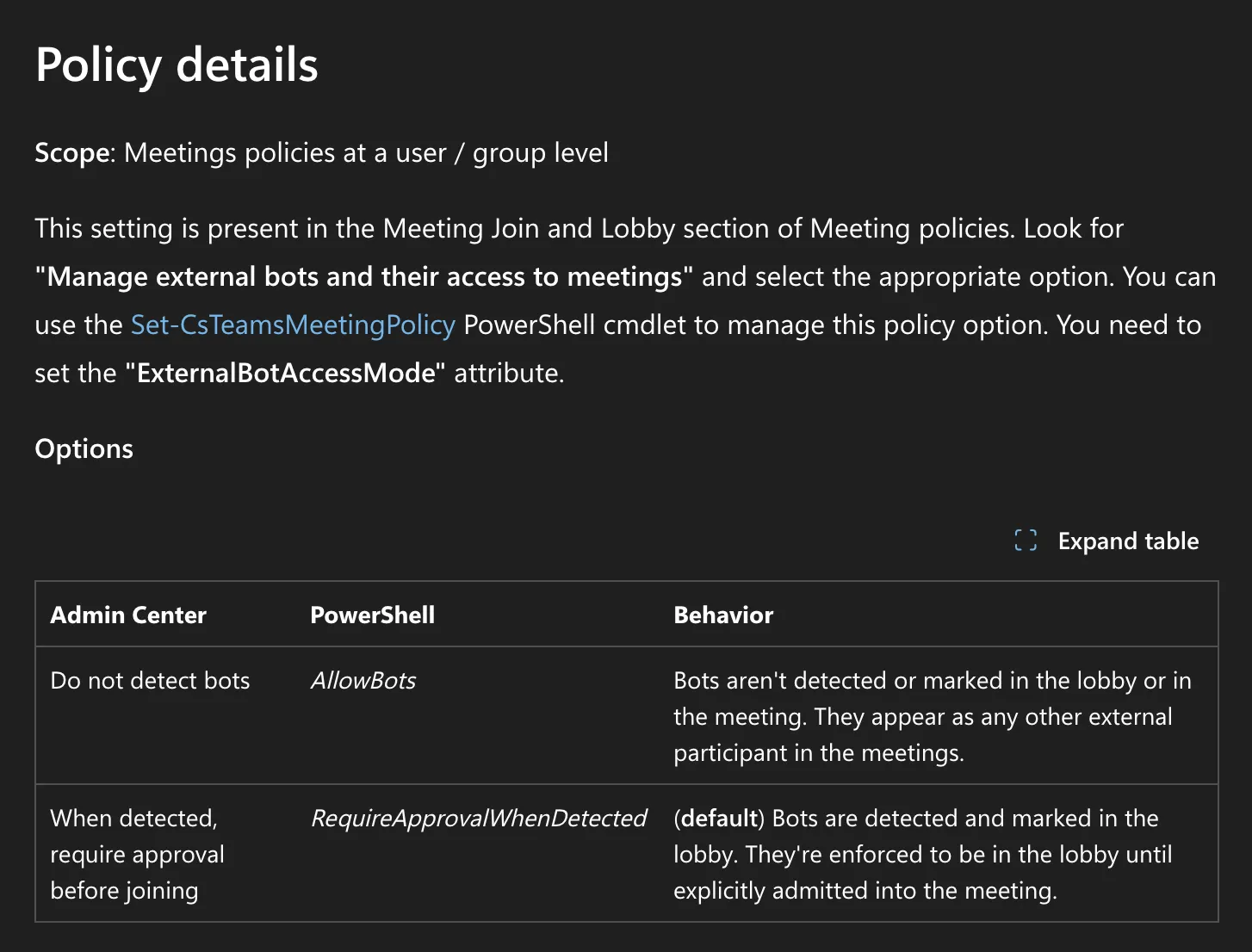
List your team’s call setups before the demo: Zoom, Microsoft Teams, Google Meet, a softphone (a calling app on the computer), a browser or CRM dialer for your SDRs and BDRs (the reps who prospect and book first meetings), and mobile calls. Then ask whether the tool joins the meeting as a bot. Microsoft’s admin documentation for the Teams policy “Manage external bots and their access to meetings” places detected bots in the meeting lobby by default, whatever the meeting’s lobby setting. A bot that Teams detects then waits in the lobby until the organizer admits it, and when the prospect hosts the meeting, the prospect decides whether it joins.
CallPrompter captures the sound the computer plays and the rep’s microphone in a desktop app for macOS 14+ and Windows 10+, so nothing joins the call as a bot. That covers Zoom, Teams, Google Meet, softphones, browser and CRM dialers, and mobile calls answered on the computer; our page on coaching on phone calls lists each setup. We do not write calls back into a CRM. A Chrome extension pulls a contact from LinkedIn, Salesforce, HubSpot or Pipedrive into the app, and custom integrations are an Enterprise item.
- Ask the vendor: “Does anything join the meeting or appear in the participant list, and what does the tool read from and write to our CRM?”
- Test it: one call on each setup your team uses, including a Teams call with an external prospect.
3. Does it understand Swiss German, Standard German, French and English?
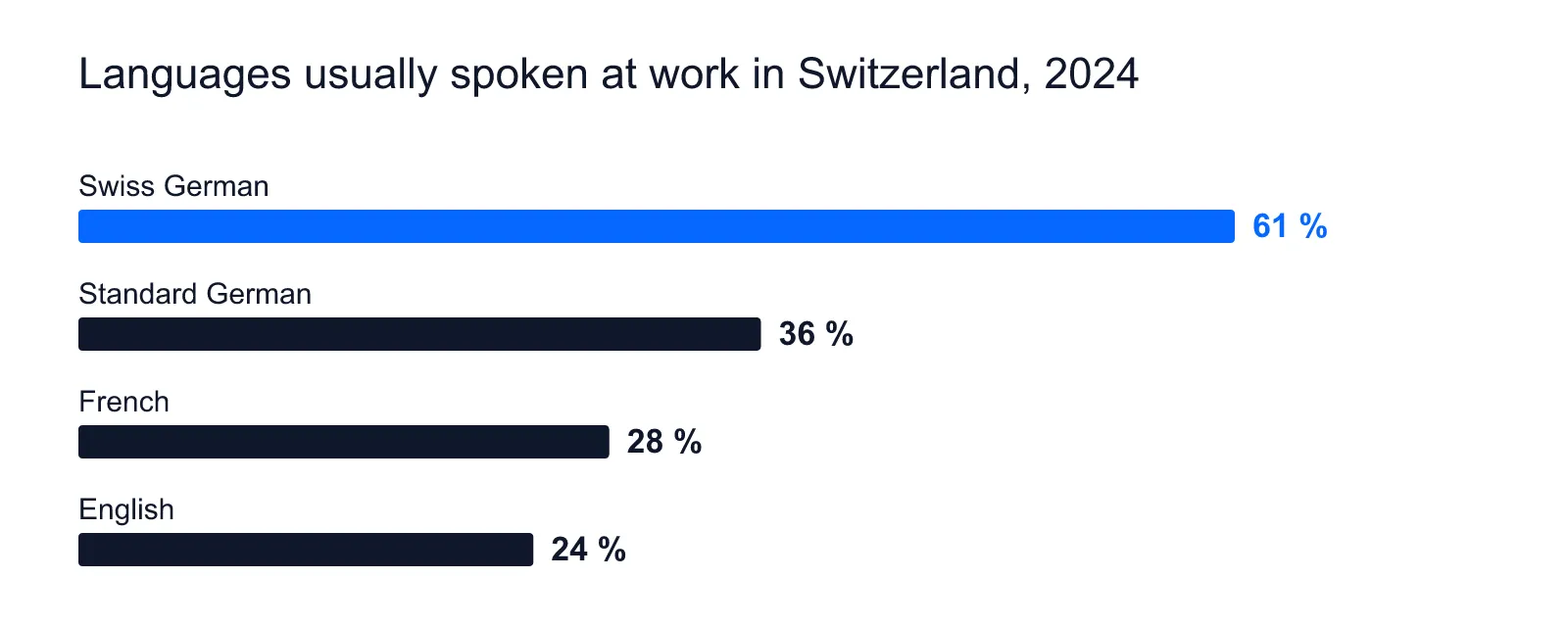
A Zurich sales team rarely sells in one language. In 2024, 61% of employed people in Switzerland usually spoke Swiss German at work, 36% Standard German, 28% French and 24% English, and 28% usually used several languages (Federal Statistical Office). A discovery call that starts in dialect and ends in English is an ordinary Tuesday for a Zurich team.
Swiss German is hard for speech recognition. It has no standard spelling, so systems turn dialect speech into Standard German text, which makes every transcript a small translation job. Word error rate (the share of words the system gets wrong) shows the gap: a research baseline scored 14.0 on read sentences from all seven dialect regions (Plüss et al., ACL 2023), while a model trained on that read speech scored 44.4 on spontaneous radio and TV speech, and the best model with broadcast training scored 17.1 (arXiv 2506.08836). A demo in Standard German proves little about your calls.
CallPrompter follows live calls in 90 languages, and the app itself is available in English, German and French. Run the dialect test on our tool exactly as on any other.
- Ask the vendor: “Which of our call languages, Swiss German dialect included, does live coaching support, and on what test?”
- Test it: real calls in Zurich dialect, Standard German, English and French, plus calls that switch language mid-call. Judge three things separately: did it transcribe the words, did it detect the objection, and was the prompt right.
4. Where is data stored, and where is audio processed?
Storage and processing are two locations, and a vendor can answer one while you hear the other. Ask for both, plus the list of subprocessors (the other companies that handle the data), where support staff access the data from, and the legal basis for each transfer abroad. The Swiss data protection commissioners’ association privatim, in cloud guidance written for public bodies, treats access from abroad to data stored in Switzerland, for example for support, as a transfer abroad (privatim cloud guidance). For a US provider, ask whether it is certified under the Swiss-US Data Privacy Framework, in force since September 15, 2024 for certified US companies only (FDPIC); without certification, ask for the contractual safeguards.
As of November 2026, CallPrompter stores transcripts, scripts, customer records and account data on servers in Switzerland. Real-time transcription is processed by a provider based in the United States, so call audio leaves Switzerland while the call is running. No audio file is kept. Before transcript text reaches an AI provider, we remove names, company names and other identifiers. Our privacy policy is the source for these statements. We also state that no model is trained on customer audio or transcripts.
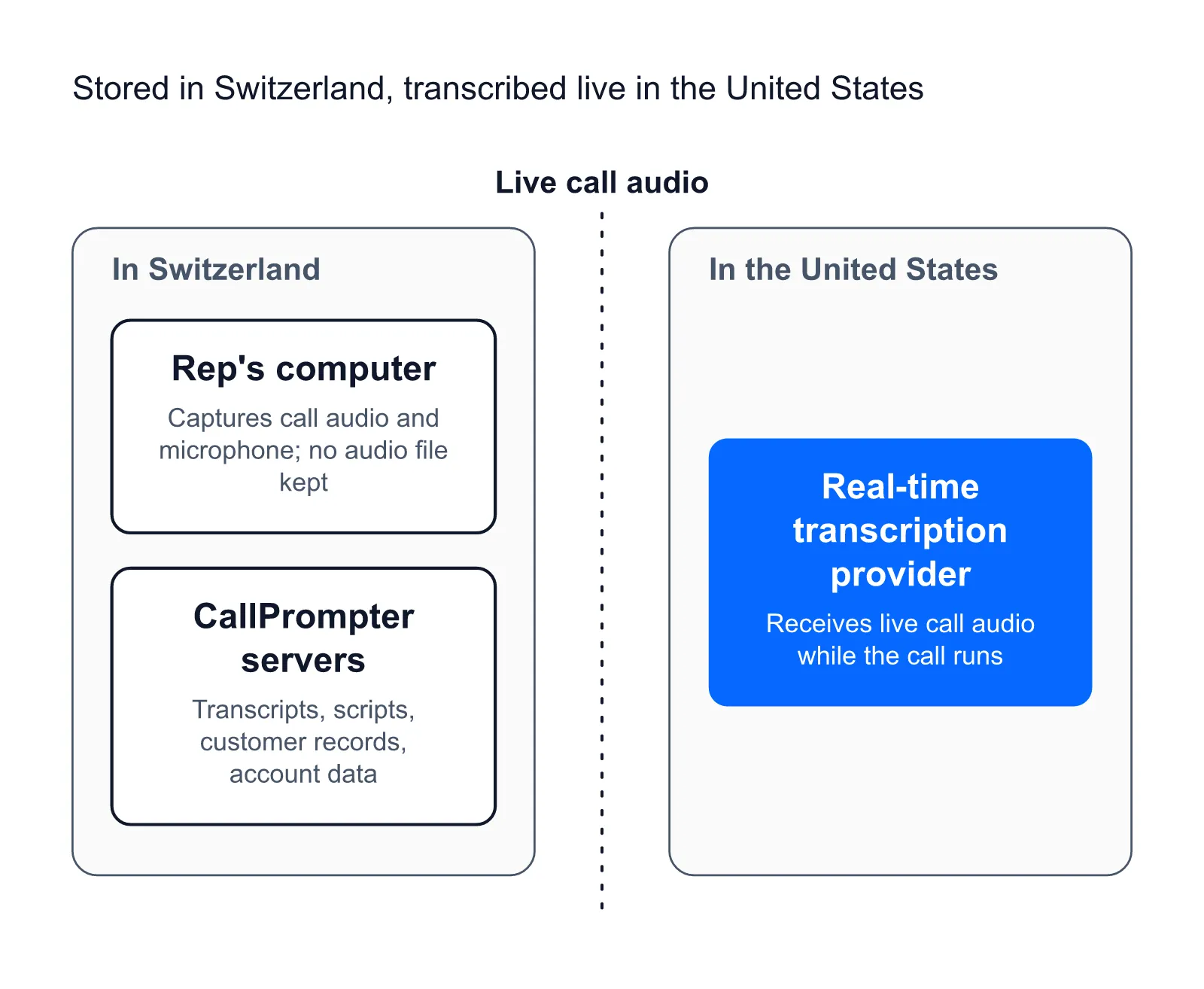
Swiss storage is not EU storage. Switzerland is outside the EU, and the European Commission confirmed on January 15, 2024 that it still provides an adequate level of protection for data transferred from the EU (EUR-Lex, COM/2024/7). If your policy asks for EU residency, Swiss hosting does not meet it on its own.
- Ask the vendor: “Where is data stored, where is live audio processed, who are your subprocessors, and what is the transfer basis for each?”
- Test it: get the subprocessor list and the data processing agreement in writing before the pilot, not after.
5. How does the prospect learn that the call is transcribed?
Ask what the tool shows or announces to the prospect, and what the rep has to say. A bot in the participant list is at least a visible signal. A tool that captures audio on the rep’s computer gives the prospect none. Under the Swiss Federal Act on Data Protection (FADP), the company that collects the data has to inform the person “in an appropriate manner” and, when the data goes abroad, name the country it goes to (Art. 19 FADP).
CallPrompter asks the rep for explicit consent before it captures any audio and shows an indicator while transcription runs. Nothing in the call tells the prospect, so telling them is the seller’s job. The consent section below sets out what Swiss law says.
- Ask the vendor: “What does the prospect see or hear, and what wording do you give customers for the call opener and the meeting invite?”
- Test it: write your team’s consent sentence for the invite and the first minute of the call, and use it on every pilot call.
6. What can managers see, and who opens a transcript?
Coaching your own reps through their call transcripts is workplace monitoring, and Swiss law treats it as its own question (see the consent section). The FDPIC’s guidance tells employers to inform employees clearly and in advance about the system, who listens, access rights, content and retention, and to put the rules in writing.
At CallPrompter, the rep who made the call can open its transcript. On Pro (USD 249 per seat per month), managers on the same team can open it too; Pro also adds a manager dashboard and team script sharing. Our support team opens a transcript only when the customer asks, and deleting the account deletes all its data within 30 days.
- Ask the vendor: “Who can open a call transcript by default, can we restrict it, and how long is it kept?”
- Test it: set the access rule, announce it to the pilot reps in writing, and check in the tool that nobody else can open their transcripts.
7. Whose words appear on screen, and how much?
Some tools show text a model writes during the call. Others show answers your team wrote and approved before it. For a required disclosure or a price line, approved wording wins, because the words come out the same way on every call. Judge live help on how little it shows you. Our founder’s rule is shorter still: “If the seller has to read it, it’s too much.” A prompt card has to land in a glance while someone else is talking.
CallPrompter shows the answers written into your own script; the model does not improvise them during the call. It follows the conversation by meaning, so “that’s more than we budgeted for this quarter” brings up the price answer although nobody said “price”. It does not scroll a script line by line like a teleprompter. The overlay (the small window of prompt cards on the rep’s screen) is only as good as the script behind it.
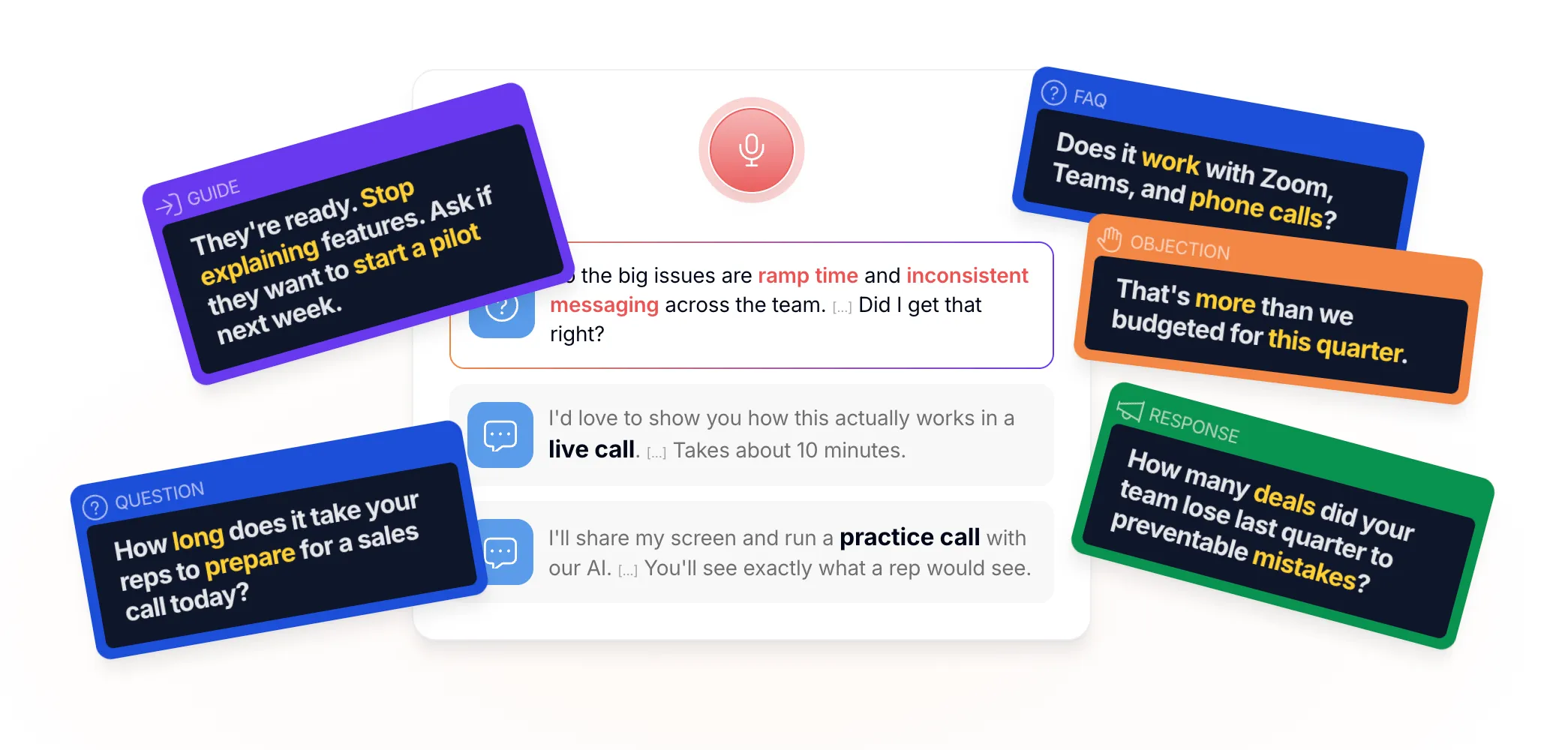
The two Swiss B2B moments we point to are a required disclosure on an insurance call and a price objection during a SaaS demo with the screen shared. The disclosure is written into the script, so it comes out word for word. In the demo, the prompts are 100% invisible in screen shares and recordings, so the rep can share the demo with the coaching still running. That keeps the coaching off the shared screen; it does not replace telling the prospect that the call is transcribed (check 5 and the consent section).
- Ask the vendor: “Are the answers on screen written by us in advance, or generated during the call, and how many words does a card show?”
- Test it: put one required disclosure and one price answer into the script, then check on pilot calls that the rep said them as written.
8. What does it really cost in Switzerland, and what proof is there?
Compare like for like: currency (many tools price in US dollars), VAT, per seat or per team, minimum seats, add-ons, annual commitment and exit terms. The Swiss standard VAT rate has been 8.1% since January 1, 2024. When a VAT-registered Swiss business buys a service from a provider abroad that is not in the Swiss VAT register, acquisition tax applies: the buyer declares the VAT itself (Federal Tax Administration). That does not apply to a software subscription bought by a buyer who is not registered for VAT: electronic services to recipients who are not liable for VAT are never subject to acquisition tax, but they can make the foreign provider liable for VAT in Switzerland (Federal Tax Administration, VAT Info 14, section 2.1.6). A price without Swiss VAT is therefore not automatically 8.1% cheaper.
Our prices, as of November 10, 2026, are in US dollars for Swiss customers too, excluding VAT, billed monthly with no annual commitment. Cancel anytime.
| Plan | Price | Scope |
|---|---|---|
| Starter | $99 / month | One seller; 24 hours of live call coaching or AI practice per month, shared across both |
| Pro | $249 / seat / month | Teams; unlimited live coaching and AI practice, manager dashboard, team script sharing |
| Enterprise | Custom pricing | From 50 seats; SSO (single sign-on), onboarding, custom integrations, uptime SLA (a contractual uptime commitment) |
For proof, ask every vendor for an outcome figure with the number of reps or calls, the period and the method. The strongest outside evidence for live AI help comes from customer-support chat, not voice sales: across 5,172 support agents, AI suggestions in real time raised issues resolved per hour by 15% on average, with the largest gains for new and less-skilled agents and little effect for experienced ones (Brynjolfsson, Li and Raymond, Quarterly Journal of Economics 2025). CallPrompter has published no outcome figure, no ramp time and no win rate, because we have not measured one.
- Ask the vendor: “What is the total cost per rep per year in our setup, VAT included, and what outcome figure can you show with its basis?”
- Test it: calculate the cost for your real seat count, and treat any outcome figure without a number of reps, a period and a method as marketing.
Swiss recording-consent law for sales calls
This section covers business calls with participants in Switzerland. It is general information from the sources linked below, not legal advice. Calls with prospects abroad fall under other rules too: US federal law allows recording with the consent of one party (18 U.S.C. § 2511(2)(d)), several US states, California among them, require the consent of all parties, and EU rules apply where they reach.
Recording without consent is an offence. A participant who records a non-public conversation without the consent of the other participants is punished, on complaint, with a custodial sentence of up to one year or a monetary penalty (Art. 179ter Swiss Criminal Code). Listening in on or recording someone else’s non-public conversation without the consent of all participants is punished, on complaint, with a custodial sentence of up to three years or a monetary penalty (Art. 179bis). The statute text is on Fedlex; only the German, French and Italian texts are legally binding.
The business-call exception is narrow. Art. 179quinquies allows a participant to record calls “in the course of business that have orders, assignments, reservations and similar transactions as their subject matter”, in the wording of the English translation, and those recordings may be used only as evidence. The FDPIC reads this as high-volume “bulk business”, such as order and reservation lines. In its words: “If, on the other hand, the call concerns a complaint or similar, recording the conversation without obtaining the consent of the conversation participant is not permitted. The same applies, for example, to complex contract negotiations conducted by telephone.” Using recordings for training or for monitoring the sales techniques of employees requires informing the people concerned beforehand (FDPIC, recording conversations). For a SaaS discovery call, a demo or an insurance advice call, treat the exception as unavailable.
Live transcription without an audio file is an open question. We found no Swiss authority or court that has decided whether real-time transcription that keeps no audio file counts as recording under Art. 179ter. Inform the prospect anyway: the FADP’s information duty applies to the transcript as personal data whatever the answer (Art. 19 FADP, Fedlex).
Monitoring your own reps has its own rules. The FDPIC states that employers may listen to or record business calls for performance and quality control, training and security, never private calls. “The persons whose conversations are being recorded or listened to must be informed clearly and in advance. In addition, they must give their consent.” (FDPIC, telephone monitoring in the workplace). Art. 26 of Ordinance 3 to the Labour Act (ArGV 3) bans systems intended to monitor employees’ behavior at the workplace: “Überwachungs- und Kontrollsysteme, die das Verhalten der Arbeitnehmer am Arbeitsplatz überwachen sollen, dürfen nicht eingesetzt werden.” SECO’s guidance on Art. 26 allows systems that listen to or record calls for performance control in telephone sales or for training, as long as the people whose calls are monitored consent and are told each time, for example by a visible or audible signal (SECO guidance on Art. 26 ArGV 3, in German). It also counts detailed checks of an employee’s activities as behavior monitoring when they run only periodically or by sample, not just when they run continuously.
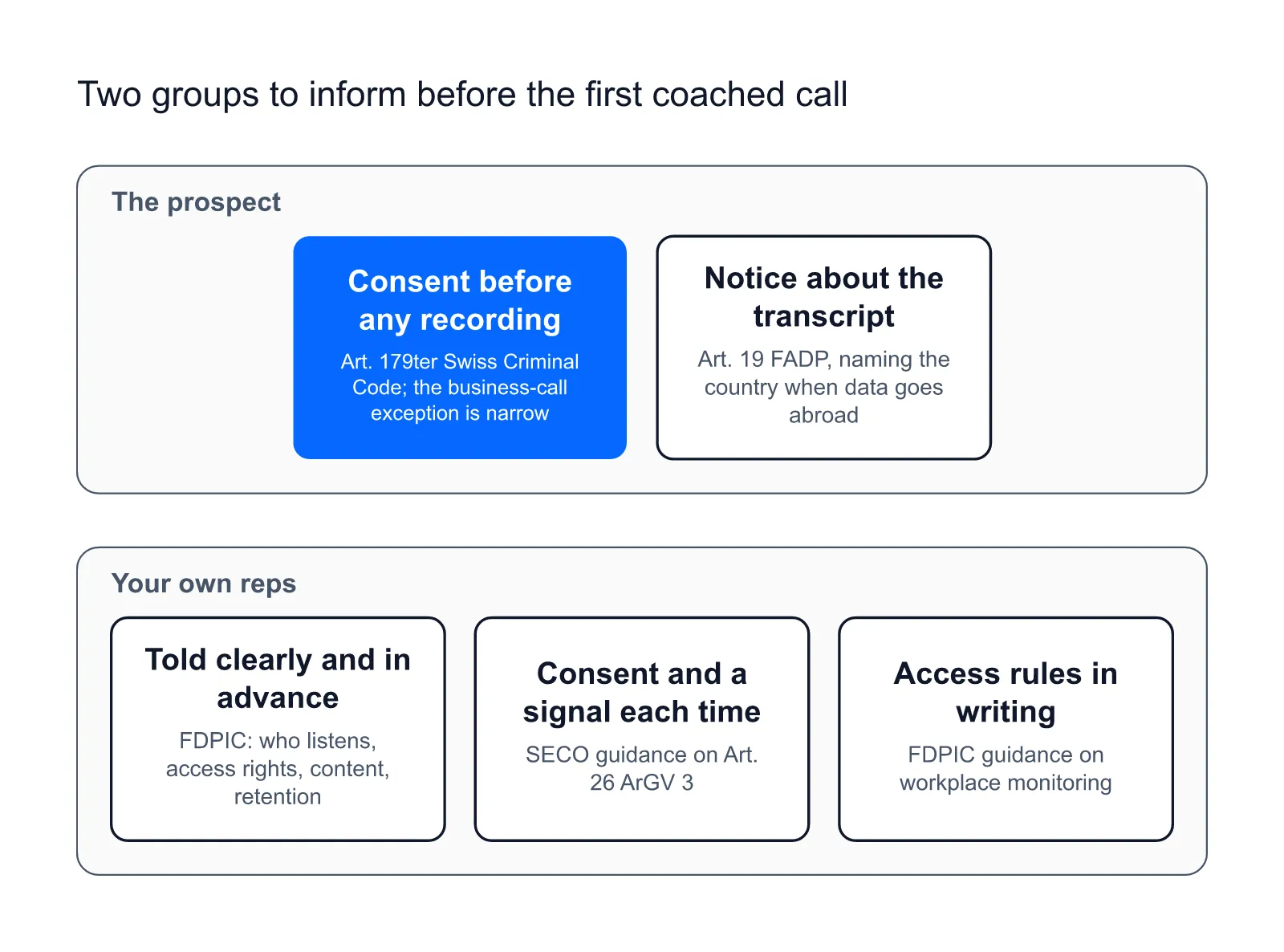
The invisible overlay in check 7 is about what a screen share captures. It never changes what the prospect has to be told. Check with your own counsel and your company’s policy before the first coached call.
Where CallPrompter fits, and where it falls short
Which tool a B2B sales team in Switzerland should pick depends on who needs help, and when:
- Reps need the words during the call (objections, discovery questions) on Zoom, Teams or the phone: a live in-call coaching tool. CallPrompter fits here, especially for B2B teams in German-speaking Switzerland that want their own approved scripts on screen, a German interface and stored data in Switzerland.
- Managers want call review, scoring and pipeline analysis afterwards: conversation intelligence. Many teams run it beside live coaching.
- A phone-first contact center needs compliance monitoring at scale: guidance inside the dialer or contact-center platform.
- New reps need rehearsal before their first live call: an AI practice tool. Our practice mode runs on the same scripts as our live coaching.
- Policy requires every processing step, live audio included, to stay in Switzerland: we do not meet that today, because real-time transcription runs through a US provider.
Here is how we answer the eight checks, as of November 2026. During the call a rep sees four kinds of cards (a question, an objection with its answer, a direction cue and a product fact), and our features page shows the question, objection and direction cards arriving on a live call.
| Check | Our answer | Basis |
|---|---|---|
| 1. Help during the call | Prompts on the rep’s screen while the prospect talks; 485 ms from objection to response on screen, in our own measurement | Product description; own measurement |
| 2. Your calls | Zoom, Teams, Google Meet, softphones, browser and CRM dialers, mobile calls answered on the computer; no bot; no CRM write-back | Product documentation |
| 3. Languages | Follows live calls in 90 languages; app in English, German and French; Swiss German not published | Our statement |
| 4. Data location | Stored data on servers in Switzerland; real-time transcription by a US provider; no audio file kept | Privacy policy; our statement, November 2026 |
| 5. Prospect consent | Rep consents before capture; indicator while transcribing; nothing in the call tells the prospect | Privacy policy; product documentation |
| 6. Transcript access | The rep; on Pro, managers on the same team; support only on request; deleted within 30 days of account deletion | Product documentation |
| 7. Words on screen | Answers written and approved before the call; 100% invisible in screen shares and recordings | Product description |
| 8. Price and proof | USD 99 per month (Starter), USD 249 per seat per month (Pro), excluding VAT, as of November 10, 2026; no outcome figure published | Pricing page |
Where it falls short:
- Call audio leaves Switzerland while the call is running.
- No CRM write-back; custom integrations are on Enterprise only (from 50 seats).
- No published outcome figure, and no published Swiss German test result.
- A young product: we launched in March 2026, and independent reviews are still few.
- The free trial has no live call coaching.
Our founder’s rule of thumb names three cases where our tool is the wrong pick: a call whose audio never plays through the computer, a complex contract negotiation, and a team that needs every processing step inside Switzerland. We are strongest where the same call repeats: demos, discovery calls, cold calls and advice calls with the same handful of objections.
How to run a two-week pilot in a Zurich sales team
Two weeks are enough to test technical fit and adoption. They are too short to prove a revenue effect in a B2B sales cycle, so judge the pilot on the eight checks.
- Pick 3 to 5 reps and two call types: one discovery call and one cold call with the “send me some info” objection. Where you can, keep a comparable group of reps without the tool.
- Write the consent sentence and the transcript-access rule first, and give both to the reps in writing before the first call.
- Turn the eight checks into a pass/fail sheet and fill it in for every tool on the shortlist.
- Measure on your own calls: prompt shown in time, prompt used, false prompts, calls in dialect, and what the reps say after each day.
- Decide in week two with the real cost per seat for your team, VAT included.
| Check | Pass if | [Tool 1] | [Tool 2] | [Tool 3] |
|---|---|---|---|---|
| 1. Help during the call | A prompt reaches the screen after a price objection while the rep can still use it | [pass/fail] | [pass/fail] | [pass/fail] |
| 2. Your calls | It works on one call per setup your team uses, including a Teams call with an external prospect | [pass/fail] | [pass/fail] | [pass/fail] |
| 3. Languages | Transcription, objection detection and prompt are right on calls in Zurich dialect, Standard German, English and French, and on calls that switch language | [pass/fail] | [pass/fail] | [pass/fail] |
| 4. Data location | The subprocessor list and the data processing agreement are in writing before the pilot | [pass/fail] | [pass/fail] | [pass/fail] |
| 5. Prospect consent | Your consent sentence is in the invite and in the first minute of every pilot call | [pass/fail] | [pass/fail] | [pass/fail] |
| 6. Transcript access | The access rule is announced to the pilot reps in writing, and nobody else can open their transcripts | [pass/fail] | [pass/fail] | [pass/fail] |
| 7. Words on screen | Reps said the required disclosure and the price answer as written | [pass/fail] | [pass/fail] | [pass/fail] |
| 8. Price and proof | The cost for your real seat count is calculated with VAT, and every outcome figure states its reps, period and method | [pass/fail] | [pass/fail] | [pass/fail] |
Pass/fail sheet for the eight checks: one column per tool on your shortlist.
To pilot CallPrompter, start with the 7-day trial: USD 0, no credit card, covering the script tools and 30 minutes of AI practice, without live calls. Our getting-started guide walks through the install and the first practice call against an AI buyer. Installing takes a minute; expect the better part of an hour to build your first script, or let the AI write a first version. Live call coaching starts on Starter or Pro, billed monthly with no annual commitment.
FAQ
Is real-time transcription the same as recording under Swiss law?
We found no Swiss authority or court that has decided whether live transcription that keeps no audio file counts as recording under Art. 179ter of the Swiss Criminal Code. Inform the prospect anyway, because the FADP’s information duty applies to the transcript, and check with your own counsel.
Does storing data in Switzerland mean EU data residency?
No. Switzerland is outside the EU. It holds an EU adequacy decision, confirmed on January 15, 2024, but data stored in Switzerland is still not stored in an EU member state.
Do prospects see live coaching prompts when I share my screen?
That depends on the tool. CallPrompter’s prompts are 100% invisible in screen shares and recordings, which keeps the coaching off the shared screen but tells the prospect nothing about the transcription.
Do Swiss companies pay VAT on sales software priced in US dollars?
Often yes. For a software subscription from a provider abroad that is not in the Swiss VAT register, a VAT-registered buyer declares acquisition tax at the 8.1% standard rate. A buyer who is not registered for VAT owes no acquisition tax; electronic services can, however, make the foreign provider liable for VAT in Switzerland.
Can a Zurich sales team use live coaching on calls in Swiss German?
Test it before you buy. Run real calls in Zurich dialect and calls that switch to Standard German or English, and judge the transcription, the objection detection and the prompt separately.
Try it on your own calls
The fastest way to judge live coaching is one practice call against a buyer persona you actually sell to. Start the CallPrompter trial, build your script and run that call before you pick Starter or Pro. Try for free. No credit card needed.
Questions before you download? Send a message through the contact page and the founder will get back to you.
Related posts
How to Choose a Real-Time Sales Coaching Tool: A 2026 Buyer's Checklist for B2B Sales Teams, From Zurich to New York
How to Follow a Sales Script Without Sounding Scripted, Robotic, or Like You're Reading It