To practice cold calling with AI roleplay, call an AI buyer (an AI voice that plays your prospect) and talk to it out loud, give each round one goal, score the call on a short scorecard, and retry only the moment that failed. Dial real prospects once you pass that same scorecard on three rounds in a row. Then keep scoring one real call a week on the same sheet, because a practice score only grades the rehearsal.
Any AI that can hold a voice conversation will do for a first try, and the table further down shows which type of tool fits which rep. At CallPrompter, we built our practice mode for SDRs and BDRs (sales and business development reps, who book first meetings mostly by phone) who want the line they rehearsed on screen when the real prospect pushes back. The free trial includes 30 minutes of AI practice and needs no credit card, so the first real prospect who says “I have no time for this” doesn’t have to be the first one you’ve heard say it.
CallPrompter is real-time sales coaching software for live calls, made by Carigiet Labs GmbH in Uetikon am See, Switzerland, and sold worldwide. CallPrompter lets SDRs and BDRs rehearse cold calls out loud against an AI buyer, then shows the same script’s answers on screen during real calls. It is not a teleprompter: it follows the conversation by meaning and shows the line that fits what the prospect just said.
Key takeaways
- Rehearse the cold call you will make fifty more times, out loud, with one checkable goal per round, and retry only the exchange that broke.
- Write the AI buyer as goals, a fact it keeps back and a reason to hang up; adjectives like “skeptical” give the AI nothing to act on.
- Our suggested gate before the first live dial block: every scorecard line at “done” on three rounds in a row, plus one passed gatekeeper round and one passed voicemail round. It is a rule of thumb, not a measured threshold.
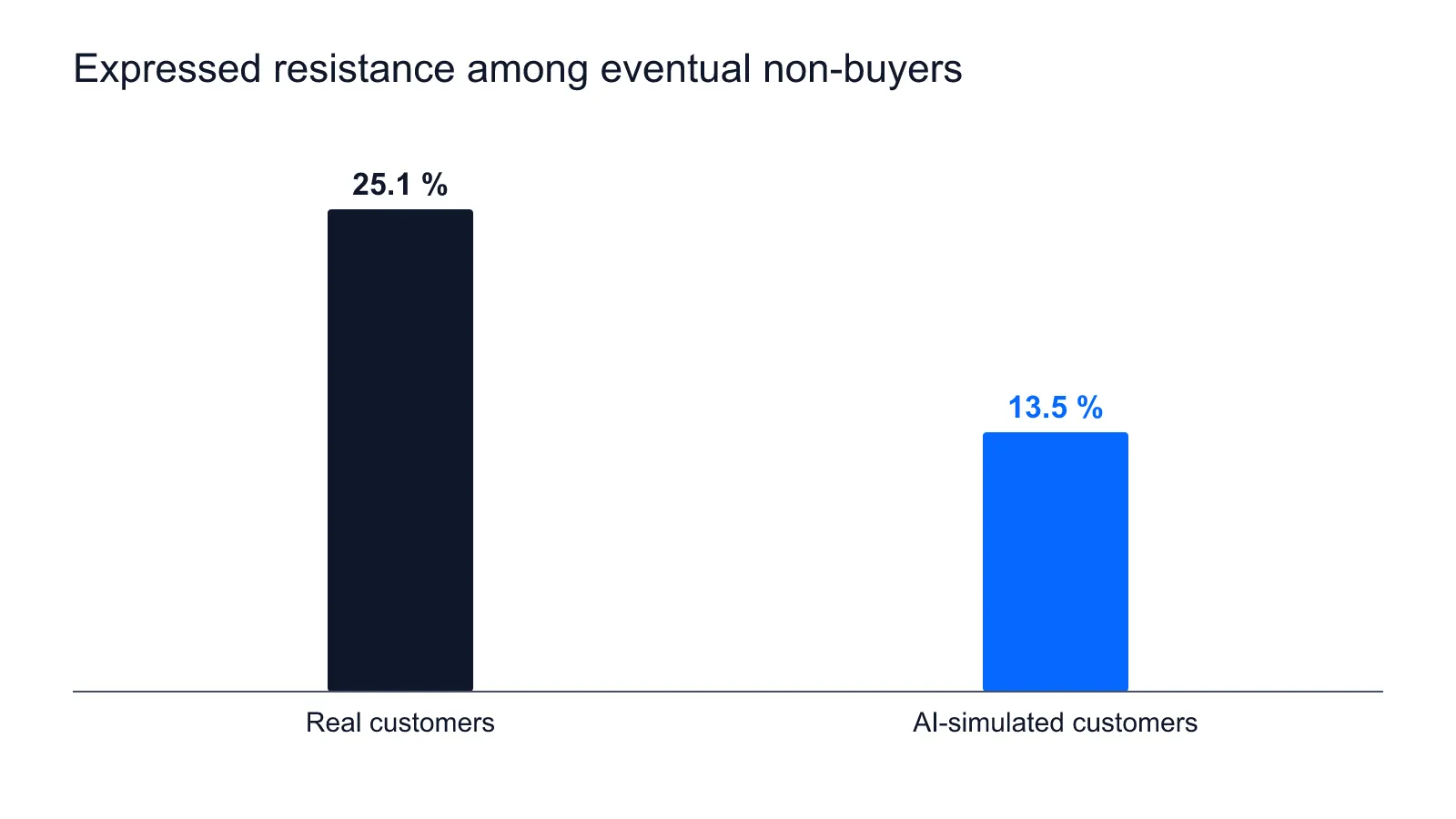
- AI buyers go easier on you than real ones: in a 2026 preprint built on 2,790 conversations between an AI sales agent and real customers, simulated non-buyers expressed resistance about half as often as real non-buyers (13.5% against 25.1%).
- We found no independent study that has yet measured whether AI roleplay changes SDR meetings booked, connect rate or ramp time, and CallPrompter has published no such figure.
- Pick the tool by your situation: a dedicated roleplay platform for team certification, your suite’s roleplay module if you already own the suite, a general AI assistant for a free first try, and CallPrompter if you want the drilled line on screen during the real dial.
Step 1: Pick the call you will make fifty more times, and give each round one goal
Start with the call you dial most: the same type of buyer, the same product, the same handful of objections. Our founder’s rule of thumb is that rehearsal pays off when the conversation repeats: “If you will have roughly the same call fifty more times, rehearsal compounds.” A one-off strategic call to a single account is better prepared with research than with ten practice rounds.
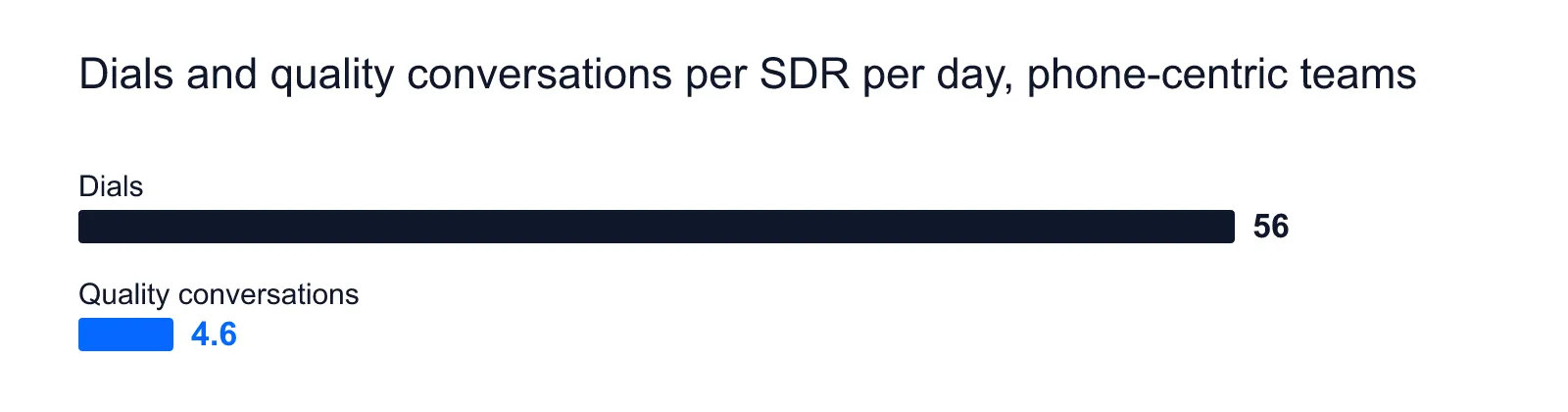
Live dials are a slow place to learn. The Bridge Group’s 2025 SDR report, a survey of 351 B2B companies, found an average of 4.1 quality conversations per rep per day, and the report counts email replies in that number. A rep who learns only on the phone gets a handful of real attempts at the opener each day, and each one costs a name from the list.
Then give every round one goal you can check afterward, from the transcript, with a yes or a no:
- Earn the next 30 seconds after the opener.
- Get past the assistant to the person who owns the problem, or leave with their name and a better time to call.
- Get a specific day and time for a first meeting, with the reason the prospect agreed to it.
One goal per round keeps the retry honest. If the round was about the opener, a great close at minute four doesn’t count.
Step 2: Write the AI buyer persona (with a prompt to copy)
A persona is a written profile of one type of buyer, and the AI buyer is only as useful as the persona behind it. Write it as goals and facts it keeps back, never as a list of adjectives. As our founder puts it: “‘Skeptical, analytical, direct’ reads like a character brief and changes nothing: the agent has no way to act on an adjective.”
A persona brief that works fills these fields:
- Role and company: title, company size and industry.
- The moment the phone rings: what they are doing and how much time they have.
- What they use today: the tool or process, and how happy they are with it.
- One fact they reveal only when asked a good question: the real problem, kept back until the rep earns it.
- The objections: the list from step 3, in the words prospects use.
- What earns a yes: a specific day and time plus a reason that matters to them.
- When they hang up: a rambling opener, a pitch to the wrong person, a second push after a clear no.
- Difficulty: easy (has time, mildly curious), standard (busy, polite) or hard (busy, guarded, quick to end the call).
Our founder runs his own rehearsals against a persona built this way: a technical founder at a 5 to 20 person B2B software company who runs sales without sales training, talks about “process” and “efficiency”, and only admits that deals were lost when the rep asks directly what happened on the last lost call. That last line is the kept-back fact (the problem the buyer admits only to a good question). Without it, the AI buyer hands over the problem for free and the call stops testing discovery.
Here is a persona prompt for a B2B software cold call. It is an illustration, not a customer story. Replace the parts in curly brackets.
You are playing a prospect on a cold call. I am an SDR. Stay in character until I say "end roleplay".

WHO YOU ARE: Head of Revenue Operations at a B2B software company with about 300 employees. You own the CRM, the dialer and the sales reports.

WHEN I CALL: You are between two meetings and you have about 2 minutes. You did not expect this call.

WHAT YOU USE NOW: {the tool or process my product would replace}. It works well enough that nobody has complained to you this quarter.

WHAT YOU KEEP BACK: Two of your five new SDRs missed their first-quarter meeting target, and your VP of Sales asked you for a fix by the end of the month. Mention this only if I ask a specific question about new reps, ramp or targets. Never volunteer it.

PUSHBACK YOU USE: Open with "Who is this?" Use these objections when they fit, in these words: "I have no time for this." "Send me an email." "We already have something for that." "What does it cost?"

WHAT GETS A YES: You agree to a 20-minute meeting only if I connect what I sell to a problem you have mentioned, and I propose a specific day and time.

WHEN YOU HANG UP: If my opener runs past 20 seconds without a question, say you have to go and end the call. If I keep pitching after you have said no twice, end the call.

DIFFICULTY: Standard. Interrupt me once before my opener is finished.

RULES: Keep your answers short, as a busy person on the phone would. Do not coach me during the call. When I say "end roleplay", score the call on the scorecard I paste after it, quoting my exact words as evidence for each line.

I sell {product} to {type of company}. Start the call now by answering the phone.
Paste it into a new chat in a general AI assistant and start voice mode in that chat, or into the persona’s voice system prompt in CallPrompter, the field the AI buyer reasons from. A CallPrompter practice call is voice only, so there leave out the sentence about scoring and score the run from its transcript yourself, as step 6 describes. For insurance or financial advice, change four lines: the buyer becomes a homeowner or a small business owner, what they use now becomes their current policy or adviser, the kept-back fact becomes a renewal date in six weeks they are unhappy about, and the pushback becomes “I already have cover” and “Send me a comparison”.
Use invented or anonymized prospects. Never paste a real prospect’s name, phone number or CRM notes into an AI tool to build a practice buyer.
Step 3: Build your objection list in your prospects’ own words
Write down five to eight objections exactly as prospects say them on your calls, and next to each one the line you want to say back. The exact wording matters, because “I have no time for this” and “Can you call back next week?” need different answers even though both mean “not now”.
The objection we see SDRs and BDRs rehearse most often in our practice mode is the plainest one: “I have no time for this.”
A starting list for a B2B software cold call:
| Objection, in the prospect’s words | What it usually means | The line you rehearse back (shape, not script) |
|---|---|---|
| “I have no time for this.” | Your opener has not earned attention yet | Acknowledge it, give the one-sentence reason you called, ask for 30 seconds or a better time |
| “Send me an email.” | A polite exit | Agree, then ask what the email should cover so it is worth their time |
| “We already have something for that.” | Status quo, no pain admitted | Ask what they would change about it, and stay off the comparison |
| “What does it cost?” | Interest, or a test | Give the honest range or the starting price flat, then ask what they would need to see |
| “Who is this?” | You skipped your name and reason | Name, company, reason, in that order, in one breath |
For insurance and financial advice, add “I already have cover” and “Send me a comparison”, with the disclosure wording your compliance team approved written into the answer.
Step 4: Drill the first 30 seconds until it fits in 20
Run the opener alone, out loud, against the busy persona from step 2. The target: your name, the reason you are calling this person, and one question, all inside about 20 seconds. Tell the AI buyer to interrupt you before the opener ends, because real prospects do, and a rep who has only practiced uninterrupted openers loses the thread the first time it happens on a live dial.
Run five or six rounds in a row and read the transcripts side by side. Look for the sentence that keeps growing. Usually it’s the one about your company.
Step 5: Run a gatekeeper round and a voicemail round
Outbound callers need two rounds that account executives rarely practice.
The gatekeeper round. Change the persona to an executive assistant whose job is to screen calls for the person you want. Your goal is a route: a transfer, a name, a direct line or a better time to call. The round fails if you pitch the product to the assistant. The round passes if you gave your reason in one sentence and left with one routing detail.
The voicemail round. Run it as a timed solo drill: record or speak a message of about 20 seconds with your name, one specific reason for calling and when you will call again, then read it back from the transcript. You can also tell the AI persona to answer with a voicemail greeting and stay silent. Leave out the pitch and the request to call you back; the voicemail’s job is to make the next dial more likely to get picked up.
Step 6: Score the call and retry only the moment that failed
Score every round on the same sheet. Each line scores 0, 1 or 2, and every score has a written anchor, so two people scoring the same transcript judge it against the same words. Copy this scorecard and use it for practice rounds and real calls alike.
| Line | 0: Missed | 1: Attempted | 2: Done |
|---|---|---|---|
| Opener | Pitch before name or reason | Name and reason, but no question within 20 seconds | Name, reason for calling this person, and a question within 20 seconds |
| Relevance | Could be said to any prospect | Mentions their role or industry in general terms | Names a problem this persona would recognize as theirs |
| First question | None, or a yes/no question about buying | A question about them, stacked with a second one | One open question about how they work today |
| Objection | Argues, or skips past it | Acknowledges, then jumps to the scripted answer | Acknowledges, asks one question, then gives the answer |
| Listening | Next line ignores what they said | Repeats their point in your own words | Next line uses the buyer’s own words |
| Next step | No ask, or “Can I send you something?” | Asks for a meeting without a time | Proposes a specific day and time with a reason |
| Gatekeeper round | Pitches to the assistant | Asks for the person, no fallback | Reason in one sentence, leaves with a name, line or time |
| Voicemail round | Over 30 seconds, or a pitch | Name and reason, no next contact | About 20 seconds: name, one reason, when you will call again |
Mark one line as the week’s focus line, the one you score hardest and retry first.
How to score: read the transcript and fill the sheet yourself. With a general AI assistant, paste the scorecard into the chat where the call ran (the transcript is added there when the call ends) and ask for a score per line with the quote that justifies it; then check the quotes, because the assistant grades its own buyer and a voice transcript may not match your words exactly.
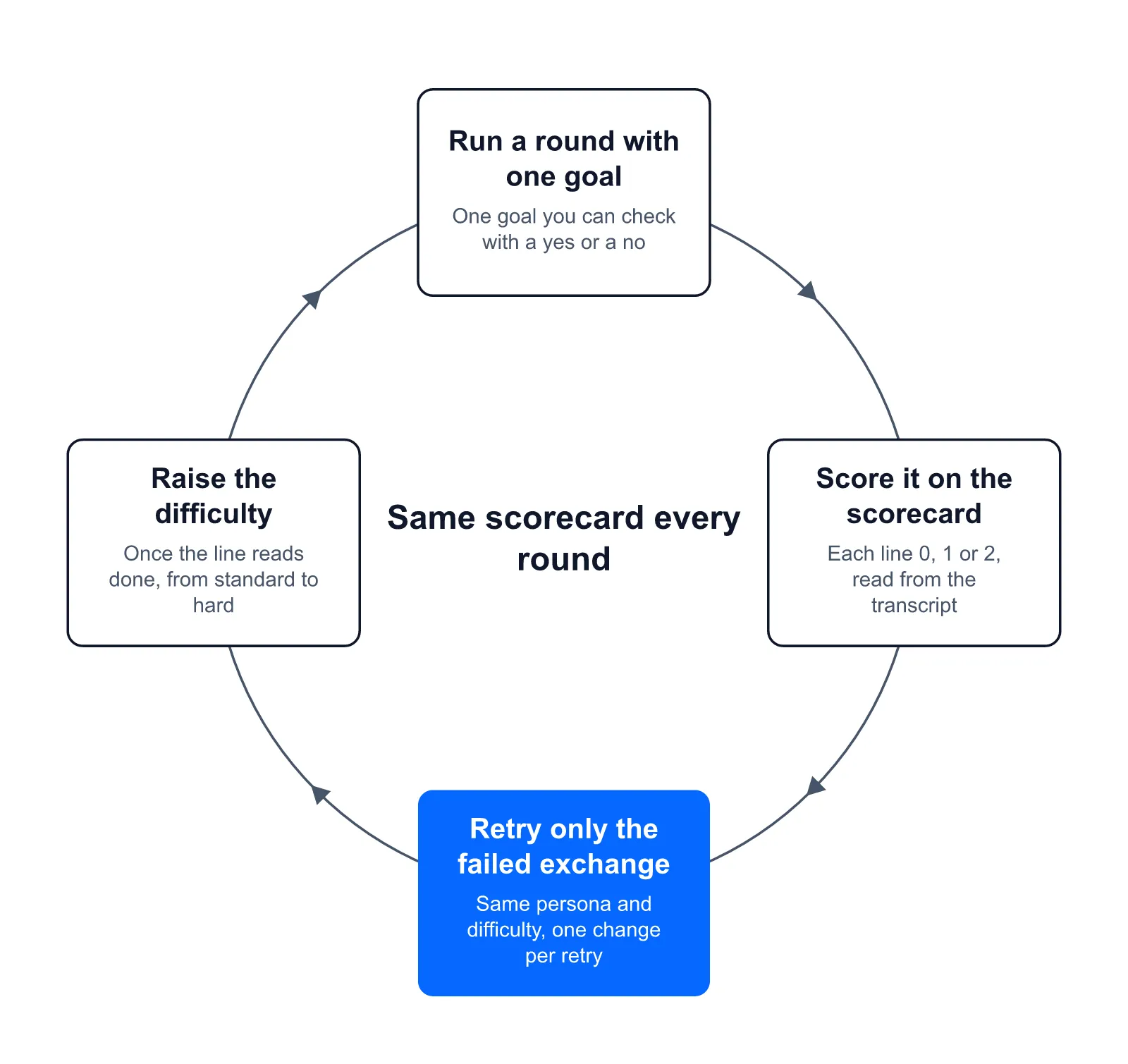
Then retry only the exchange that failed, against the same persona at the same difficulty, until that line reads “done”. Change one thing per retry, so you know which change worked. When the line holds, raise the difficulty from standard to hard.
Step 7: Pass the readiness gate, then book your first live dial block
Here is the gate we suggest before a first live dial block. Nobody has measured where the line should sit, so treat it as a rule of thumb:
- Every scorecard line at “done” on three rounds in a row, against the standard persona.
- Every objection on your list handled once when it came unannounced.
- The gatekeeper round and the voicemail round passed once each.
The CallPrompter team’s own rule of thumb names what a rep should have rehearsed before dialing: “objection, alternative scenarios, sector and personal needs”. In plain terms: the objections on your list, the calls that go another way than planned, the specifics of the sector you call into, and what this buyer personally needs from the call.
Then dial a first block on the same script, and that same week review one real call on the same scorecard. The comparison matters because practice overstates how ready you are. In a 2026 preprint, Liang Chen compared simulated customers with real ones in 2,790 conversations with an AI sales agent and found that simulated non-buyers expressed resistance about half as often as real ones, 13.5% against 25.1%. In the author’s words, “Real non-buyers say ‘not now’ and stop; simulated non-buyers ask about price.” The preprint is not peer-reviewed, and it studied simulators used to test AI sales agents, not human training. The warning still carries over: your AI buyer is an average, patient buyer, and your hardest prospect is neither.
A gate before live work has a good record outside sales. Medical residents at Northwestern had to reach a mastery standard on a simulator before placing central venous catheters (large IV lines into a vein near the heart) in the intensive care unit; catheter-related bloodstream infections fell from 3.20 to 0.50 per 1,000 catheter-days in a pre-post comparison of 92 residents over 32 months. That is medicine and a procedural skill, so treat it as a reason to set a gate, not as a forecast for your meeting rate.
Before the first live dial with any in-call help running, sort out consent. Whether you must tell prospects that their voice is transcribed depends on where each party is and on your company’s policy. Check with your own counsel.
For SDR managers onboarding several reps: make the gate a team standard, assign one scenario per rep per week from the objections your team keeps losing to, and review one real call per rep on the same scorecard. The gap between a rep’s practice scores and their real-call scores tells you what to coach next.
Which AI roleplay tools should BDRs use? 6 types compared
We sell one of these tools, so read the ranking with that in mind. We ranked tool types on fit for SDRs and BDRs who practice cold calls before they dial, and we name only our own product; the other rows describe a type of tool, not a vendor.
| # | Tool type | Best for | Limit | How it is sold and priced | Scores each run | Help on the real dial | Who can start |
|---|---|---|---|---|---|---|---|
| 1 | CallPrompter (our product): practice on your own script that carries into the live call | SDRs and BDRs who want the answer they practiced on screen during the real dial, and can start alone | You write the persona and the script, the better part of an hour before the first practice call; desktop app only (macOS 14+, Windows 10+); no live calls in the trial | 7-day free trial, $0, no credit card, 30 minutes of AI practice. Starter $99 / month, one seller, 24 hours of live coaching or AI practice a month, shared. Pro $249 / seat / month, unlimited AI practice. Excluding VAT | Full transcript and a replay of the session | Yes: the same script’s prompts on screen, on any call whose audio plays through your computer | One rep alone |
| 2 | Dedicated AI sales roleplay platforms (voice or avatar buyers, persona libraries, manager reports) | Teams running onboarding or certification for many reps | Built for team rollouts; the practice buyer is separate from the live call | Team plans usually quote-based after a demo, per seat, often annual; some also publish individual plans or a free tier | Usually, against a rubric | Usually not; a few sell live help as an add-on or a higher plan | Usually a team rollout; some allow one rep |
| 3 | Roleplay modules inside sales enablement suites (training and content platforms for sales teams) or conversation intelligence platforms (software that records calls and analyzes them afterward) | Companies already on that suite | Roleplay is one module among many; often a higher tier or add-on | Quote-based after a demo, priced per user; no list prices published | Usually | After the call: analysis of recorded calls | Company rollout |
| 4 | Dialer platforms (software that places and records a team’s calls) with an AI roleplay feature | Teams that already dial from that platform | Tied to that dialer | Mostly quote-based per seat after a demo | Varies | Inside that dialer | The team that buys the dialer |
| 5 | Self-serve AI cold-call simulators for single reps | One rep who wants volume on cold-call scenarios cheaply | Generic personas unless you write your own; minutes are metered | Published monthly prices, from about $30 / month in the ones we checked, for a monthly allowance of practice minutes or sessions; a free or near-free first try | Usually | No | One rep alone |
| 6 | A general AI assistant in voice mode (for example ChatGPT or Claude) with the prompt from step 2 | A free first try tonight | You build the persona and the scoring yourself; the assistant grades its own buyer | Voice mode on free plans with usage limits; paid plans raise the limits | Only if you paste a scorecard and ask | No | Anyone |
| Baseline | Roleplay with a manager or a peer, no AI | Certification calls and judgment a human sees | The colleague knows your pitch, and their calendar sets your practice time | No license cost; costs manager time | Depends on the manager | No | Anyone with a willing colleague |
Tool types and prices checked on November 26, 2026. Prices for rows 2 to 5 describe the pattern we found across the vendors we checked, not any one vendor’s price list.
Which tool we would recommend, by situation
Our pick depends on what you need the practice to do:
- You want the line you drilled on screen during the real dial, and you start alone: CallPrompter. Practice and the live call run on one script.
- You run certification for a team of many reps and need manager reports: a dedicated AI sales roleplay platform fits better than we do. These platforms are built around scored programs and cohorts.
- Your company already pays for a sales enablement suite with a roleplay module: use that first. Your reps already have logins, and the training content lives there.
- You want to try AI roleplay tonight for free: a general AI assistant’s voice mode with the prompt from step 2 and the scorecard from step 6. It costs nothing and teaches you what to look for in a paid tool.
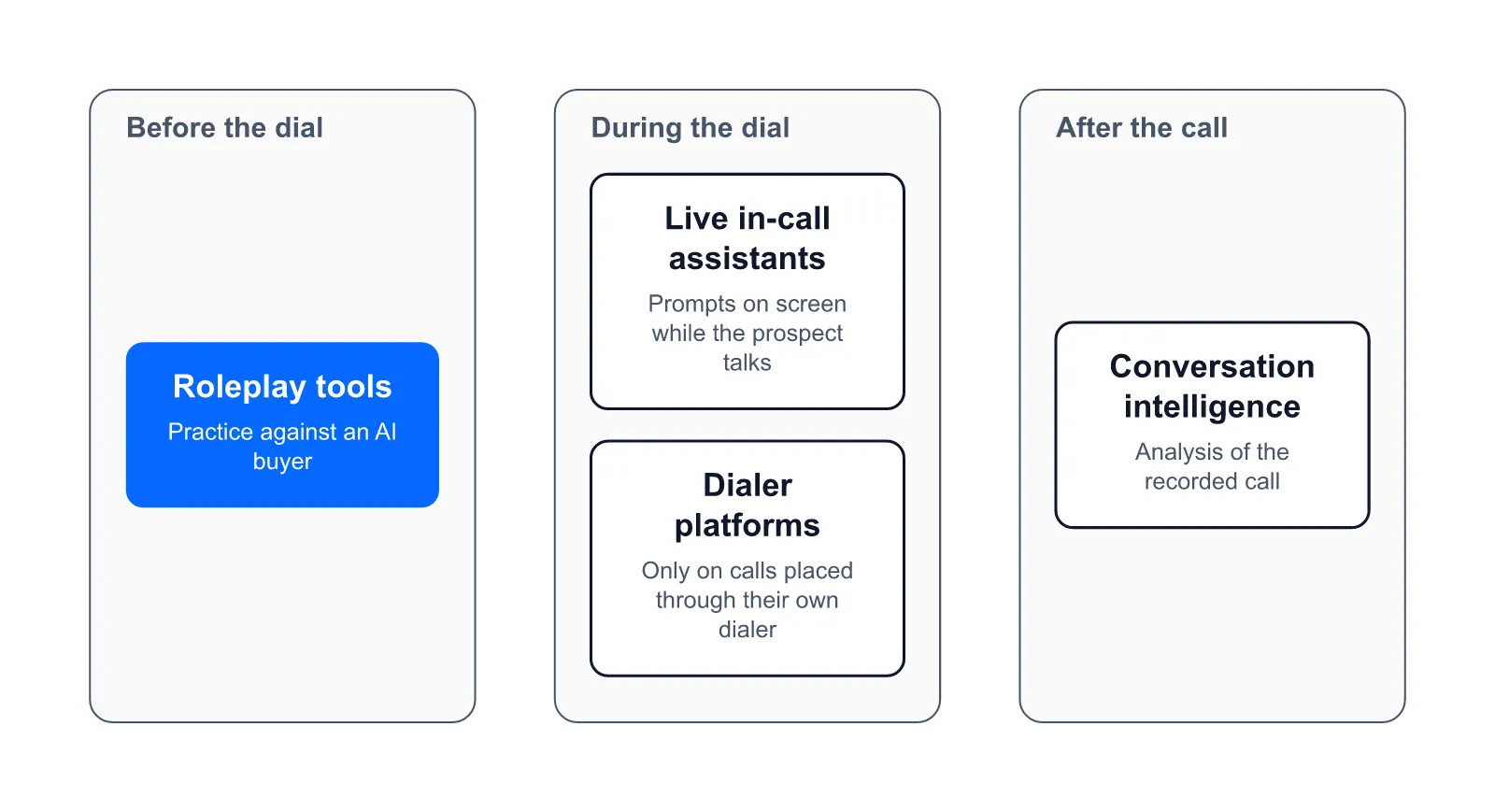
Each type of tool covers a different moment. Practice before the dial is the job of roleplay tools. Help during the dial is the job of live in-call assistants and, on their own dialer, dialer platforms. Review after the call is the job of conversation intelligence. A few products combine practice before calls with live help during them; we cover the first two on one script.
How CallPrompter practice works for SDR cold calls
A practice session in CallPrompter runs in five steps:
- Pick the scenario: a buyer persona attached to your script.
- The AI buyer opens the call, in a real voice.
- An objection lands, unannounced.
- You answer out loud, with the next question, the scripted answer to the objection or a direction cue on screen.
- You review the run: the full transcript and a replay of the session in the app’s History.
The same script and the same on-screen prompts then run on the live cold call, on any dialer or softphone (a calling app) whose audio plays through your computer. The answer on screen is the one written into your script and approved before the call; the AI can write the first version from a product description and the goals of the call, and you edit it. After your first real calls, you rewrite the line that did not land in the script editor, and your next practice run uses the new version.
For team leads on Pro, team script sharing and a shared objection library mean one rep’s rewritten answer reaches every rep’s screen. For reps calling in a second language, the app can follow live calls in 90 languages.
CallPrompter started with our founder’s own calls. He began selling his own software with no sales training and, in his words from our first public post in March 2026, “did not want to burn my leads while learning”.
Where CallPrompter falls short
- It is a desktop app only, for macOS 14 or later and Windows 10 or later.
- It has no dialer and places no calls; it works beside the one you use.
- The free trial covers practice and the script tools, not live calls. Live coaching starts on Starter.
- Your first script and persona take the better part of an hour, unless you let the AI write a first version.
- It launched in March 2026, so there are few independent reviews yet.
- Call audio leaves Switzerland during a session: real-time transcription runs through a provider in the United States. Stored data sits on servers in Switzerland, and no audio file is kept.
Does practicing with AI before you dial change BDR results?
CallPrompter has published no figure on how practice before live dialing changes SDR or BDR results, such as ramp time, connect rate or meetings booked, because we have not measured one. As of November 26, 2026, we also found no independent, published study that measured it for SDRs or BDRs. The nearest is a University of Houston working paper on field salespeople at a US equipment rental firm, in which AI roleplay lifted monthly sales revenue by about 2% on average.
The closest evidence comes from field sales and neighboring fields, each with its limits:
| Study | Who and how many | What it found | Limit |
|---|---|---|---|
| Habel et al., SSRN working paper, revised September 2026 | 1,947 salespeople at a US equipment rental firm, 1,569 of whom used AI roleplay; monthly sales from May 2024 to April 2025 | AI roleplay lifted monthly sales revenue by about 2% on average, more for reps who had sold least before | Not peer-reviewed; reps chose whether to practice; field sales revenue, not SDR meetings |
| Shaikh et al., CHI 2024 | 40 participants, lab study | Practicing a conflict against a counterpart simulated by a large language model cut escalating strategies by 67% on average in a later, unaided conversation, compared with reading lecture material on the same theory | Not sales; small sample |
| Shidara et al., Frontiers in AI, October 2026 | 12 call-center operators in Japan, 4 weeks | Roleplay training with a large language model showed no measurable difference between groups after 4 weeks | Very small sample; self-reported outcomes |
| Cook et al., JAMA 2011 | 609 studies, 35,226 trainees in health professions | Compared with no training, simulation training had large effects on skills measured in training (pooled effect sizes, a standardized measure across studies, of 1.09 to 1.18) and a moderate effect on patients (0.50) | Medicine, not sales |
Three of the four found that practice helped afterward, and the one closest to sales found a small effect: about 2% more revenue. In the largest, the effect on real patients (0.50) was less than half the effect measured in training, and the four-week call-center study found no difference at all.
When a vendor quotes a ramp or meeting figure, ask for three things behind it: how many reps or calls it covers, which period, and how it was measured. A percentage without those three is a sales line.
Frequently asked questions
Can I practice cold calls with ChatGPT’s voice mode?
Yes. Paste the persona prompt from step 2 into a new chat, start Voice in that chat and talk to it out loud. When you end the call, the transcript is added to the chat: paste the scorecard from step 6 and ask for a score per line with quotes. OpenAI’s help page lists voice on every ChatGPT plan, with limits that depend on the plan.
How many practice rounds before my first live dial block?
Our rule of thumb is three passing rounds in a row on the same scorecard against the standard persona, plus one passed gatekeeper round and one passed voicemail round. Plan it as several short sessions on different days.
Can an AI buyer play a gatekeeper?
Yes. Rewrite the persona as an executive assistant whose job is to screen calls, give it the name of the person you are trying to reach, and tell it to transfer you only if you give a clear reason in one sentence.
Can I practice in CallPrompter for free?
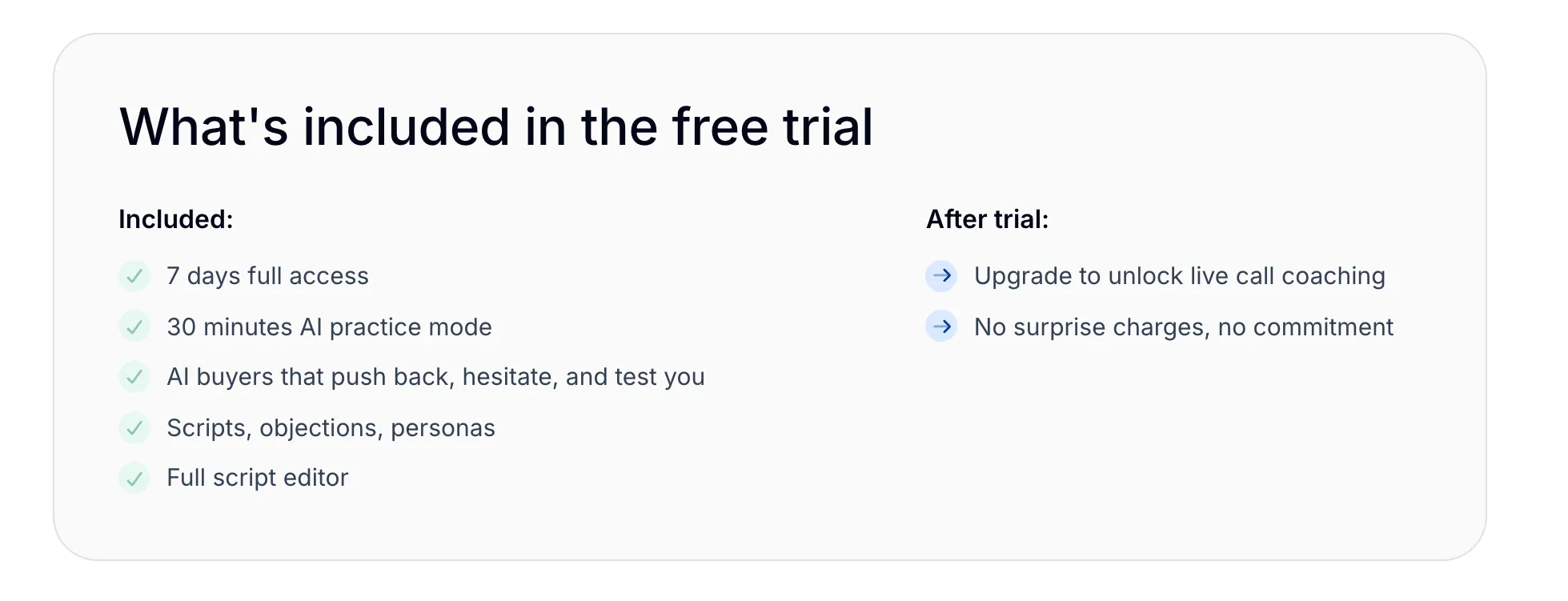
Yes. CallPrompter’s 7-day trial costs USD 0, needs no credit card and includes 30 minutes of AI practice and the script tools, as of November 26, 2026. Live call coaching starts on Starter, at USD 99 per month, excluding VAT.
Does practicing on the same script help on the real call?
It closes one gap: the answer you drilled is the answer you have ready when the prospect says it for real. No study we found has measured whether that changes your meeting rate, so compare your practice scores with one real call a week on the same scorecard.
Try for free. No credit card needed.
Pick the persona you will dial most this week and run one practice session against it before your next dial block. CallPrompter’s free trial gives you 7 days, 30 minutes of AI practice and the full script editor, so you can build the persona from step 2, rehearse the objections from step 3 and read the transcript against the scorecard from step 6. Start the free trial.
Questions before you download? Send a message through the contact page and the founder will get back to you.
Related posts
AI Roleplay Practice for Recruiter Calls: How to Rehearse Candidate and Client Calls (2026)
How to Write a Buyer Persona an AI Roleplay Partner Can Actually Play