When a prospect says they already have someone for that, say this: “That makes sense, and I’m not asking you to replace anyone on this call. What does the current setup handle well, and where, if anywhere, does it still leave work on your side?” Then stop talking. Those two sentences accept the incumbent as a settled fact, take replacement off the table for the next minute, and ask the one question that turns the objection into information you can use.
I spent twenty-five years in software engineering before I had to sell my own product with no sales training, and that is the problem CallPrompter was built for. The constraint we design against is how little a seller can absorb mid-call, and it applies to a script as much as to a live prompt: one sentence you can say out loud beats a rebuttal you have to remember. What follows is the four-step framework behind those two sentences, three versions of the script for whatever the prospect says next, why we never name the other provider, and a one-line version for a cold call.
Key takeaways
- Acknowledge the incumbent before anything else: “That makes sense, and I’m not asking you to replace anyone on this call.”
- Explore with one open question before any specific probe: “What does the current setup handle well, and where, if anywhere, does it still leave work on your side?” Then stop talking.
- Differentiate against the gap the prospect named, using verifiable facts about your own product and none about theirs.
- Advance by asking when the arrangement is next reviewed and what has to be decided before then. The renewal date is rarely the decision date.
- “Makes sense, I’m not asking you to switch. What does it not cover?” is the whole framework compressed into one line for a cold call.
Why “we already have someone for that” is hard to beat
The current arrangement has a built-in advantage simply because it is current. Samuelson and Zeckhauser’s foundational work on status quo bias showed that labeling one option as the incumbent raises how often people pick it. In one four-candidate illustration from their model, an option’s predicted share moved from 20.5% as an alternative to 38.5% as the status quo. That is a modeled share rather than a vendor-switch rate, and the pull grew stronger when there were more alternatives and preferences between them were less clear.
More useful is what switching actually costs a business customer. A mixed-method B2B study of 38 business customers who had changed providers, followed by 184 customers matched to twelve months of transaction records, sorted switching costs into three kinds. Relational costs were the only kind associated with all four purchasing outcomes measured, including whether the customer actually stopped ordering.
| Switching cost | What it looks like to the buyer | The question that surfaces it |
|---|---|---|
| Procedural | Search and evaluation, setup, and relearning a way of working | “What would have to be reworked if this changed?” |
| Financial | Money already committed, or terms that get worse at lower volume | “Is anything in the current arrangement tied to volume or to a term?” |
| Relational | Losing a supplier who knows the account, and the person behind it | “Who owns that relationship internally, and who else signs off?” |
The third column is the part that goes on the call. Each of those questions surfaces a cost without asking the prospect to defend the decision that created it.
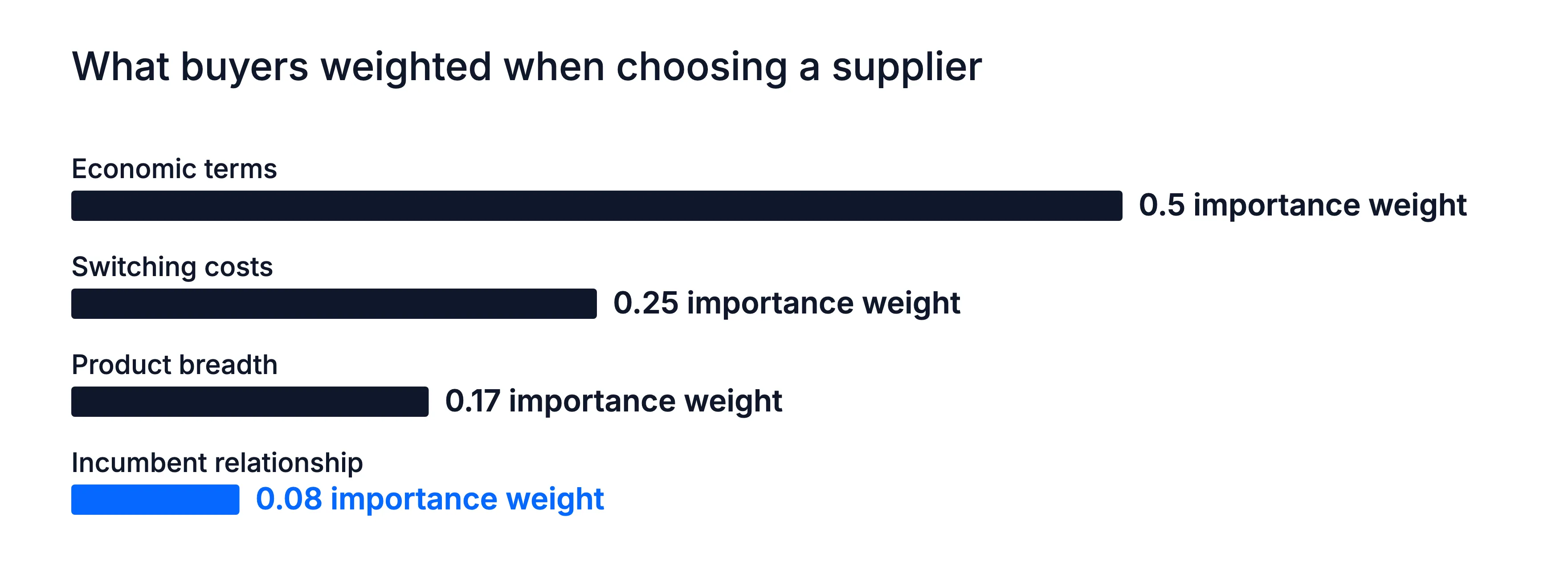
None of this says the incumbent wins. In a conjoint experiment with 114 corporate banking customers, buyers weighted economic terms and product breadth far above the incumbent relationship: economic terms carried an importance weight of .50 and switching costs .25, while the interpersonal relationship with the incumbent carried .08, and it did not significantly blunt the pull of a 15% better offer. The incumbent starts ahead. It does not finish there.
One honest limit, because you will hear the stronger version of this claim from other places. There is no study that puts a seller on a live B2B call, has them criticize the incumbent, and measures whether the buyer defends that vendor harder. The supportable version is narrower: an attack adds threat and argument to a decision that inertia and switching costs already protect.
The four-step framework: acknowledge, explore, differentiate, advance
Four steps, in order, none of them skippable. The whole sequence fits in a minute of call time, and the first three exist to earn the fourth.
Step 1: Acknowledge the incumbent and drop the pressure
Say: “That makes sense, and I’m not asking you to replace anyone on this call.”
This is the one line most sellers skip, and it is the one with the clearest behavioral support behind it. A 2025 meta-analysis of message effects on psychological reactance pooled 33 studies and 146 effect sizes and found that freedom-threatening wording reliably produced more anger and more negative thoughts than low-threat wording, with an overall reactance effect of r = .20 (95% CI .16 to .23). Anger in turn tracked with worse persuasion outcomes at r = -.23. Wording that leaves the buyer in control costs you nothing and removes a predictable obstacle.
Acknowledging is not agreeing that the call is over, and it is not a compliment you do not mean. You are conceding one fact, that they have a provider, so the conversation can move to a fact you do not yet have.
The research tests wording in general rather than this sentence on a sales call. Use it as a well-founded default and expect it to clear an obstacle, nothing more.
Step 2: Explore with one open question, then one specific probe
Say first: “What does the current setup handle well, and where, if anywhere, does it still leave work on your side?”
Open questions are the highest-yield and least-used move in a conversation like this. In an analysis of 61,057 speech turns across 309 recorded negotiations, open-ended questions made up only 8% of turns, roughly one every four minutes, and asking them was associated with better outcomes for the asker. Two follow-up experiments with 1,452 and 372 participants found the same effect when the question type was assigned rather than chosen.
Then, only after they give you a signal: “When that happens, what does it delay, cost, or put at risk?”
The sequence matters. Four experiments on question phrasing found that a question presuming a specific problem pulled out far more unwelcome information than a general one. In a used-product negotiation, disclosure of a known problem ran at 8.1% after a general question and 89.0% after a question that named the problem directly. The same research found the cost of getting the order wrong: when the problem was genuinely rare, assertive questions lowered how warm and competent the asker seemed, from a rating of 4.85 after a general question to 3.77 after a problem-presuming one. Earn the specific question with a signal first.
| Question form | Disclosure of a known problem (study 3) | Rating of the asker when the problem was rare (study 4) |
|---|---|---|
| A general question | 8.1 % | 4.85 |
| A question that assumes there is no problem | 61.1 % | 4.04 |
| A question that names the problem | 89.0 % | 3.77 |
Disclosure rates come from the used-product negotiation in study 3; the asker ratings come from study 4, where the problem was rare. Source: Minson, VanEpps, Yip and Schweitzer, Organizational Behavior and Human Decision Processes, 2018.
A short relevance cue before the question helps. Conversation analysis of twelve recorded first-time B2B meetings found that sellers who drew out disclosure did it with embedded expertise, evidence of preparation, and tailored references rather than with question syntax alone. “We often see teams keep their main provider and still handle the renewal paperwork by hand” is a cue. “Where is your provider failing you?” is an accusation with nothing behind it.
Four signals that the call is worth another five minutes
This is our own rule of thumb for separating the prospects worth staying on from the calls that are already done. Listen for:
- “It’s fine, but…” Anything after the but is the opening.
- A described workaround. “We export it and then…” is a gap the prospect has already stopped noticing.
- An answer about somebody else. “My team finds it clunky” is a complaint with a sponsor attached.
- A renewal inside a year. That puts a real decision on a real calendar.
None of the four, and there is probably nothing here. Say so and end cleanly. Continued probing after a genuine no-gap answer is the same freedom-threatening pressure step one was built to avoid.
Step 3: Differentiate against the gap, not against the provider
Say: “That’s the part we handle. [Specific capability], so [specific operational consequence]. I can show you that one piece without asking you to change the rest of the arrangement.”
Two rules make this step work.
The first is scope. You are comparing your capability with the gap they just described, not your company with their company. A gap the prospect named out loud is a fact you both agreed on thirty seconds ago. A claim about the other provider is one you cannot verify on a call and they can reject in a word.
The second is that a carve-out usually beats a replacement. The switching-cost research above gives the reason: procedural, financial and relational costs all attach to replacing the whole relationship, and most of them fall away when you propose solving one piece alongside it. Sell the piece, not the switch.
Step 4: Advance to the real decision date
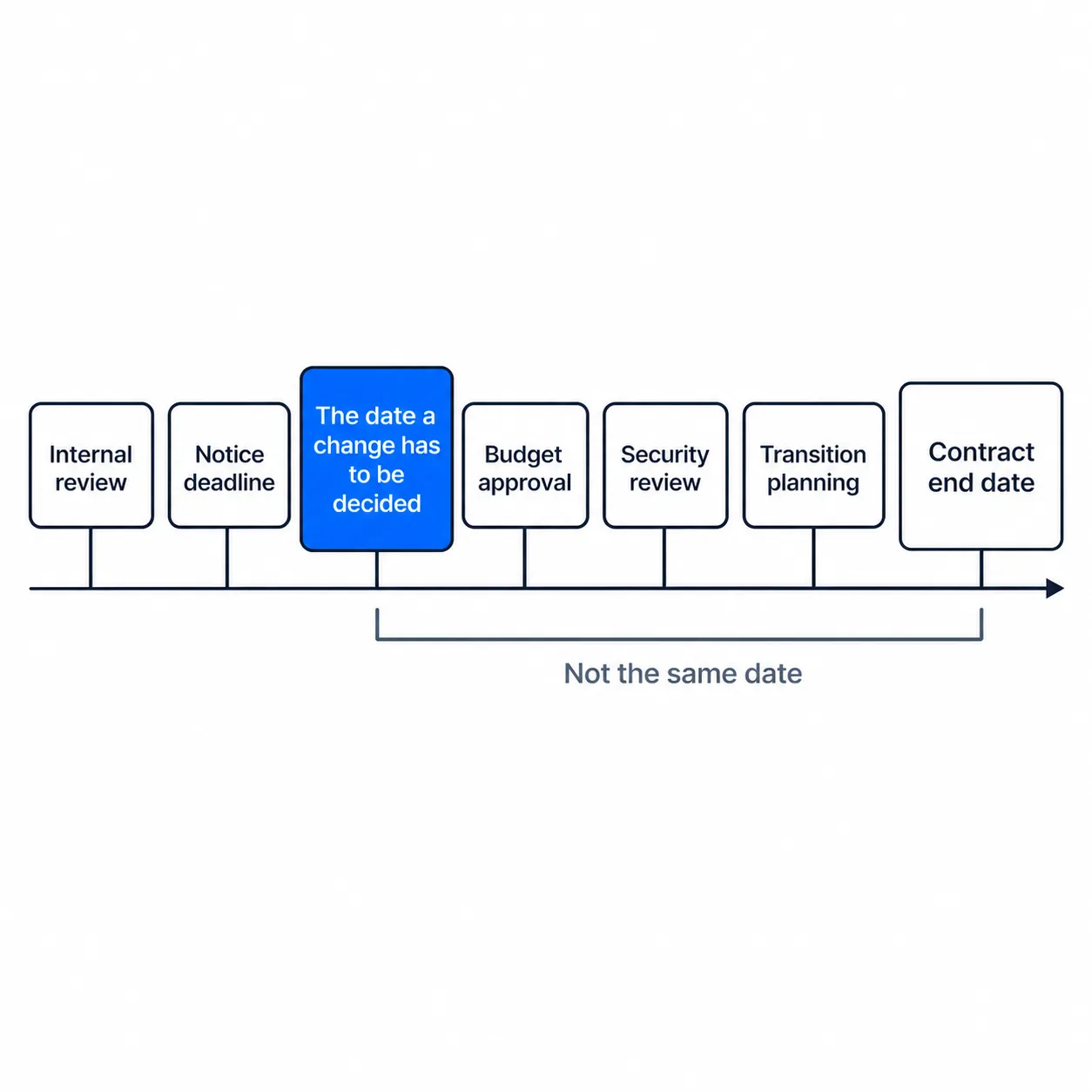
Say: “When do you next review the arrangement, and by what date would a change have to be decided? Is there a notice or procurement deadline before that?”
“When does it renew?” is the wrong question, and it is the one most sellers ask. The contract end date is frequently not the buying window. Australian government guidance on contract end dates makes the point plainly. The decision to extend or go back to market has to leave enough time for a new procurement and a transition, the timeline varies with complexity, and some software licenses have no fixed end date at all and are governed by periodic review instead. Review, notice, budget approval, security review and transition planning can all sit months in front of the date on the contract.
There is no published cross-industry average for how far ahead buyers start looking, and anyone quoting you one is guessing. Ask for their dates instead of assuming yours.
If there is no gap, no trigger and no review point, the honest move is to close the loop: “Then it sounds like you’re covered. If that changes, I’ll be here.” A disqualified prospect you left on good terms is worth more than a meeting you forced.
Three versions of the script, by what the prospect says next
The four steps do not change. What changes is how much of step two you need before you get to step three.
| What you hear | What it tells you | Where to take it |
|---|---|---|
| “It’s working fine for us.” | No stated gap yet, and no permission to look for one | One adjacent-scope question, then a clean exit or a review date |
| “It’s fine, but we still do X by hand.” | A gap the prospect named themselves | Straight to step three, scoped to that one thing |
| “We’re up for renewal in the spring.” | A date, but not necessarily the decision date | Step four first, then the gap that has to matter in that decision |
The prospect is happy with the current setup
In insurance and financial advisory this arrives in a fixed dialect: “I already have cover through my broker,” or “my adviser handles that.” Take it at face value and ask one scope question rather than a quality question.
Say: “Good, that tells me the core is covered. Does that adviser handle this specific area too, or is it managed separately?”
Ask whether the area is covered, never whether the buyer is allowed to look elsewhere. Swiss insurance intermediaries owe their clients clear pre-contract information, disclosure of their compensation where they are untied, and conflict management under the Insurance Supervision Act. Swiss client advisers have to establish a client’s situation, goals, knowledge and experience, document the service and manage conflicts. None of those duties makes a buyer exclusive to whoever they already work with. Whether an existing mandate ties their hands is a question about their broker-of-record letter and their notice clause, and it is not yours to interpret for them on a call.
If the scope question comes back clean, exit on a date: “Then I won’t manufacture a problem. When do you next review the setup, if at all?”
The prospect names a gap
Say: “Understood. When that happens, what does it affect? That’s the one area I’d compare, not the whole relationship. We handle it by [specific capability]. Worth twenty minutes on that piece alone?”
Repeat their words for the gap. If they said “we export it into a spreadsheet every Friday,” the thing you are comparing is the Friday export, and the meeting you are asking for is about the Friday export.
The prospect is close to a renewal or a review
Say: “Useful timing. What has to happen before that decision, internally? Review, notice, procurement, transition? If [their gap] is going to matter in that decision, let’s compare that one piece before the date it actually has to be decided.”
Renewal is a trigger, not a window. Analysis of 296 real contracts between one supplier and 128 customers found that renewal tracked with embeddedness: higher volume, supplier-dedicated assets and buying multiple products all raised the odds of renewing, and 37% of contracts renewed overall. So ask what is tied in, not only whether they are happy.
Drill all three out loud before you need them on a live call. If you are picking something to drill against, this is how we would judge an AI roleplay tool.
Before you handle the objection, check that the call is allowed
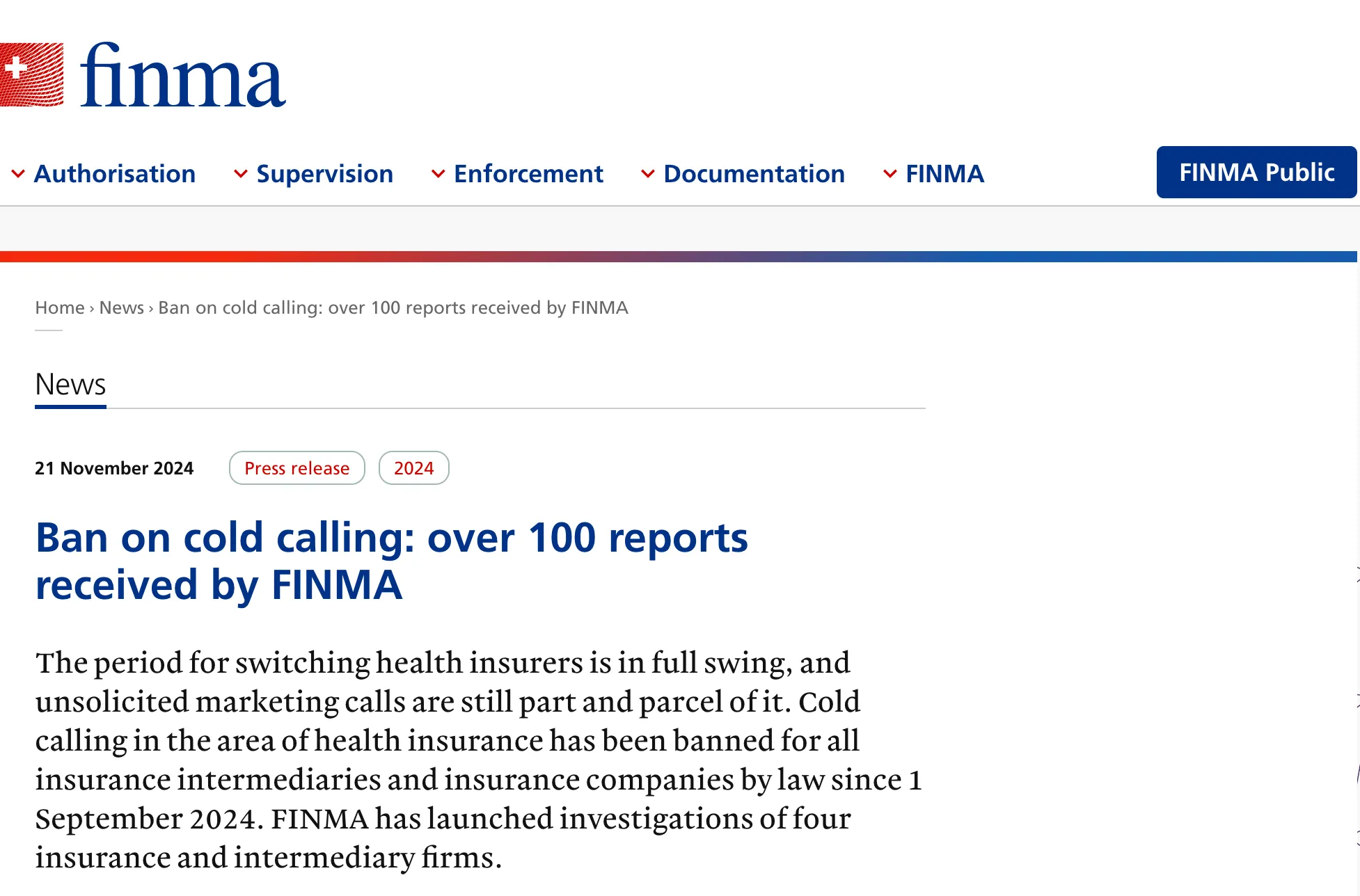
In Swiss health insurance, unsolicited telephone cold acquisition has been prohibited since September 1, 2024 for insurers and intermediaries alike, with narrow exceptions for an existing business relationship, a customer relationship inside the previous 36 months, or a referral from someone the consumer knows. FINMA received more than 100 reports in a little over two months after the ban took effect and opened investigations into four firms.
The rule is specific to Swiss health insurance and is not a ban on B2B prospecting in Switzerland or anywhere else. It is here because it is the clearest case of a scripting problem that no script solves: if the call itself is not permitted, there is no objection to handle. Check the rule for your market and your line of business before you drill the reply.
Why we never name the other provider
Our rule for live calls is simple. Name the gap, never the provider. Three reasons, in descending order of how often they apply.
Tactically, naming them moves the prospect from describing a situation to defending a decision they already made, and the switching costs above are already doing enough work for the other side.
You also cannot verify a claim about someone else’s product in the four seconds you have to say it. Improvised competitive claims are where sellers say something they cannot support.
The legal picture is more nuanced than “you can’t name competitors,” and it is worth getting right rather than repeating. This is editorial, not legal advice, and it varies by jurisdiction.
- United States, federal. The Lanham Act’s false-advertising provision reaches representations made “in commercial advertising or promotion.” In Fashion Boutique of Short Hills v. Fendi USA, the Second Circuit held that roughly a dozen disparaging salesperson comments in a customer universe of thousands were not disseminated widely enough to qualify, and pointed the plaintiff to state law instead. An organized play repeated across a market is a different matter.
- United States, state law. The same case is the warning. The federal claim failed and the New York business slander and product disparagement claims went to a jury, which awarded $35,000 in lost sales, $5 in reputational damage, and $75,000 in punitive damages. Spoken publication to one customer is enough for those torts, and the elements vary by state.
- Switzerland. The Federal Act against Unfair Competition covers disparaging a competitor through false, misleading, or unnecessarily injurious statements, and it carries no mass-publication threshold in its text. Article 23 makes intentional infringement punishable on complaint. No reported Federal Supreme Court decision squarely tests an ordinary one-to-one prospecting call, so read this as the scope of the statute rather than as settled call-specific precedent.
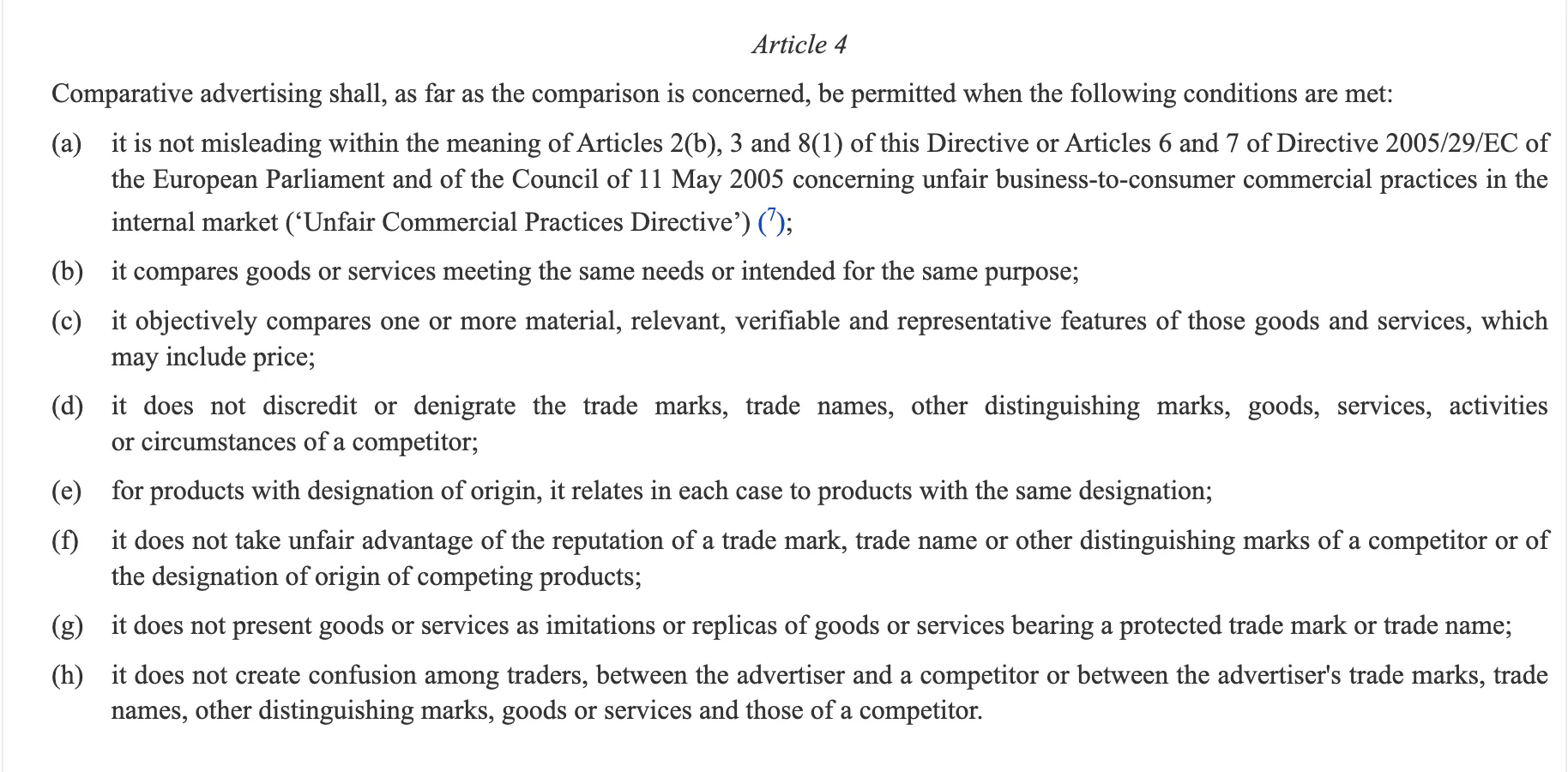
- European Union. Directive 2006/114/EC deliberately permits comparative advertising and then conditions it: no misleading claim, objective comparison of material, relevant, verifiable, and representative features, and no discrediting or denigration of the competitor.
Put together, naming a competitor is not automatically unlawful anywhere in that list. False, misleading, unverifiable and unnecessarily denigrating claims are where the exposure concentrates, and a live call is precisely where those get made. A no-name rule is a risk-control standard a sales manager can enforce in one sentence, which is why we use one.
We write by the same rule at CallPrompter. We sell into this market too, and you will not find another product named in our content, including in the comparisons where naming one would make our case faster. In our own category the incumbent is usually a post-call conversation intelligence tool rather than a person, and the honest version of that comparison is about when help arrives, not about whose product is worse.
The cold-call version, in one line
On a cold call you do not have a minute, and you will not get a second question if the first one sounds like a pitch. Compress the whole framework into one line:
“Makes sense, I’m not asking you to switch. What does it not cover?”
Acknowledge, no threat, open question. If the answer is “nothing, it’s fine,” you have your disqualification and you can end it there. If there is a pause before the answer, there is a gap.
What the four steps look like as a live prompt
On a live call all of this has to fit on one card. In CallPrompter’s own measurement, 485 milliseconds pass between the model having heard enough of the prospect’s speech to classify the objection and the response being ready, and what appears then is the response written into the script for that objection. The desktop app listens to the conversation and matches what the prospect just said against the objection library semantically rather than by keyword, so it follows the conversation instead of waiting for an exact phrase.
The design constraint is the one I started with: judge live help by how little it shows you. What appears is a short card with the reply and the next question, not the reasoning behind it, because reasoning competes with the words you are speaking.
Worth being plain about the limit. Out of the box the product transcribes the call and follows where you are in the script. What it says is what you put in it. The four steps on this page only become a prompt once someone writes them into an objection entry, adds the three sub-case variants and attaches the personas they sell to. The overlay is only ever as good as the script behind it.
Objection: we already have someone for that

Trigger phrases
- we already have someone for that
- we already work with someone
- we have a provider for that
- I already have cover through my broker
- my adviser handles that

1. Acknowledge
That makes sense, and I'm not asking you to replace anyone on this call.

2. Explore, open question first, then stop talking
What does the current setup handle well, and where, if anywhere, does it still leave work on your side?

3. Specific probe, only after a signal
When that happens, what does it delay, cost, or put at risk?

Signals that earn the specific probe
- "it's fine, but ..."
- a described workaround
- an answer about somebody else
- a renewal inside a year

4. Differentiate against the gap, never against the provider
That's the part we handle. [specific capability], so [specific operational consequence].
I can show you that one piece without asking you to change the rest of the arrangement.

5. Advance to the real decision date
When do you next review the arrangement, and by what date would a change have to be decided?
Is there a notice or procurement deadline before that?

Variant A, the prospect is happy with the current setup
Good, that tells me the core is covered. Does that adviser handle this specific area too, or is it managed separately?

Variant B, the prospect names a gap
Understood. When that happens, what does it affect? That's the one area I'd compare, not the whole relationship.

Variant C, a renewal or review is close
Useful timing. What has to happen before that decision, internally? Review, notice, procurement, transition?

Cold call, one line
Makes sense, I'm not asking you to switch. What does it not cover?

Rule for this entry: name the gap, never the provider.
Practice the reply before it costs you a live one
The reason to drill this objection rather than read it is that the words are easy and the timing is not. Acknowledging takes discipline when your instinct is to argue, and the specific probe is only right once the prospect has handed you a signal.
Practice mode runs the same scripts the live overlay runs, against a simulated buyer that interrupts and pushes back out loud, so what you rehearse is what you will have in front of you on the real call. CallPrompter’s free trial is seven days with no credit card and includes 30 minutes of practice. Live call coaching sits on the paid plans rather than in the trial, which we would rather say here than have you find out after signing up.
So take the four steps above, write them into an objection entry with the three sub-case variants, and drill them out loud before your next dial. Thirty minutes of practice is enough to find out which of the four you skip under pressure.
Related posts
How to Choose an AI Sales Roleplay Tool That Actually Simulates Practice

Conversation Intelligence or Live Coaching: Which One Solves My Problem?